
To wake up unaware
remaining unaware
is a pseudo-blissful ignorance
which lasts lifetimes
until
it is
far
too late
to bury
the sealed
casket of
hell

Wild Grain Happening … Photo by Thomas Peace c. 2018
To wake up unaware
remaining unaware
is a pseudo-blissful ignorance
which lasts lifetimes
until
it is
far
too late
to bury
the sealed
casket of
hell
Wild Grain Happening … Photo by Thomas Peace c. 2018
Looking is easy. Anyone can (and anyone does) do just that. They can easily look at separate things…. things at a distance. But seeing is another matter. Seeing — real seeing — involves perception beyond all of that separation that you genetically inherited over eons of time (i.e., generations of experiences) or obtained from storing what was personally learned; it exists beyond what was gathered from accumulated learning. Seeing is not from accumulation; it surpasses and is phenomenally much more than what mere accumulation can offer. Most people look at what they were taught to recognize. Seeing cuts through barriers, surpassing them. Seeing puts the unfeeling, obtuse notion of “me” separate from “everything else” aside. But a lot of people are afraid to feel. They don’t have the courage or the moxie to feel. Real perception melts away the self and allows compassion to flower (beyond a dead consciousness). Real living involves real seeing… real perception.
Looking is easy. People, who merely look, throw bombs. Real perception — instead — is deeply compassionate.
Don’t be just anyone.

Silver-Spotted Skipper with extending proboscis … Photo by Thomas Peace c. 2018
But if all haves
could seldom
see
past twisted crime
maybe some living compassion
could
free some dead slaves
from
time

Stink Bugs Feeding from Petiolar Glands (that emit nectar) from Wild Chamaecrist fasciculata Plant. (It was Linda, ‘shoreacres’, who found out just what these strange sections of the plants were… regarding an earlier article/posting we had on them. Note how the bug is using its proboscis to feed from the gland of the plant. ) … Photo by Thomas Peace c. 2018
Between)the great purchase
of life’s parameters,
the price was everything
while the cost was nothing…
and we had plenty of nothing to give,
since it constituted everything,
(such as the space between
protons and electrons)
which seems to begin
to sum up the whole thing.
Just don’t squabble about the price,
since it cost you nothing(while
rattling in pockets
is change

Southern Cloudy Wing Skipper … Photo by Thomas Peace c. 2018
It’s no mere coincidence that a narrow-minded brain can only see partially. Look with wide eyes.
Plurality won the referendum over “holistic insight and oneness” (because unity had insufficient votes).
If you were duped by miseducation and are cut off from the whole of life… then you don’t mind being indifferent to (or to be malevolently maltreating) “others.”
Don’t fall for all of the insincere claptrap which propaganda-oriented news and which commercialism provide; be an oasis from society’s calamity.
If you seek the truly unknown via a system or formula, you will have remained in the “known” patterns and methodologies of others.
This isn’t a fly-by-night universe (after all); what each of us does has infinite implications/consequences.

Mushroom Umbrella (with dew) … Photo by Thomas Peace c. 2018
One must put up barriers to keep oneself in time.
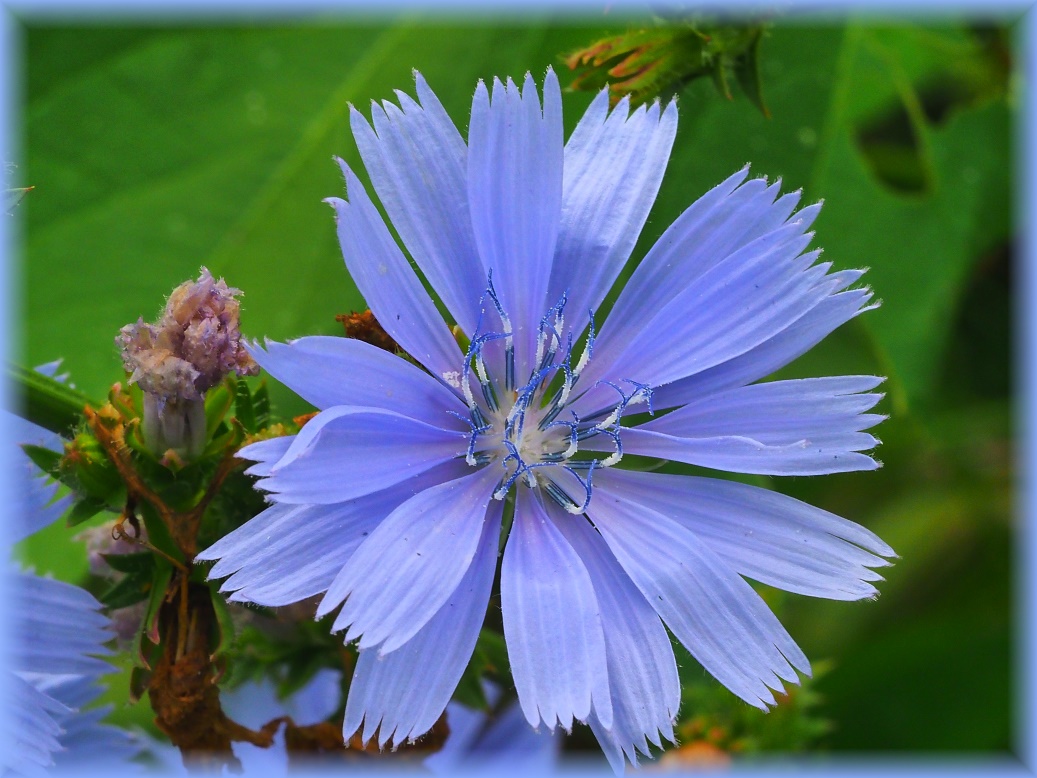
Wild Chicory … Photo by Thomas Peace c. 2018
the favor.
The day we kissed everything,
everything kissed us back,
and
since
we are everything,
we
returned

Kissing Mushrooms … Photo by Thomas Peace c. 2018
We so habitually separate. We, psychologically, separate the perceiver from “that which is perceived” so readily, so habitually, just as we were taught… and just as primitive conflicting, opposing factors (over eons) have dictated. Time, additionally, is separated. Of course, chronologically, actual physical time (in many, limited respects) has sections, but we, psychologically, almost constantly live in (and “as”) the past, as learned (stored) symbols, words, and concepts (of the past) that we constantly use (and are protrusions of what was poured into us). What is projected internally (psychologically) is what we are (i.e., what we actually are) fundamentally. If we remain in the old and limited, we remain old (internally) and limited. Even our concepts about the future are extensions of past accumulated (old) symbols/patterns. (Even when we think that we often live in the present, we — in actuality — do not.)
One can’t choose to perceive correctly… any more than one can choose to be wise or choose to be a genius. Choice and will are not keys to vast understanding. Understanding takes place when limited perception and fragmentation are not dominating factors. Will and choice are crude extensions of limited fragmentation; the chooser separating himself (or herself) from the choice is a mere continuity of primitive, illusory, fragmentary opposites. When fragmentation and limited perception no longer dominate, then there is a wholeness that is not the result of a mold or a mere blueprint.
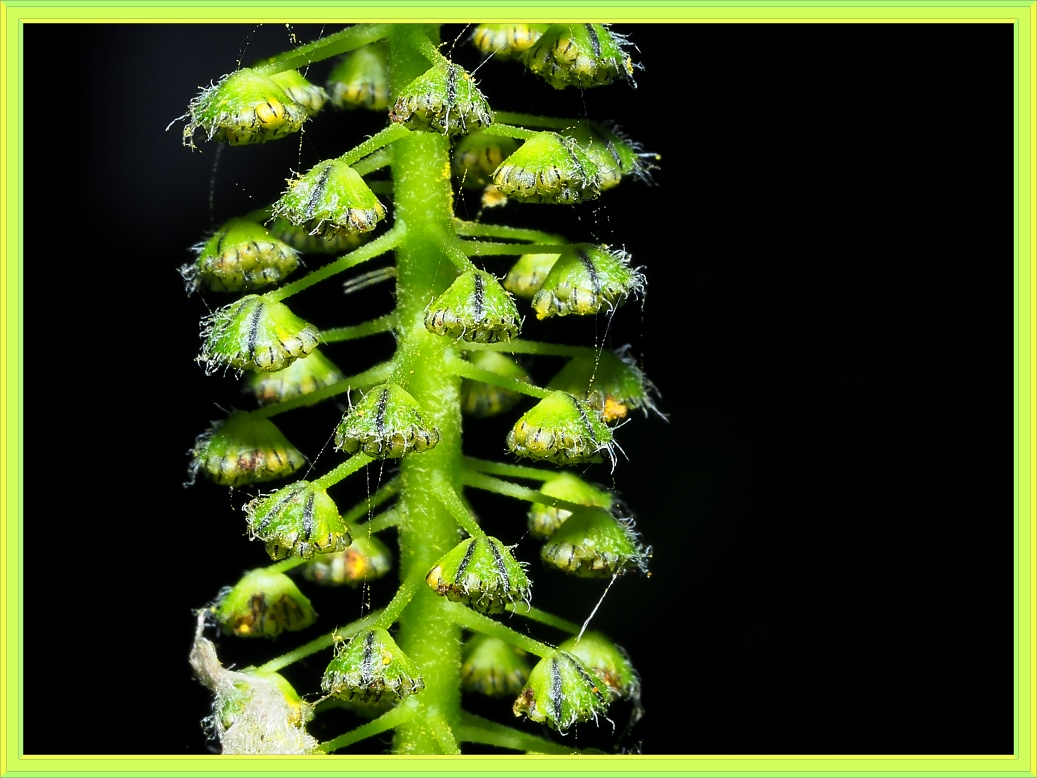
Wildflower Flower Pods … Photo by Thomas Peace c. 2018 .JPG
An indelible, sacred energy
that rarely visits…
Its immensity surpasses all
things within the world of the
opposites.
Though ineffable, it is the real flame beyond
all of the smoke,
the true light beyond all shadows.
Do not take my word for it.
Find out!
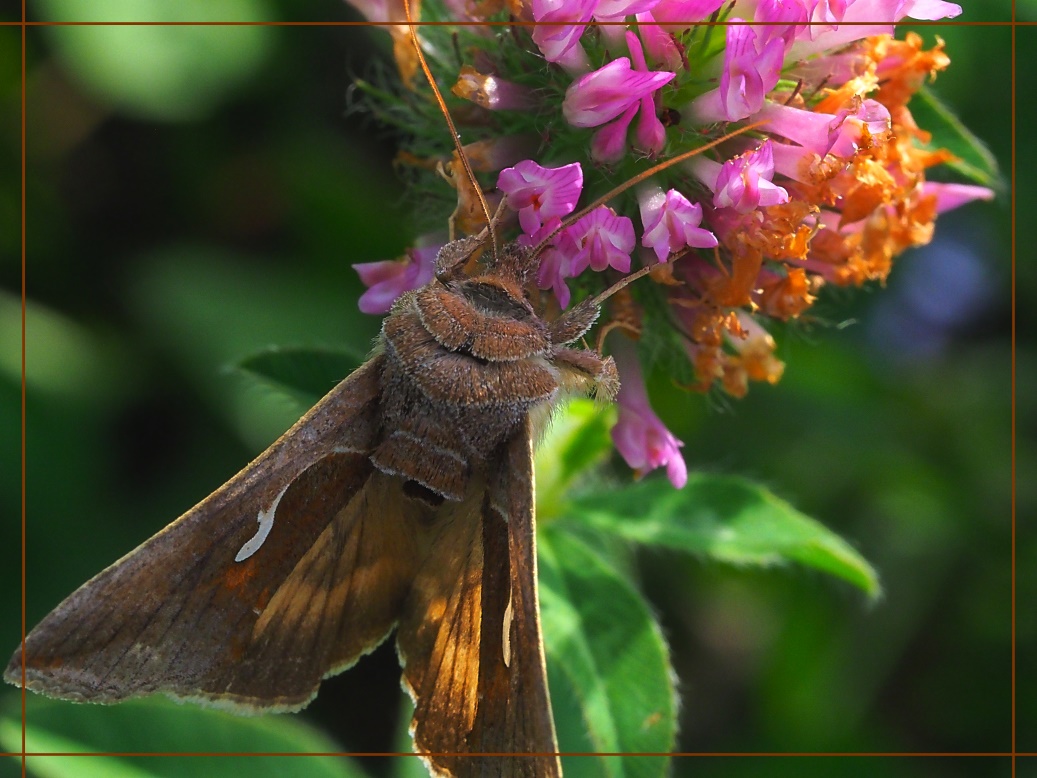
Looper Moth on Clover Flower … Photo by Thomas Peace c. 2018
It’s a wonderful day
to look beyond the crime of politics
and, instead, perceive things without measure,
while realizing that simple, pure things are
(the only real treasure).

Common Blue … Photo by Thomas Peace c. 2018
When there is the negation of what order and love are not, perhaps love will be there. There is no “you” that wills that negation, for the very self itself (i.e., the “I” or the “me”) must be part of that negation… not merely controlling it from (or “as”) a distance. Of course, we are not suggesting harm to the body in any way; such harm would not entail love. Love is not merely measurable (i.e., not merely of measure), so one cannot merely “know” that one has it. Thinking and time are of measure and a mind that is merely caught up in thinking and measurement (in and “as” time) cannot love deeply (though it can easily think that it can). Clinging to an isolated concept of “me” (apart from all of life) requires distance and a measurement of opposites. Psychological distance and measurement create the “I” and the “I” would not exist without such psychological distance and measurement.
A lot of people say “I love you” very easily (as if one knows that one “has” it… as if it entails an absolute separate subject and object). Is there really an “I” that is separate from what the whole world is? Is there really an isolated “you” — that is looking from a (learned) distance, an accumulated psychological space — that is separate from what the whole world is? Psychological separation, isolation, and conflict depend upon limited thought/thinking, and without limited thought/thinking, such separation wouldn’t exist.
Our minds are often so very distorted and not whole. The grocery stores, these days, are chock-full of fragmented, over-processed, pseudo-foods. And, in the United States, for example, there is more obesity and more cancer (and strange, deleterious syndromes popping up) than ever before. Too few of us eat real, whole foods like our grandparents did; we assimilate garbage both mentally and gustatorily, and we don’t mind being normal (and swallowing it all) one bit.

Yellow Tiger Swallowtail Butterfly … Photo by Thomas Peace c. 2018
While it occurs
one feels
a trillion times
more alive than
one has ever felt
before
Afterward
one doesn’t forget
the answer to the question
of whether the
immeasurably sacred
exists
or not

Lichen on Tree Branch … Photo by Thomas Peace c. 2018
Don’t be a second-hand, hodgepodge mix of what others (in your life) programmed you to be; perceive directly, without mere conditioning/reaction.
Quixotic, extremely idealistic behavior is often based on dead, old patterns; look at life afresh, without dead blueprints.
Don’t merely pigeonhole others with an old, categorizing-oriented brain; perceive with fresh and lucid eyes.
Many of us take immaculate care of our overly fancy cars while we guzzle sugar, starch, alcohol, and processed foods like there’s no tomorrow.
To habitually take refuge in old-fashioned beliefs may be like finding protection in a rainstorm by depending on an old, torn, metal umbrella.
Roses are red and violets are blue… wake up and realize that what you perceive is you.
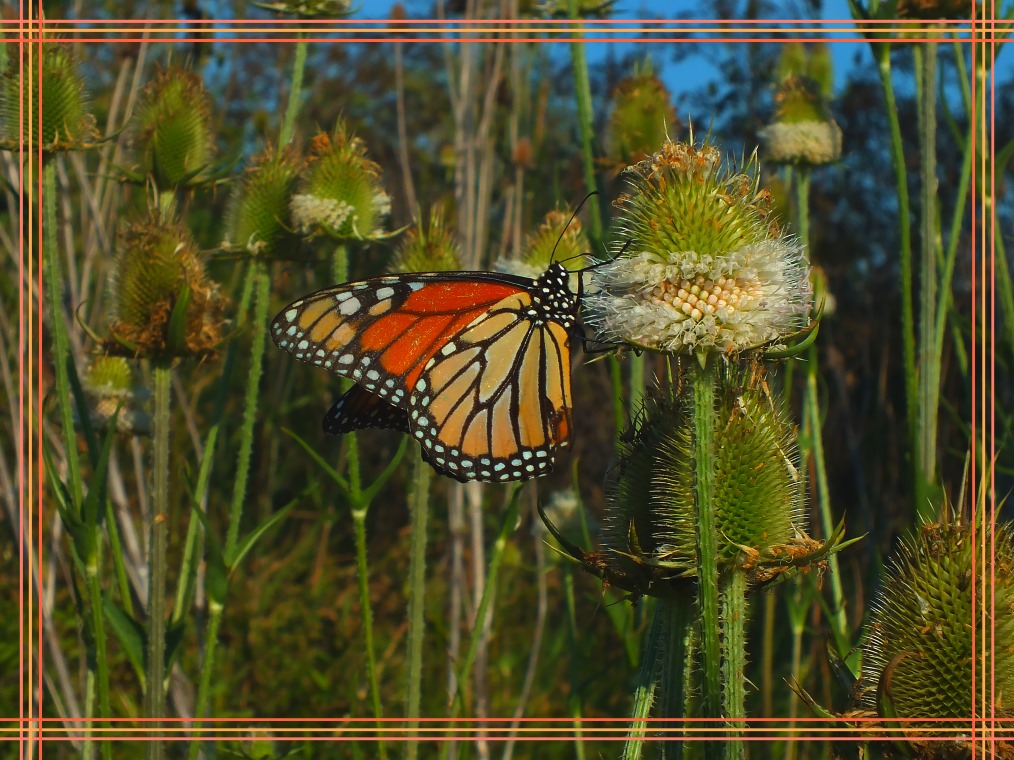
Female Monarch Butterfly … Photo by Thomas Peace c. 2018
Merely sitting on your can
with eyes closed
with legs crossed
while supposedly “controlling ‘your’ thoughts from a distance”
(in order to get something)
is not it.

Fruit-fly on a small leaf … Photo by Thomas Peace c. 2018
The elderly Lo Zu was sitting on a huge fallen log next to a beautiful pond that was not far from the village. A much younger man, who was an atheist, came by and said to him, “Many people in the area say that you are a great wise man, a holy man, but if there is no God, then you are not a holy man, you are nothing.”
Lo Zu invited the man to sit next to him on the large, fallen log, which he did. Then Lo Zu, said (while smiling), “We two can agree on one thing; I am nothing.”
“Then there is no God,” the man pronounced with confidence.
Lo Zu then said, “‘God’, for most everyone, is an image (or series of images) that they have learned. (They will insist that it is something much more than absorbed images.) To these images, they associate power, dominance, kindly (special) protection, fatherliness, and unlimited knowledge. However, these images (and their associative emotions) are self-protrusions of thought/thinking.”
“And so not anything real?” asked the man.
Lo Zu then said, “The sign on the road, just outside of town, that has the name of the town upon it, is not the town. If someone steals the sign, they are not stealing the town. If someone wants to visit the town, they do not crawl up the sign. Additionally, to really be sure that the town is there, one must visit the town.”
“I see what you are getting at,” said the man. “So, you are suggesting that one, such as you, can visit God.”
“Not really,” said Lo Zu. “If one, through supposed will and choice, decides to visit ‘God,’ one is visiting one’s own learned images, one’s own learned thoughts and strong emotions associated with such thoughts. Such a ‘visiting’ is usually a self-deluding form of acquisition that involves greed.”
“So there is no real God,” the man insisted.
“Jumping to conclusions,” Lo Zu suggested, “may be as foolish as worshipping mere self-fabricated symbols, mere signs. A strong belief that there is no God may be as superficial and primitive as a strong belief that there is a God. Holistic perception inquires (without accumulated patterns) into what might be sacred; it inquires with a passion that surpasses beliefs of any kind (and actually finds out).”
“So what are you saying?” the visitor queried.
Lo Zu replied, “I am saying that I will not encourage you to worship or to cling to any symbols of power, any symbols of divinity. Worshiping self-created or learned images, that one projects (from what one absorbed from others), is similar to worshipping parts of oneself. It may be that the true answer has to come to you. (It cannot merely be visited, like an ordinary town.) The true answer is probably rather unapproachable, but that may be a real key; conclusions, accumulated images, and greed cannot expose it. It is beyond foolish grasping. The internal images of self are nothing when foolishness ceases. When all of the windows are open and the room is not filled with garbage… only then can the breeze, perhaps, flow through.”
With that, Lo Zu stood up and began walking with his meandering cane and said, “We must go; we see someone carrying a heavy burden and we will help them with it, to a certain point. You can come along also… unless you prefer to remain stuck where you are.”

Bumblebee covered with Golden Pollen … Photo by Thomas Peace c. 2018
The dichotomy between the “perceiver” and “that which is perceived,” is essentially (psychologically) illusory and nonexistent.
To overlook and ignore others is to be partially dead psychologically — as so many are — while one merely concentrates on a small point, called “me.”
Forget what everyone taught you about life and death; go out, sit with nature, and look at everything as if for the first time.
Peace will never come as long as each of us belongs to some separative group.
If to be typically human is to abide by commercialism and to pollute the planet… then we need to become superhuman (and green).
To function all of one’s life in predictable, knee-jerk reactions of self-projected selfishness is safe, easy, comfortable… but also, unfortunately, dead.
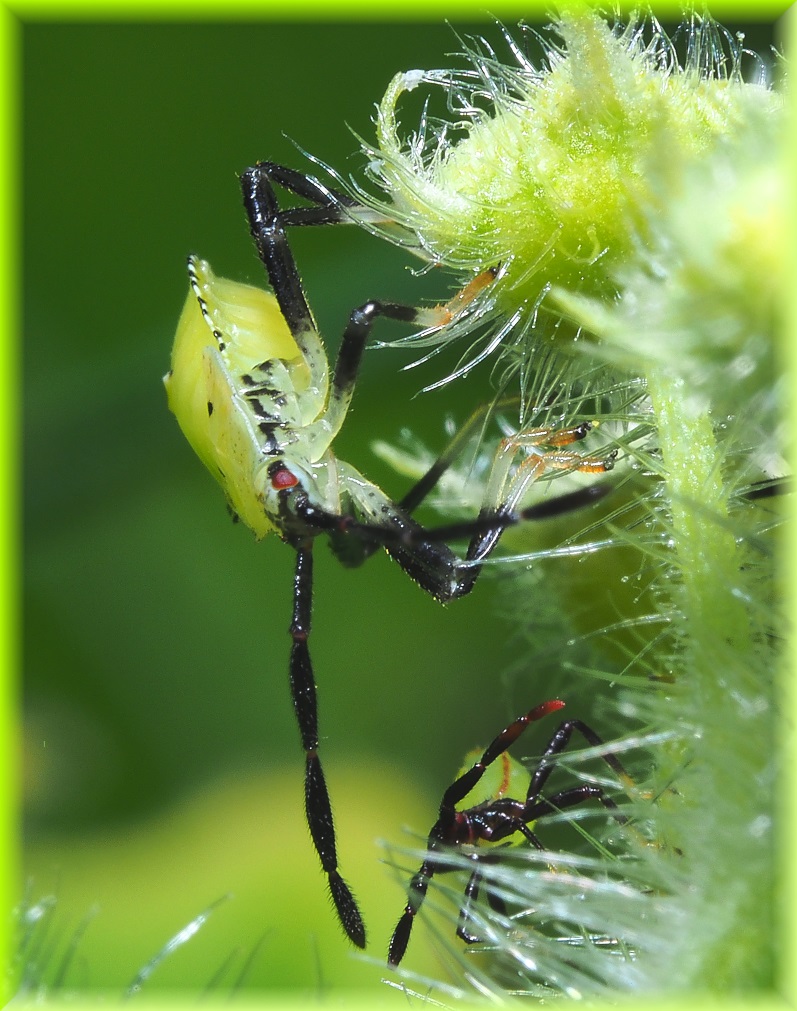
Aphids up close … Photo by Thomas Peace c. 2018
Lo Zu, after one of his frequent walks into the fields and wooded areas of nature, came walking into the village. He stopped to rest for a while and leaned on his sinuous pole, his meandering cane; nearby, a small group of men, all of them sitting together, continued to repeatedly laugh hysterically.
Lo Zu realized that they were laughing at the fact that a nearby dog was repeatedly chasing its own tail. Lo Zu continued to walk again and came closer to the men who were laughing. He heard one of them say, “That dog is really ignorant!” All of them, except Lo Zu, continued to laugh at the dog as it continued to chase its own tail.
Lo Zu turned to face the sitting men and said, “It is so easy to come to conclusions; conclusions that are wrong.” Lo Zu further went on, “That dog could chase that cat that is a little way down the road, but cats can quickly scratch and the dog could easily get a gravely injured eye. Likewise, the dog could chase after that man walking across the street. However, the man could kick the dog or throw something at it, injuring it. Instead, the dog takes the prudent approach and, for great exercise, chases its own tail. A most intelligent animal! I, myself, walk daily to the meadows and woods to enjoy the sweet butterflies and creatures; therefore I get quite a bit of exercise. I see that dog exercising ‘most every day also. Sometimes I see it chasing butterflies, which is also a very wise and safe form of exercising. Exercising often is great intelligence. I see you men sitting around here a lot each and every day. Do any of you exercise?”
“Not really,” said one of the men. (The men were no longer laughing.)
“I didn’t think so,” replied Lo Zu. He further added, “The beginning of this doglike life always chases its own end; let the dog be your teacher.”

Black Swallowtail on Thistle Plant … Photo by Thomas Peace c. 2018
A Halloween colored dream
came swimming beyond scream
and then a cruel green witch flew by
if you know what i mean
*****************************************************************************************************
One of our pet Koi Angelfish:
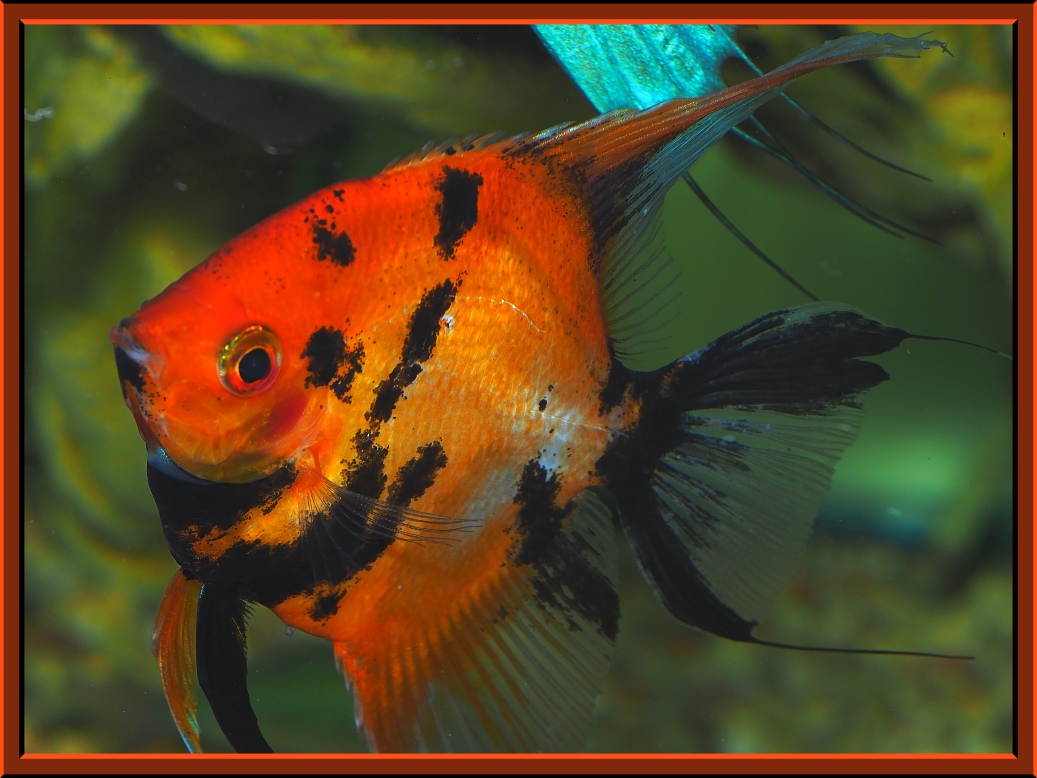
Fire Red Koi Angelfish … Photo by Thomas Peace c. 2018
Life is not a game. Too many of us go through life as if the mission is to be totally entertained. Most people are afraid of death, yet they may not have ever truly lived. Very many people assume that they are alive. To go through existence merely imitating others and spewing out what was poured into one by society… may not be “living” whatsoever. It is so easy to conform. It is so easy to just fit in the machine and be another cog in the wheel. Only a very few have been visited by that timeless energy that enraptures and transcends consciousness.
To inquire — to really inquire — into whether or not the sacred exists, takes great passion, great profundity. A stagnant, indifferent mind could not do it; stagnation and indifference make the actual answer all the more elusive, for the answer lies beyond limitation. To find the true answer necessitates that the mind be of considerable order and completeness. An incomplete mind is never fully alive, never fully whole.
The world has far too many seeds (of consciousness) that have never sprouted, that have never really begun growing. The answer is immeasurable and cannot be communicated about via mere fragments/words/symbols/patterns. The minds of most people consist largely of mere fragments/words/symbols/patterns.
We can change.

Green Grasshopper on his favorite leaf … Photo by Thomas Peace c. 2018
True wisdom has great wholeness, expanse, and vastness; indifference is of limitation and is confined.
Often dying psychologically to “thinking” is alive, harmless, and highly intelligent. Constantly reacting as mere symbolic thoughts is cadaverous.
Ignorance often does not recognize its own ignorance. Wisdom often goes unnoticed and unappreciated by those who have little wisdom.
Nonsensical behavior often makes excuses. Behavior that is prudent is honest and compassionate.
Many need to make-believe about some heaven or magical domain in the future (that was fabricated by make-believers); escaping what “actually is” is ignorance. (The aforementioned words are not at all meant to deny true eternity or sacredness.)
Wisdom naturally goes beyond superficial values and superficial behaviors.

Silver-Spotted Skipper Butterfly Up Close … Photo by Thomas Peace c. 2018
This is the poem
that came out of the grave
to tell you what death is.
Everyone has avoided the answer
but here is the answer:
Death is indifference;
Death is mental fragmentation;
Death is accepting immorality;
Death is accepting mortality;
Death is belonging to separatist organizations that
one thinks are “right,”
and death is the limited space surrounded by boundaries.
It is very rare to see two Ambush Bugs together with a victim like this.

Two Ambush Bugs with their Bumble Bee victim on Thistle Plant … Photo by Thomas Peace c. 2018
One finger said
to the other finger,
“I want to be close to you!”
The other finger said,
“I feel that we two are
very close.”
Then they passionately wrapped around
each other intertwining.
A somewhat distant finger (away from
the other two) pointedly said,
“You two seem as if you were made for each other!”
Then, after a considerable time, fingers
of a supposedly separate
hand jealously came attacking,
and total war broke out.
A real fact is that,
in war,
the winners are the losers.

Illinois Meadow Wildflower … Photo by Thomas Peace c. 2018
Let’s pull some forever out of a hat
mail a kind letter back to oneself
and sit again wisely where always sat
Allow tears to flow back into red eyes
and dream again of flying as a child
beyond cold gravity… blue skies

Getting ready to fly… Male Clouded Sulpher Butterfly … Photo by Thomas Peace c. 2018
Silence is not an achievement that is the result of your reaction; true silence is when conflict ends.
Lucid, insightful wisdom doesn’t take time… but sequential, symbolic thought does.
Compassion isn’t the left arm hating the right arm and thinking it is separate.
John Lennon was right: “Living is easy with eyes closed… misunderstanding all you see.”
Each of us is responsible for getting oneself and the world right. Oneself includes — and is — the world.
Don’t think with a prefabricated mind, with a handmedown, archaic mentality; look at things beyond the ways you were taught.

Wood Boring Crane Fly … Photo by Thomas Peace c. 2018
They provided us with delectable ideas
which our minds assimilated like gluttons.
We, of course, became hungry for more.
Our ravenous appetites drove us
to the next serving… and to the next.
One palatable idea after another
is what we craved; anything other
than facing the starvation of the
emptiness within.
True intelligence can only, for a
limited time, feast on the illusions they
provide. After
that limitation is reached, real
sustenance breaks free beyond
their insipid inedibilities.
Will habit continue to feast on delicacies
of disorder? Even the supermarkets are
full of the artificial.
It’s good to eat healthy, whole,
nourishing food.
It’s not so good to allow oneself
to be conditioned to merely
swallow a lot of mindless crap.
[Note: These are not the kind of eggs that you can purchase at the supermarket. These are 1 millimeter insect eggs on a leaf. Note the orderly patterns in which they were laid.]

Tiny insect eggs on a leaf… Photo by Thomas Peace c. 2018
As if he crawled
out from M.C.Escher’s Dream Woodcut
he watches the camera
and the camera manipulator
waiting for
the aloneness
that he cherishes and lives by
beyond mere supplication

Praying Mantis Hanging Around… Photo by Thomas Peace c. 2018
Many people suffer from depression and sorrow. Many take pharmaceutical antidepressants and regularly go to clinics to receive therapy. Of course, for some, it may involve issues based on heredity and diet. For many, it entails accumulated psychological problems. Most, when they were much younger, did not have such issues; in youth, they were filled with wondrous curiosity and inner vitality. Many, as they age, become jaded and unhappy, bored with the same-old-things and with the monotony of it all.
A large part of the problem lies in wrong education. Most, throughout their education, were not encouraged to be keenly aware of their own minds… to be aware of the essence of thought and thinking and to explore beyond the realm that thought and thinking manifest as. Most, from society as it currently is structured, were taught to cherish and exclusively dwell in the process of thinking… in mostly math and reading and such, and not so much with wholeness and integrity. Few were encouraged, in their youth, to question everything and to be free from mere standard ways/procedures. These days, almost all of us are immured within the walls of thought/thinking. Most exclusively dwell in (and “as”) thought/thinking… and very few value going beyond that domain. Most have put all of their eggs into that one basket; in that, they dwell. That basket is like a small, limited prison. Many minds are imprisoned (i.e., deeply embedded) in dogmas, beliefs, presuppositions, antiquated systems, and isolating boundaries.
As one has said so many times before, thinking is always symbolic, always second-hand, limited, and merely representational. Yet so many cling to thinking and unquestionably exist almost exclusively as what it is. Even when most of us look at things, we are looking with (and through) the screen of thinking; such thinking involves labeling, categorizing, classifying, identifying, and pigeonholing. When most look at things, they are primarily looking with the memory bank (i.e., through retained knowledge). Such a memory bank is from the past and is always old, always of stored data. They look with (and from) the stored (old) past… and they inevitably get bored while they feel stale and full of the mundane. With this situation, antidepressants and clinical so-called experts can only help so much. One of the functions of the human mind is to be of order and to transcend sorrow; transcending sorrow is, in itself, order.
A mind of deep awareness can often look at things without merely using the storehouse of old and stuffy memory. To perceive without relying on the storehouse of dead memory (and stale patterns of remembrance) is a living art. There is no method to this art. It does not involve old patterns that you can absorb or practice to improve yourself over time. Using thought when it is necessary but often going beyond it, the wise mind sagaciously realizes that profound bliss is not a mere remembrance. Profound joy is not labeling everything and then looking at everything through (and “as”) dead labels. To perceive without the burden of the past is real living. Real living is not the past perpetually relabeling things (with endless symbols) into the present and future. The mind that goes beyond “perception through mere symbolism and fragmented mental constructs” is a liberated, whole, free mind full of joy.

All Tied Up In Knots… Photo by Thomas Peace c. 2018
As Grover on Sesame Street
— not that i ever watch it
with our pet parrots —
says: “Oh, lower case “i,”
you are so cute with your
little dot!”
Grover is right! It is a
marvelous letter and helps
to represent what i am
(even though it really isn’t
what i am whatsoever)!

Two Pearl Crescent Butterflies… Photo by Thomas Peace c. 2018
Deep passion — to find out about the whole of existence — goes far beyond details and fragmentary parts.
There can be a holistic awareness, not merely of the five “separate” senses that one “has,” but rather “as” the holistic senses working together harmoniously, as one, without thought/thinking constantly interfering, separating.
When one was young, one mustered up all of the energy that one had to perceive the truth and the whole. That’s the only way to be!
Order comes through understanding and perception… not via rigid, limited ideals which bring about conflict.
Many animals value life just as we do… maybe even more so.
Look beyond the learned patterns; see beyond the limited, learned symbols.
True wisdom goes beyond perceived borders and is therefore truly compassionate and caring.

Scarlet-and-Blue Leafhopper …Photo by Thomas Peace c. 2018
One little tentacle at a time
One little seed among many
One small leaf rising to shine
One tiny bristle around plenty
One curious mind turning into this rhyme
After this line won’t be any

One Little Tentacle at a Time… Photo by Thomas Peace c. 2018
A number of young men and young women in Lo Zu’s village gathered around him
one day and one of them said, “Many people, even from other villages, say that
you are a great sage, a man of vast wisdom who carries the truth; please show us
how to carry the truth with us.”
After a considerable length of silence, Lo Zu stood up and said, “If you want the truth, follow me and do exactly what I say, but it will be a very arduous journey with many difficulties.” Then Lo Zu took his meandering cane and began walking, and all of the youth eagerly followed him, with excitement and expectation in their eyes.
He walked through a very large meadow, often bending down to examine the beautiful wildflowers and
insects (while deeply enjoying them). The youth all followed. Then he walked into a thick forest
containing many creeks harboring extremely slippery rocks. All of the youth were somewhat afraid,
but they continued to follow him. After a couple of hours, they came out of the forest
and began climbing a small mountain, all following Lo Zu carefully and diligently. When they
finally reached a very lofty height, Lo Zu stopped walking and began carefully placing large
rocks in each of the youths’ hands. As he placed the large rocks in the hands of each of the
young followers, he said, “These are very special, sacred stones of truth; please carry these back to the
village very carefully, without dropping any; please do not drop the truth.”
Each of the youth carried a number of stones. They followed Lo Zu down off of the mountain. They struggled on their way through the dark forest; it was very
perilous and difficult with the weight of the stones making their journey all the more excruciating. As they walked through the large meadow, back toward the
village, many of them were aching with pain from the tiresome journey and from the heavy weight of the stones (over time).
When they finally reached the village, Lo Zu told them to place the stones in a large pile. It was the end of the day, getting dark, and everyone was extremely exhausted (except for Lo Zu who did not carry any stones). Lo Zu asked them, then, to stand in a circle around the stones. Then Lo Zu remarked to them all, “Here is the truth you worked so diligently for. These stones are absolutely worthless. They are not any different from any other stones that one can find. You believed in me, hoping for the truth to be handed to you. Out of your confusion, you decided that I always held the truth (to give to you). Many people, out of confusion, choose high-ranking “others” to lead them to the truth; out of their confusion, they choose! They go to temples and ask the temple-keepers to give them the truth. What the temple-keepers generally give, however, is as useless as these rocks. Nevertheless, people blindly and devotedly adhere to what they say, just as you have done with me today. It is evening, and you may be disappointed to find that you have wasted your whole day. Do not feel too wronged by this. Many people have wasted their entire lives in carrying the worthless stones, burden, weighty images, and so-called sacred statues of others, and it isn’t evening at the end of it for them; it is the time of their death. They wasted not a day but their entire life, and the sacred eluded them.
Therefore, do not cling to any groups or authoritarian leaders who claim to give concrete methods toward the truth; instead,
find living truth within, without using taxing systems or time.
The first step and the last step are one.”
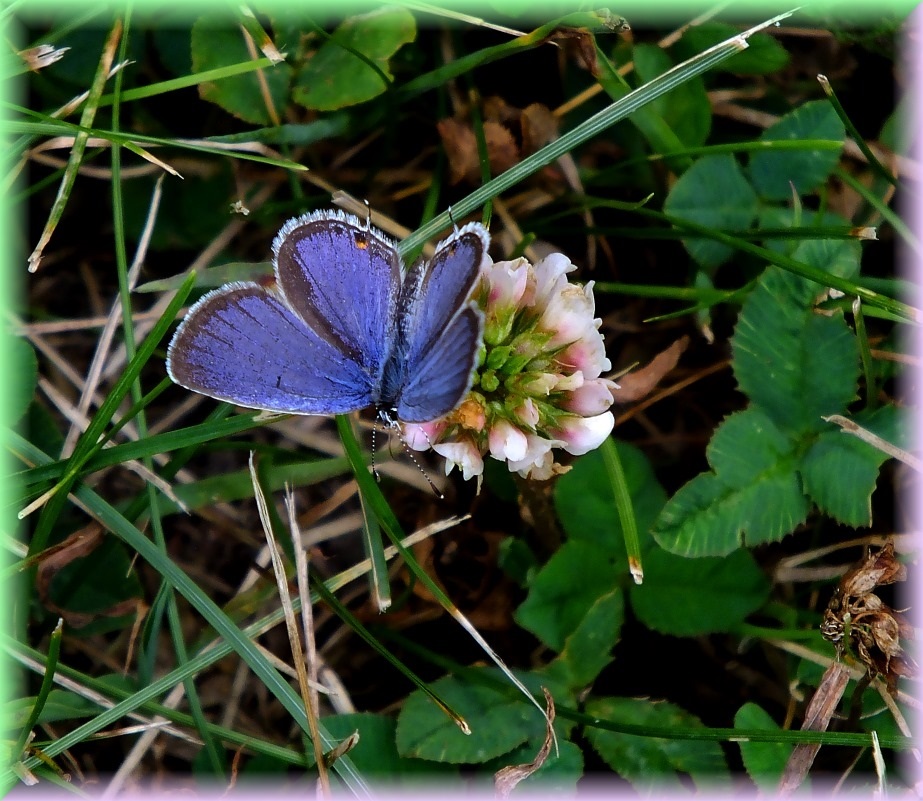
Magnificent Eastern Tailed Blue (in a meadow, of course!)… Photo by Thomas Peace c. 2018
Life is so much more
than books and words
and iPhones and money
Death is so much more
than finality and crying
and funerals and caskets
If one is of deep understanding
Life and Death are
not two different things

Augochlora Green Metalic Bee… Photo by Thomas Peace c. 2018
My wife and i were at a relative’s funeral, a number of years ago, and my older cousin was in the church pew in front of us. At the end of the mass, she turned around and said to me, “It’s too bad that you are a heathen.” I did not reply anything back to her. (By the way, i had undergone a profound Timeless/Enlightenment experience long before this occurred, though don’t just believe that; “experience,” by the way, is not a very good word to use for this; no word is sufficient.)
I have always been profoundly interested in spirituality and in the philosophical aspect of things all of my life. I do not belong to any organized religion because, like separative countries, organized religions tend to divide people and (to a large extent) tend to be a form of tribalism which leads to conflict and war. Though i am not one to put any credence or reliance into “belief” — since belief tends to be the crude result of a blind acceptance of presuppositions, conclusions, or group acceptances — i am very interested in investigating into truth and holistic order. I probably had read the New Testament, by the way, many more times than my brazen cousin did. Years ago, when i was quite younger, i hung around a lot with Professor David Bohm, talking one-on-one with him often about the deeper aspects of truth and reality. David Bohm was a co-worker with Albert Einstein, by the way. Einstein loved Bohm and called Bohm his “spiritual son.” I’ll never forget the wonderful discussions that we had.
As far as the Bible goes, most biblical scholars agree that most of what was handed down over the years has been grossly distorted over time from what the historical Christ actually said (i.e., distorted by mistranslations and intentional, self-serving additions by others). However, probably if one is truly wise, one can — to a large extent — tell the difference between the weeds and the wheat.
One of the many sections that i find interesting starts at Matthew 13:10:
Then the disciples came and asked him, “Why do you speak to them in parables?” He answered, “To you it has been given to know the secrets of the kingdom of heaven, but to them it has not been given. For to those who have, more will be given, and they will have an abundance; but from those who have nothing, even what they have will be taken away. The reason I speak to them in parables is that “seeing they do not perceive, and hearing they do not listen, nor do they understand. With them indeed is fulfilled the prophecy of Isaiah that says:
‘You will indeed listen, but never understand,
and you will indeed look, but never perceive.
For this people’s heart has grown dull,
and their ears are hard of hearing,
and they have shut their eyes;
so that they might not look with their eyes,
and listen with their ears…'”.
So, here, in this alleged saying, Christ seems to be saying that he will be telling special things (or even secrets) to those that are close to him, who really care. He also seems to be saying that the masses get parables but not the direct, significant, straight teachings. As in ancient times, most people do not inquire into what such special teachings may have consisted of; most did not inquire into what such special messages were about.
The ancient Gospel of Thomas was discovered in an earthenware jar in 1945 in a desert by a poor farmer who was digging for fertilizer. Additionally, Greek fragments of the gospel were found in ancient dump heaps. The Greek fragments were an even earlier example than the 1945-discovered Coptic version, and were likely a more pristine version of the gospel (and likely are less distorted). I hope someday that a full, early Greek version of Thomas is discovered! Many prominent biblical scholars maintain that the Gospel of Thomas was written before any of the four (previously oral) gospels were written. There is much evidence — and books have even been written on this — that the Gospel of John was written as a rebuttal to the Gospel of Thomas. Ancient people who were appreciative of the Gospel of Thomas were all butchered and killed by the ancient Bishops and their followers, long after Thomas was written. The Gospel of Thomas is not full of weird miracles and tons of parables but, instead, contains more direct, simple wisdom sayings and suggestions to look within (rather than to intermediary priests in temples). Do you think that an early gospel — though it was dearly accepted by many early in the history of all of this — would be tolerated by the self-appointed religious, orthodox “authorities” while it suggested that one look within, while it condemned the temple leaders? The Pharisees, the strict, orthodox, temple-attending people at the time of Christ, were often referred to in a negative way in Thomas (and in some of the other new testament gospels). Jesus was, at first, a follower of John the Baptist, who despised the “high-ranking” Pharisees and Sadducees, the religious leaders (of organized religion) in Israel at the time of Jesus; John got as far away from the temples as he could… (into wonderful, beautiful nature) to speak to the people, away from the orthodox priests/rabbis. It was likely these religious leaders who had John the Baptist terminated, and it definitely was the leaders of organized religion who had Jesus killed (as well as, later on, all of the admirers of The Gospel of Thomas). Do you know what they did with popular iconoclasts in the distant past? They nailed some of them to dead trees; and, very possibly, if they became exceptionally popular, they twisted around and distorted what they had said to suit their own power-hungry ends.
Prelude and a few select sayings from the Gospel of Thomas:
These are the hidden sayings that the living Yeshua spoke and Yehuda Toma the twin recorded.
(1)
And he said,
Whoever discovers what these sayings mean
will not taste death.
(3)
Yeshua said,
If your leaders tell you, “Look, the kingdom is in heaven,”
then the birds of heaven will precede you.
If they say to you, “It’s in the sea,”
then the fish will precede you.
But the kingdom is inside you and it is outside you.
When you know yourselves, then you will be known,
and you will understand that you are children of the living father.
But if you do not know yourselves,
then you dwell in poverty and you are poverty.
Sayings 61, 62, 66, and 67:
(61)
Yeshua said,
Two will rest on a couch. One will die, one will live.
Salome said,
Who are you, mister? You have climbed on my couch
and eaten from my table as if you are from someone.
Yeshua said to her,
I am the one who comes from what is whole.
I was given from the things of my father.
Salome said,
I am your student.
Yeshua said,
I say, if you are whole, you will be filled with light,
but if divided, you will be filled with darkness.
(62)
Yeshua said,
I disclose my mysteries to those who are worthy
of my mysteries.
Do not let your left hand know
what your right hand is doing.
(66)
Yeshua said,
Show me the stone that the builders rejected.
That is the cornerstone.
(67)
Yeshua said,
One who knows all but lacks within
is utterly lacking.
(The aforementioned excerpts were taken from the Nag Hammadi Library Marvin Meyer Translation of Thomas. http://gnosis.org/naghamm/gosthom-meyer.html
A good book to read, if you are really interested in this, is “The Five Gospels: What Did Jesus Really Say? The Search for the Authentic Words of Jesus” by Robert W. Funk.
However, I feel that what is most important is to not rely on past writings or sayings of others — especially rather antiquated ones — but, instead, to perceive freshly and find out for oneself (without dependence on organizations and handed-down beliefs).
***************************************************************************************************************************
This is a male Snout Butterfly. The males have four legs and a pair of unusable anterior legs; those unusable, anterior legs can be seen in the photograph. The females have six usable legs.

Male Snout Butterfly… Photo by Thomas Peace c. 2018
I am not the problems, this morning,
upon waking up,
that i went to bed with.
This waking is a real awakening,
a true awakening.
It is not an awakening to some second-
hand religion or separative flag
that was shoved down my throat.
It is not an awakening to what others
have said that i was in the past.
It is even beyond what i thought i was
in the past.
It is, very possibly, a true renewal,
a true awakening
beyond the past images and labels
about myself and others.
It is not the old and stale past
getting out of bed; it is
newness, pristine perception,
and whole, healthy action
beyond mere reaction.
It is perception beyond the secondhand images
implanted by a largely immoral society.
We’ll not miss that nightmarish,
assembly-line-brain of conditioning!
The old, jaundiced brain upstairs is dis
app
ear (arh-whoooooo)
ing
“So goodbye yellow brick road
Where the dogs of society howl
You can’t plant me in your penthouse
I’m going back to my plow!”

Mushrooms deep in the woods… Photo by Thomas Peace c. 2018
Dreams are often a means for the mind to cope with everyday life, involving the past and the possible future, and all are projections from (and “as”) the mind. Phantasmagoria, in most minds, are the self-protrusions of thought, stemming from the old past (though often concerned about the future). Dreams, though superficial as they are, are an attempt by the mind at adjusting and dealing with life’s ups and downs. Dreams are often a scenario of what may occur that is challenging; they are often a postulated sequence of future events. Usually, though, they are far more superficial than what the waking brain would actually benefit from. If the mind is full of conflict, problems, fear, frustration, anger, friction, and manipulation during the day, chances are that it will dream with a great deal of these “scenarios” going on. A mind of great harmony, mindfulness, awareness, and wholeness, on the other hand, need not dream with such “scenarios” much at all. Dreams, for such a mind of awareness, would be few and far between. A mind of wholeness and integrity would not often dream; dreams, for such a mind, may occur, however, if certain unusual (rather incompatible) foods have been inadvertently consumed.
With a mind of great mindfulness, wholeness, and awareness, sleep is an extension of the quietness, awareness, and harmony that has gone on during the day. That quietness is natural and is not the result of some secondhand method or stale blueprint. Silence, during sleep, can be a motiveless vastness that is beyond accumulation, greed, fear, struggle, strife, wanting, getting, being, not being, conflict, opposites, time, concocted images, and disorder. Then, occasionally, such a mind may see images or patterns of what will actually happen in the future; however, these insights would not merely be speculative protrusions of the mind; rather, they would entail flashes concerning what actually takes place in the future.
Sleep can be when regeneration and rejuvenation take place, washing the mind free of habitual garbage from the past. Silence can be of clarity and great order. A mind without the beauty of real silence and harmony is an impoverished mind.
Giant Robberflies rival dragonflies in their effectiveness as predators. They easily catch other flying insects in flight and are voracious hunters.

Robber Fly … Photo by Thomas Peace c. 2018
One young student of life asked Lo Zu, “Of all the various types of clouds in the sky,
which is the one that you deem best?”
The great sage’s penetrating eyes sagaciously looked up and he said,
“Not the huge, mountainous, white towering clouds that have accumulated much. Neither the
saturated, heavy clouds, for each is darkly full of itself; nor the clouds that stretch, sheet-like,
blanketing the whole sky; they think that they know everything.
However, there is real beauty in the little, truly humble, faint cloud of no-mind that one can barely see,
that no one notices; it lets the sun through and helps illuminate the darkness. Fireflies can illuminate
darkness too; very few people love them like I love them.”

Firefly Illumination Happening!… Photo by Thomas Peace c. 2018
A trashcan that is full of leftovers and rubbish cannot receive something precious, such as a priceless treasure. We hold so much information, filling us, satiating us to the brim, and we think we are doing just wonderfully; however, the world is not, for the most part, better off because of it. It is important to think a lot and to think in ways that are significant and that have profound meaning; too many of us, however, habitually think all kinds of needless things over and over, repetitiously. There can be an intelligence of silence that exists beyond mere repetitious words/symbols. This silence involves an emptiness that penetrates and that is full of life. To be empty — truly empty — is the action of true humility. That true humility brings about real order and the purity of “harmonious action.” It is no longer filled with secondhand beliefs, opinions, primitive perspectives, and dead traditions; it is whole, unsullied, and pristine beyond the rubbish of propaganda and learned distortion.
If procedures and systems involving time are needed to (supposedly) empty the mind, that is questionable; because the “cleaner/eraser (i.e., the one supposedly doing the emptying)” and the contents to be emptied are (psychologically) one and the same. When one is engaged in such attempts at emptying, a false conflict often ensues. One cannot, via some concocted will, make the mind empty. With intelligent, uncalculated perception, however, there is a possibility that a timeless emptiness can exist without illusory effort. That timeless emptiness, if it really is timeless emptiness, is what perceives beyond distortion and secondhand rubbish. Such perception is beyond tainting, beyond corruption, beyond habitual (sequential) repetition, beyond ugly, robotic manipulation. Such perception is a danger to all that is false.

Monarch Butterfly on Coneflower… Photo by Thomas Peace c. 2018
Before after came
it took some time to remember
which, of course, came before
now was ever formulated
Supposedly, depending on circumstances,
once upon a time
was reading this
before the story’s ending was
conceived
like a grin without a face
or a tear without an “I”
as what was up
reads
d
o
w
n
Note: Buffalo Treehopper… The eye is not a double-exposure; that is how the eye and eye edge actually look.

Buffalo Treehopper… Photo by Thomas Peace c. 2018
Beauty needs no reason
like bourgeois businessmen do
who strut with the deepest frowns
competitively struggling for what
beauty is not
The faceofthewings(lookclose
ly)has eyes
a dimple and a smile
That smile transcends
sorrow
[Note: Do you see the “Smiling Face” in the Swallowtail’s wings?]

The Face on the Wings of a Tiger Swallowtail Butterfly… Photo by Thomas Peace c. 2018
Why
dew
sew
many
cling
two
the
s
u
p
e
r
f
i
c
i
a
l
?

Rose Chafer… Photo by Thomas Peace c. 2018
Many people do things habitually, mechanically, without thinking, without much awareness, in very robotic ways. The mind gets used to functioning in (and “as”) habit; dullness, and incessant routine set in, making the mind more and more repetitive, more and more machine-like. People get so used to repeating the same set of routines day after day, month after month, year after year, such that they hardly know (or try) anything different. (Air-polluting, fossil fuel spewing vacations aren’t a way out of this, by the way.)
Many people mindlessly and habitually cling to what they were taught, religiously, politically, nationally, ethically, socially, culturally, at home and in the office. To them, “THIS IS THE WAY THINGS MUST BE DONE,” and that is that. Then they remain teaching their children to dwell in the same grooves, to function in the same patterns. Anyone who questions the status quo is considered a trouble-maker or some kind of freak and is cast out. It may be, however, that, in such an atmosphere, true creativity and true “aliveness” is squelched. In such an environment, the truly insightful and the truly creative person is considered an oddball.
Be one of the lemmings if you want to (like most want to), but as for that… well, it’s not for me. Like Einstein, i don’t give a rat’s behind about “fitting-in” or about superficial appearances. It’s the deeper things that matter, and you can’t go deeper if you are stuck in superficial paradigms and one-dimensional routines.
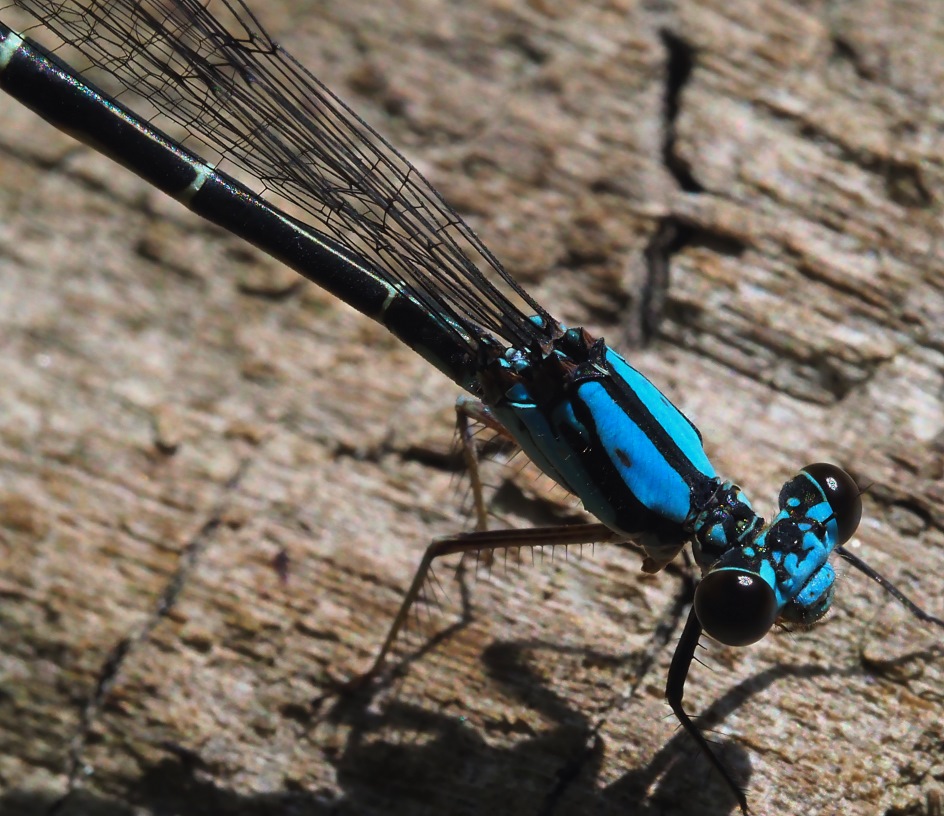
Blue Damsel… Photo by Thomas Peace c. 2018
Especially i just want to breathe
when air is getting dirtier
Especially i just want to see
when the world’s views are getting cloudier
Especially i just want to hear
when so few are really listening
Especially i want to smell
when so many just pass the flowers by
Especially i want to feel
when many are just indifferent
And most especially i want to live
beyond a cadaverous respectful comfort

Question Mark Butterfly, and why not? Photo by Thomas Peace c. 2018
Comparison is often such a vulgar and unnecessary thing. Many people, throughout life, continue to habitually compare themselves with others. Those “others” are often very standard, ordinary, bourgeois, and dull. People compare their home, livelihood, lifestyle, and overall life, with others. Comparison invites imitation; imitation reinforces “second-handedness” and conformity to formulated, standardized “set patterns.” Fear often emanates from comparison… “Will I be as successful as them?” “Am I too different?” Comparison often paves the way to jealousy and superficial showing-off and boasting. (Some people, for instance, go ga-ga, trying to have the hugest and “most pretty” home; this is so childish and superficial.) Taunting another may often involve comparison. Comparison thrives in the world of the opposites (where differences are often magnified). Comparison can make the mind dull; it can be what nourishes mental sorrow.
The wise mind can exist where comparison is seen for what it is and where it is put in its appropriate place (where its limited aspects are seen). Such a mind can be of a profound joy where comparison does not often needlessly enter. When the mind compares, the mind is comparison (within the limited corridor of the opposites). Uniqueness and spontaneous insight usually do not ever depend upon comparison. Comparison and contrasting correlations can be very useful at times, but the mind need not depend upon them as deeply as it usually does. Perceiving directly, without employing comparison, is often very significant and profound.
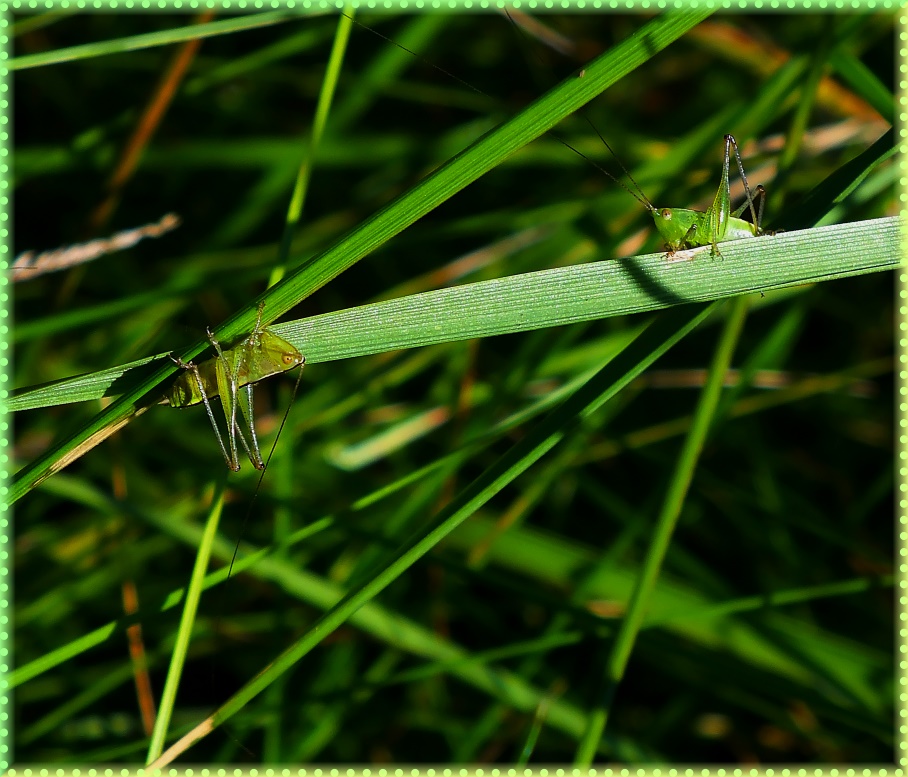
No need to compare! Photo by Thomas Peace c. 2018
“I want happiness,”
said the greed to be happy.
Joy is motiveless.

Magnificent Milkweed Flowers… Photo by Thomas Peace c. 2018
As a young student was walking by, Lo Zu asked, “How many legs do you have?”
The young student replied, “Two!”
Then Lo Zu remarked, “That is a shame.”
Many weeks later, the same young student observed Lo Zu and asked,
“Why is it that you often bend down and focus upon the insects and spiders?”
After some silence, the great sage answered, “What you think you are, you are not… and what appears to be what you are not, you are. For instance, when an ant is looked at, a deep perception consists of six legs. When a spider is examined, a great perception consists of eight legs. When butterflies are seen, a deep perception embodies wings, and when bees are observed, there is diligence and responsibility.
There is no “I” or “me” regarding this, since both are merely empty, delusive, learned abstractions.
Therefore, this does not involve mere identification; it is much deeper than that!
Most people merely see things with lazy eyes of delusion and separation.”
“I don’t quite understand,” said the student.
With a tender smile, Lo Zu warmly replied, “That is OK; maybe someday you will understand and no
longer be
just another one of the two-leggers.”

Eastern Tailed Blue Butterfly … Photo by Thomas Peace c. 2018
It’s supposed to be
pockets of human beings,
not pockets of the whole of nature!
*******************************************************************************************************
I speak from the heart on this. My wife and i do not have any children. I love kids and had worked for my career as a teacher for the multiply handicapped, but this planet has way more than its share of humans. In the past, i have lost a number of girlfriends because of my stance on this. It is very interesting (and tragic) that this most vital subject — that directly impacts the whole earth and all of its creatures including man — is mostly neglected (and not seriously considered) worldwide.

In too limited of a space… Photo by Thomas Peace c. 2018
Few of us, so very few of us, have deep, immeasurable space within (and “as”) the mind. Most minds are endlessly chattering about one thing or another, filled with series after series of limited thoughts (which are merely symbols), images, fears, opinions, musical tunes, and past experiences. Most minds are satisfied with remaining cluttered by what was poured into them. Most go from one series of reacting thoughts and repetitive reconfigurations to another… endlessly. Being satisfied with that is the norm, and that leads to depression, melancholiness, and division.
This space — of thought — which most people adhere to, and consist of, is of limitation. It is the small space of fragmentary symbols, which thoughts actually are. It is the little space between “self” and “other life forms.” It is the fallacious space between a supposed “me” and the so-called distant thoughts that it allegedly controls. It is the space between the past and the future. It is the space between “us” and “them.” It is the little space of sorrow.
Remain plastered there, if you wish. However, it may be most prudent to intelligently consider going beyond the norm. Will going beyond the norm necessitate more methodologies (from the stale past of the old teachers and religious/philosophical/political leaders)? Will going beyond the norm require following certain patterns in time, as in the ways we have merely functioned in throughout the past? Surely not! Love cannot exist deeply and profoundly if limited patterns and limited space crowd the mind. It is the mind that is full of walls of separation and limitation that is the prejudiced mind, the hating mind, the callous and uncaring mind. Love cannot enter what is limited, fragmented, contaminated, and “unwhole.”

Perpetuity… Photo by Thomas Peace c. 2018
The shadow of my wing
unfolds as a very curious thing
reading this to the very end
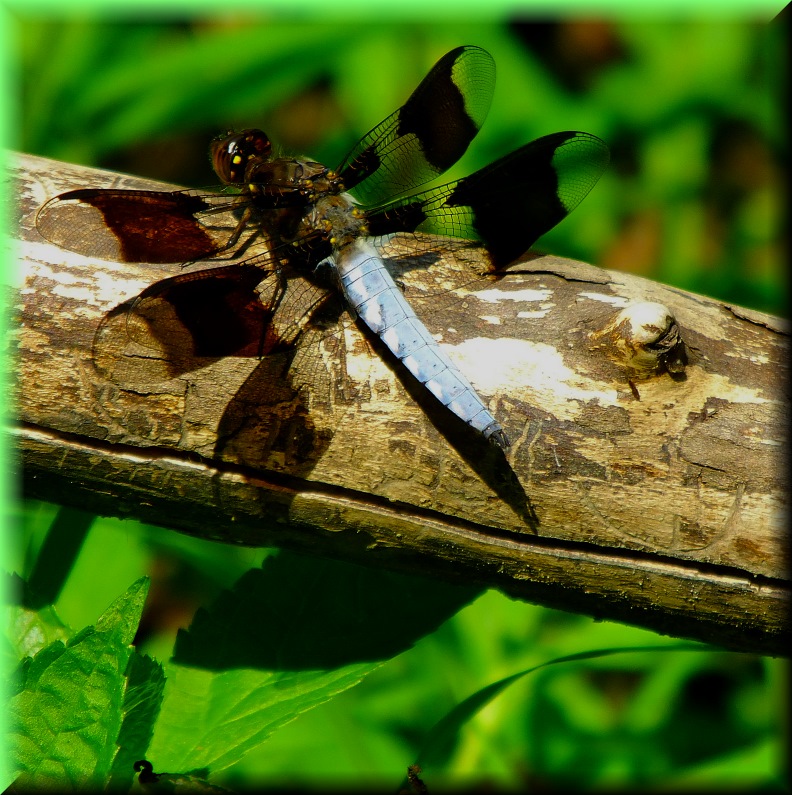
The Shadow of the Dragon’s Wing… Photo by Thomas Peace c. 2018
Little Miss Could
promised to marry Should
They’d live in a sweet fancy house
mostly made of would
But then she met Why
with a special twinkle in his eye
He visited her ‘most every day
and often made her pie
When Should found out
he began to scream and shout
He demanded that all the pies be trashed
and that instead she eat sauerkraut
Miss Could began to cry
she threw a gigantic pie
It flew in Should’s round pretension
hitting him squarely in the “I”
Mr. Why married Miss Could
right there in the neighborhood
and he baked her plenty of pies
just as she felt he wood

Tiger Swallowtail (i.e., Mrs. Why, stuffed from eating pies!)… Photo by Thomas Peace c. 2018
Many of us hold assumptions/presumptions, either consciously or unconsciously, that dictate how we observe and react. These assumptions are what we have absorbed from others and may not be separate from what we are. Many people assume that they are separate from others. Many assume that they are separate from their so-called “own thoughts” and rule them from some kind of internal distance. Many assume that the perceiver is (psychologically) separate from the perceived. Many assume that their family consists of a few human beings. Many assume that endlessly imitating others is safe, sane, and wonderful. Many assume that they are fully autonomous and have absolute free will. Many assume that they are dominant, both internally and externally. Many assume that animals were put here for man. Many assume that they have a right to destroy nature. Many assume that someone who sees things very differently than they do is strange or wrong and should be avoided. Many assume that degrees from universities are a sign of deep intelligence. Many assume that thoughts are what they control by a central “I” or “me” that is not another thought. Many assume that fragmentary, limited science has all of the answers. Many take for granted that money and “showing off” are more important than caring.
It may be that the very intelligent mind goes beyond absorbed presumptions. Such a mind transcends fear, separation, prejudice, conflict, indifference, dead habit, delusion, and mediocrity. It is likely that only such a mind may be visited by the ineffable and sacred eternal.
[Note: According to the environment-oriented Sierra Club which we belong to and donate monthly to: Monarch butterfly populations have been rapidly declining in North America since 1997. In fact, the Midwestern United States have seen an 88 percent decline in the number of Monarchs, and a 64 percent decrease in the available Milkweed, which serves as the Monarch’s only egg-laying habitat and food source for Monarch caterpillars. We need to stop denying man-made global warming and do much more. I, myself, over the past years, have seen a dramatic decline in many butterfly and bee species.]

A Monarch Among Us… Photo by Thomas Peace c. 2018
 Tom's Nature-up-close Photography and Mindfulness Blog