Can real, psychological quietness be “made” to happen by a learned psychological image of a central controller (that is neither central nor a true controller)? Is such a “made” quietness actually phony, because it was concocted by a conditioned psychological process that is — in itself — erroneous (and not a legitimate controller)? A fallacious process is not likely to produce a very orderly (profound) psychological result. To psychologically die to what is false is easy if a real, living passion for truth is there, and if real courage, joy, and intelligence are also factors. True quietness may occur — naturally and without effort — in a mind that is orderly, perceiving without much conditioning and contamination by a manipulating society.
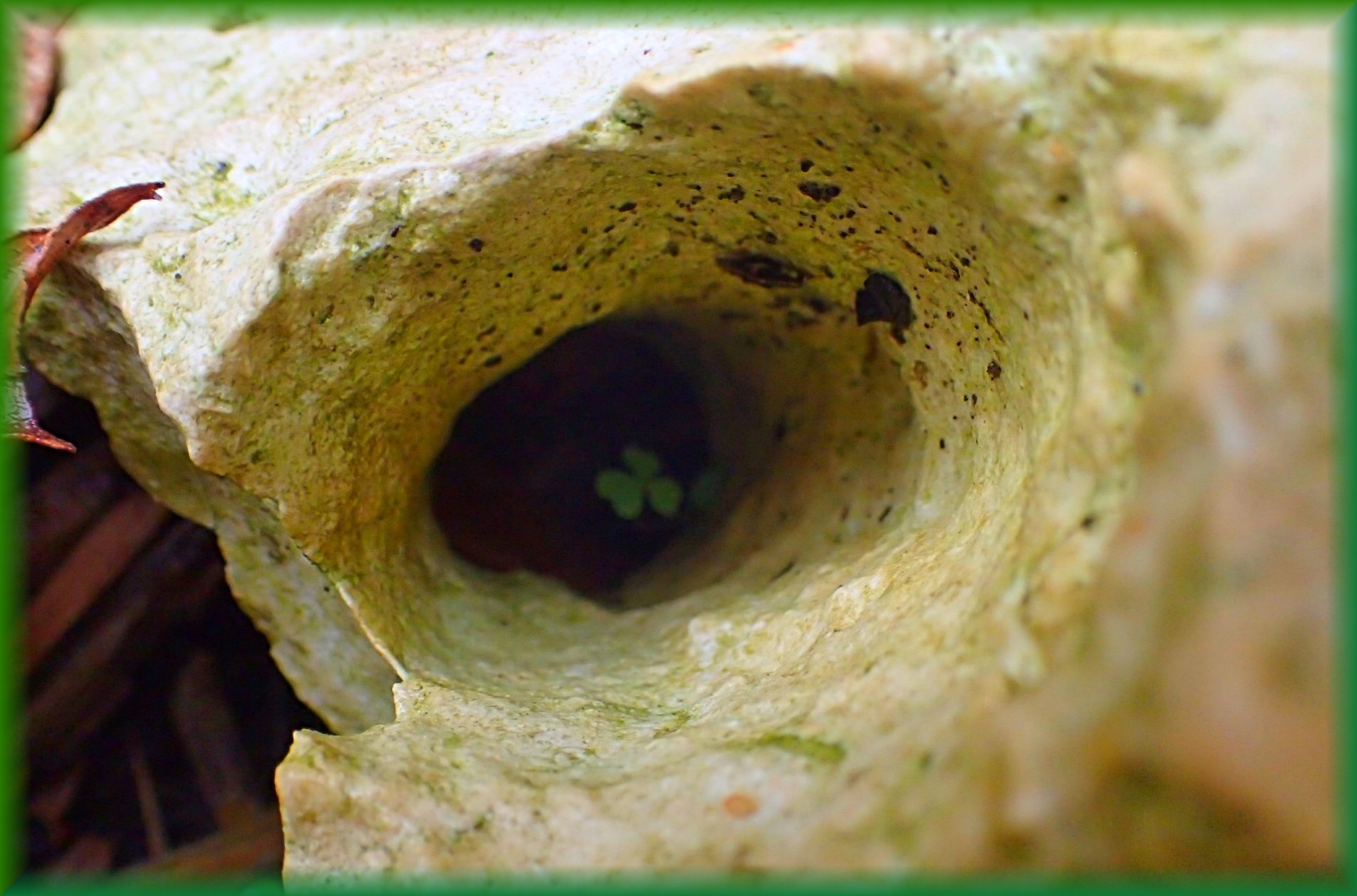
In the eye of the stone… Photo by Thomas Peace c.2024
When we sleep — to help create psychological order — the mind often dreams about things that went on during recent days. Some of these dreams may not seem relevant to what actually went on… but, nevertheless, oftentimes they (indirectly) are. (Analyzing them doesn’t do much good, since the analyzer is the analyzed.) If one is very aware and holistically mindful during the day, then dreams are unnecessary. Then, the mind does not need to try to establish order during the night; order was already established. Without incessant dreaming, the mind can exist in (and “as”) a profound, mindful, meditative silence. Such silence is beautifully beyond repetitive, fabricated patterns and concocted symbols.
Be very holistically aware during waking hours, without constantly looking at things, and labeling things, symbolically (i.e., without merely seeing via words and stored mental images). Then, as was mentioned, you will see that having many dreams is unnecessary. (Of course, eating certain spicy or unusual foods — like pepper or piperine — may inadvertently cause dreams following the time they were consumed.) Please be sure to get enough sleep.
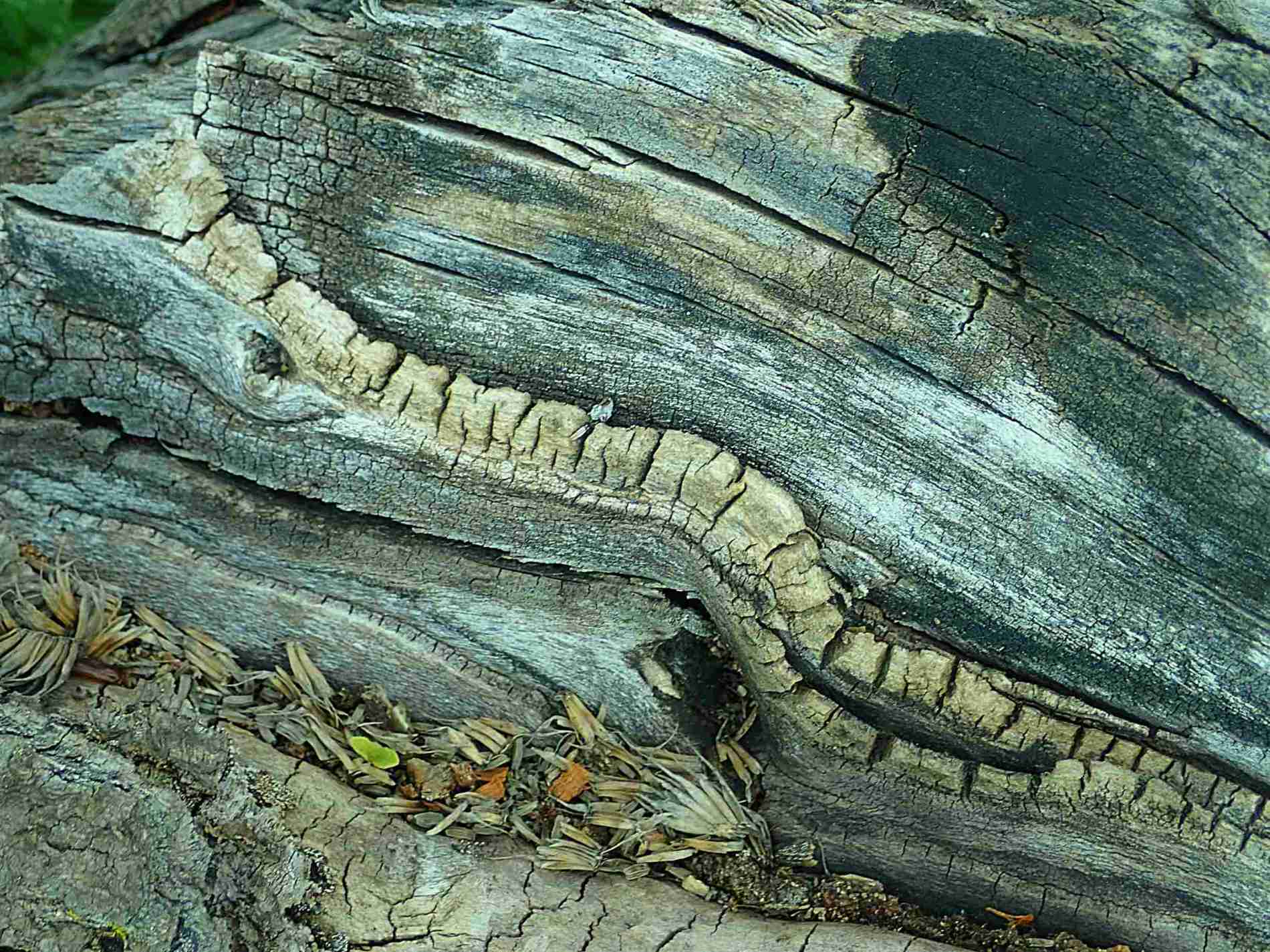
Dentition of a Fallen Log … Photo by Thomas Peace c.2024
When you are genuine and whole, you are largely unaffected by the accepted beliefs and psychological frameworks that society embraces. Then you stand alone. Such a person is blessed. Then one sees beyond the fragmentary and fallacious acceptances, beliefs, and assumptions. Then one actually thinks (and questions) beyond blind dependence.
Society tells you that you are in charge of your own thoughts. Society does not suggest that thoughts make the thinker and that the thinker is a product of thought. (By the way, what one implies here does not negate eternity.) Society predominantly endorses fragmentation and friction, not wholeness and deep compassion. Society endorses (and teaches) dominance by the self. Society sees — and encourages you to similarly see — life and death as two separate things, not as what is together as one, as a larger, beautiful whole. Society encourages you to see with distance, and it encourages you to see with distinct borders and separation. You know that society of course; it’s what is continually falling into widespread disorder and chaos.
Please look beyond the fragmentation that was poured into you. Ironically, nourishing the isolated self — as so many narcissists do — negates real security and the understanding of sweet eternity.
Please consider perceiving beyond influence. Influence rooted in the past may distort perception, causing it to be jaded. We were all heavily conditioned in childhood. We were conditioned to hold certain beliefs and opinions. We were conditioned to perceive through separation, psychological distance, and mental screens involving labeling and pigeonholing. We were taught that fragmentary, manmade borders are legitimate and absolute. We were primarily taught that we are separate from the world, separate from all of life’s creatures, and separate from those other countries.
Additionally, beyond outside social structures trying to condition one, one also can further condition oneself. One can, for example, mislead oneself into thinking that one is superior to others, that one is meditating spectacularly (while all the while one is actually hypnotizing oneself), that a central “controller” is separate from “other” thoughts, or that one is somehow special (such that it is OK for one to take advantage of others).
It is arduous to go beyond outside authority. It is much easier to follow instructions and to do (and think) as you were told. Going beyond “inside” authority is likewise very difficult. When one goes beyond inward authority, perception exists without relying on past conditioning that is mistakingly taken to be original, isolated, or self-created. (One thinks that one needs to control oneself to be good. However, the very control may create a false inward authority, dominance, and friction. Legitimate order may involve much more than that old game.)
To go beyond outside and inside influence may involve great wisdom, freedom, and integrity.
Many people — unfortunately, as adults — primarily look at things in life with (and “as”) the known. They recognize things as what they have seen before. This recognition occurs when the mind habitually sees through a screen (and background) of memory. When memory looks, it looks from the old, stale past. Memory is rooted in the old; it is oldfangled. The past, being old and secondhand, tends to make the mind stale, bored, and lacking in passion (from recognizing the same old things repeatedly).
It may be that a wise mind, however, often looks at life freshly, without merely perceiving through stored, musty images (of what was). When we were young, we glowed with the passion of seeing life without stale (learned) recognitions. Then we were blissful; then we were flowing while not merely recognizing. (When i was biologically young, i told people that i would never grow up.)
Look at life happily, joyfully, blissfully, soaringly, and fresh… without always carrying the oppressive burden of the past.
I am positing here that by seeking enlightenment, enlightenment never happens. Seeking it instantly nullifies it happening. Seeking takes time, and one cannot obtain the timeless by practicing or doing things (to get it) within (and “as”) time. Thinking manifests in (and “as”) time. Thinking, per se, usually occurs for motives. When thinking is not necessary (for a period) then perhaps the element of timelessness can occur. But if one craves it or grasps for it… it will not happen. One must be indifferent about timeless enlightenment occurring. Then one is not merely seeking an end via some calculated means.
Understand the mind from moment to moment (without a final goal in mind). Someone commented to me recently that they found a method to practice meditation (and said that it was good for beginners). I replied by suggesting that any deliberate practice turns one into a secondhand human being. Additionally, it is very easy to fall into self-hypnosis and subsequently wholeheartedly consider it to be great meditation. Also, there are no “beginners” with this. ”Beginners” implies time; getting to the timeless via time may be a fallacy. Trying to attain enlightenment may merely reinforce a selfish ego (wanting to get something). Reinforcing a selfish ego does not lead to what is beyond deception and selfishness.
Whatever you do, don’t look at life and the world beyond the systems, patterns, and ways in which you were taught. If you look outside of the systems, patterns, and ways — which were poured into you, forming your consciousness — you may be a danger to all that is false, fragmentary, and distorted. Keep looking at things just as you were programmed to. Don’t question anything. Be sure to accept (and cling to) everything that they poured into you.
Continue to observe things from behind a self-made psychological wall supporting separation and isolation. Continue to mindlessly escape into endless forms of entertainment, travel, drugs, and amusement. Continue to have opinions based on how you were raised and taught. Worship the dollar. Grow out of that youthful, magical wonderment concerning life and turn into a fusty adult who sees little of life’s newness and magical beauty. Get dreadfully bored while seeing and thinking the same old patterns. Think only of yourself and have no feelings for others. Continue to worship the dollar. Never stop endlessly chattering with mental symbols, patterns, and words.Look at everything through a maladjusted psychological screen (or curtain) of separation and division. Be very afraid of sweet and refreshing mental silence. Seldom look at (or visit) nature. Do not fundamentally change on the inside, but make your body look very unusual and different on the outside. Continue to worship the dollar.Go through existence being narrow-minded, selfish, and opinionated. Blindly cling to a lot of manmade patterns that were concocted in the distant past, and never look at reality without old, dusty, iron-clad beliefs. Keep your lawn looking perfect, but remain disorderly and a mess inwardly.
Where the Fairies Live … Photo by Thomas Peace c.2024
The mind may be a prisoner of its own delusions and misconceptions. To extricate the mind from the quagmire (that it is likely in) may require much more than mere reactions. Mere reactions are likely just extensions of the confusion, disorder, uncertainty, and disarray that the mind is (in). In other words, if the mind is disorderly, who is going to make it orderly?… Will it be another part of that same mind assuming to have (or be) authority or order?
Though we all have to react… merely reacting may not be a profound solution regarding fundamentally existing beyond the disorder. If we perceive our reactions without judgment, ideologies, beliefs, and images of what others have taught… that very perceiving may be beyond the realm of mere reacting. If the mind ceases to depend on standard and ordinary reactions, perhaps it may undergo a transformation wherein few reactions continue to contribute to the misconceptions and delusions that it existed as (in the past). Looking without merely having obtrusions of thought occur as reactions, however, may be easier said than done. The very way we observe things is often heavily tarnished with reactions that we are — for the most part — unaware of. A mind of pristine, untainted “observing,” however, goes beyond being merely rather mechanical and robotic. Such a mind is where true joy and true living exist. Rather crass, robotic minds — though they may say otherwise — are divorced from deep joy and insight. Deep joy and insight are not mere projections (as reactions) from a heavily conditioned mind. Deep joy and true wisdom aren’t part of what must depend; they are spontaneous and not fabricated.
It may very well be that the best joy, the best insights, and the best perceptions… are not merely what are sought (through and “as” reaction). Often, at the precise moment that one seeks to be joyous, joy is not. Most of us have relied, as we were taught, on time to become joyful and wise. However, the most profound joy and the deepest wisdom may not involve a factor that takes, requires, or involves time. Deep joy and deep wisdom are timeless and are not of the realm of mere acquisition (with and by) delayed reactions (about patterns) in time. However, in “time” the wisdom of compassion intelligently acts to help others.
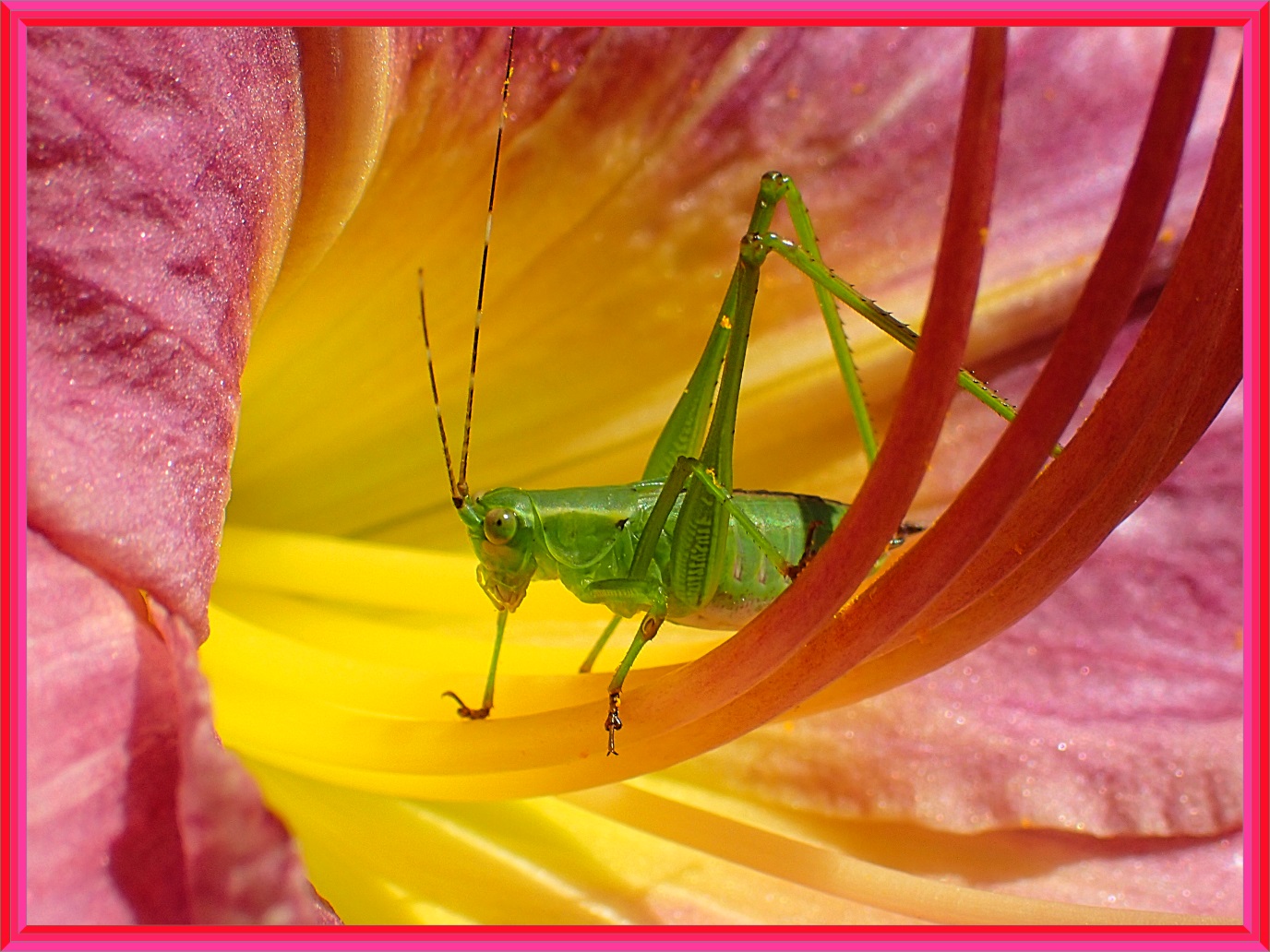
[Note: The front leg has a tannish, round area under the knee… that is its hearing mechanism. Since it has one on the left and right legs, it can hear in stereo.]
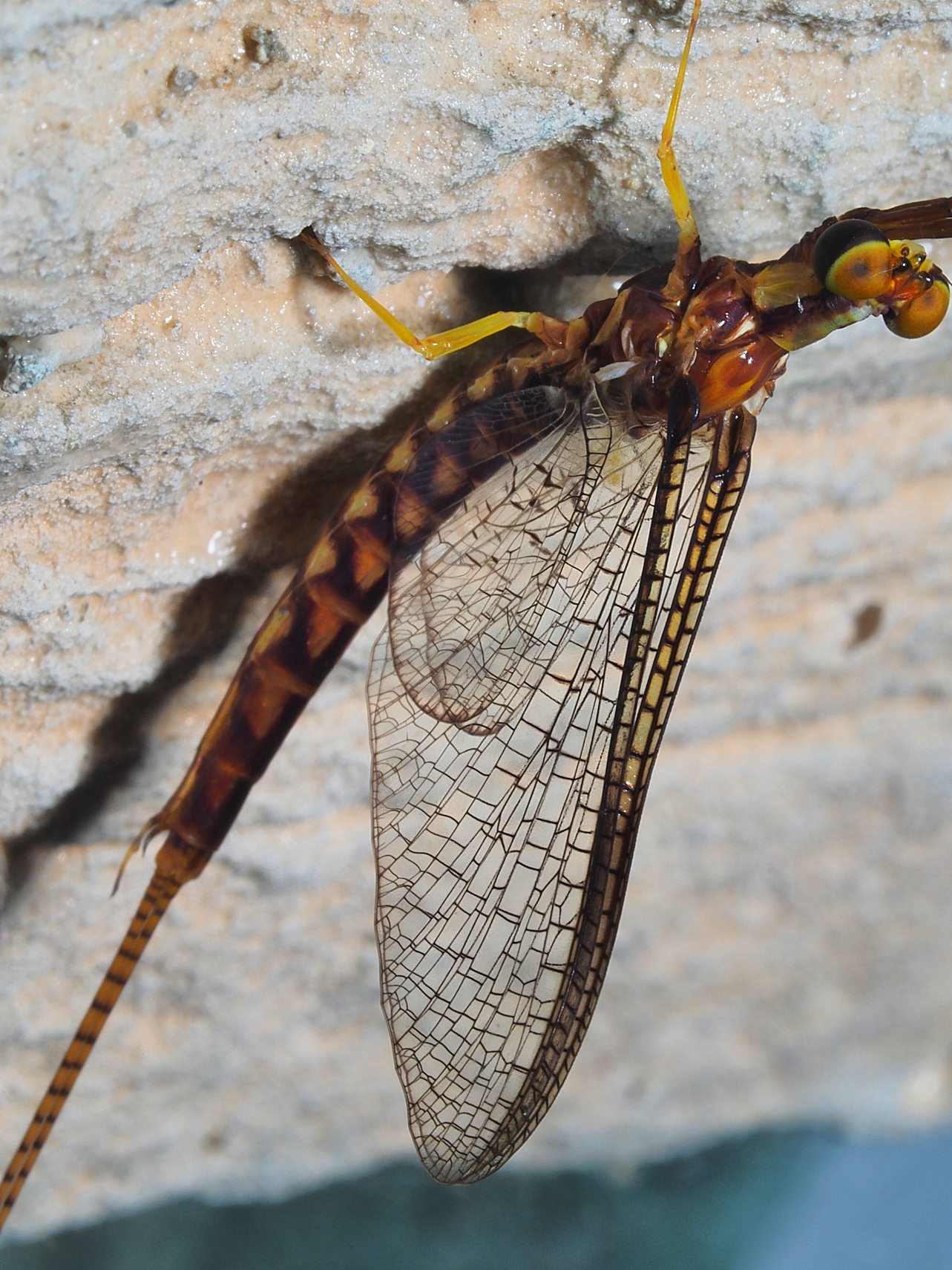
Resting on the Balcony … Photo by Thomas Peace c.2024
A run-of-the-mill consciousness that has accepted everything society has poured into it inevitably perceives with (and “as”) confined limitation. It sees what it was taught to see; it thinks (for the most part) what it was taught to think. Ironically, such minds think that they are free.
A limited consciousness will have perceptions and mental reactions defined by limited borders. It may feel free, but such freedom is like the freedom of a dog tethered by a chain; it can go where it wants but where it goes is essentially nowhere.
Orderly, intelligent awareness breaks through this whole circus in (and “as”) a mindful, spiritual revolution. Such a consciousness is not just a product of society. Lemmings are very good at imitating others and at falling into an abyss. Please be different!
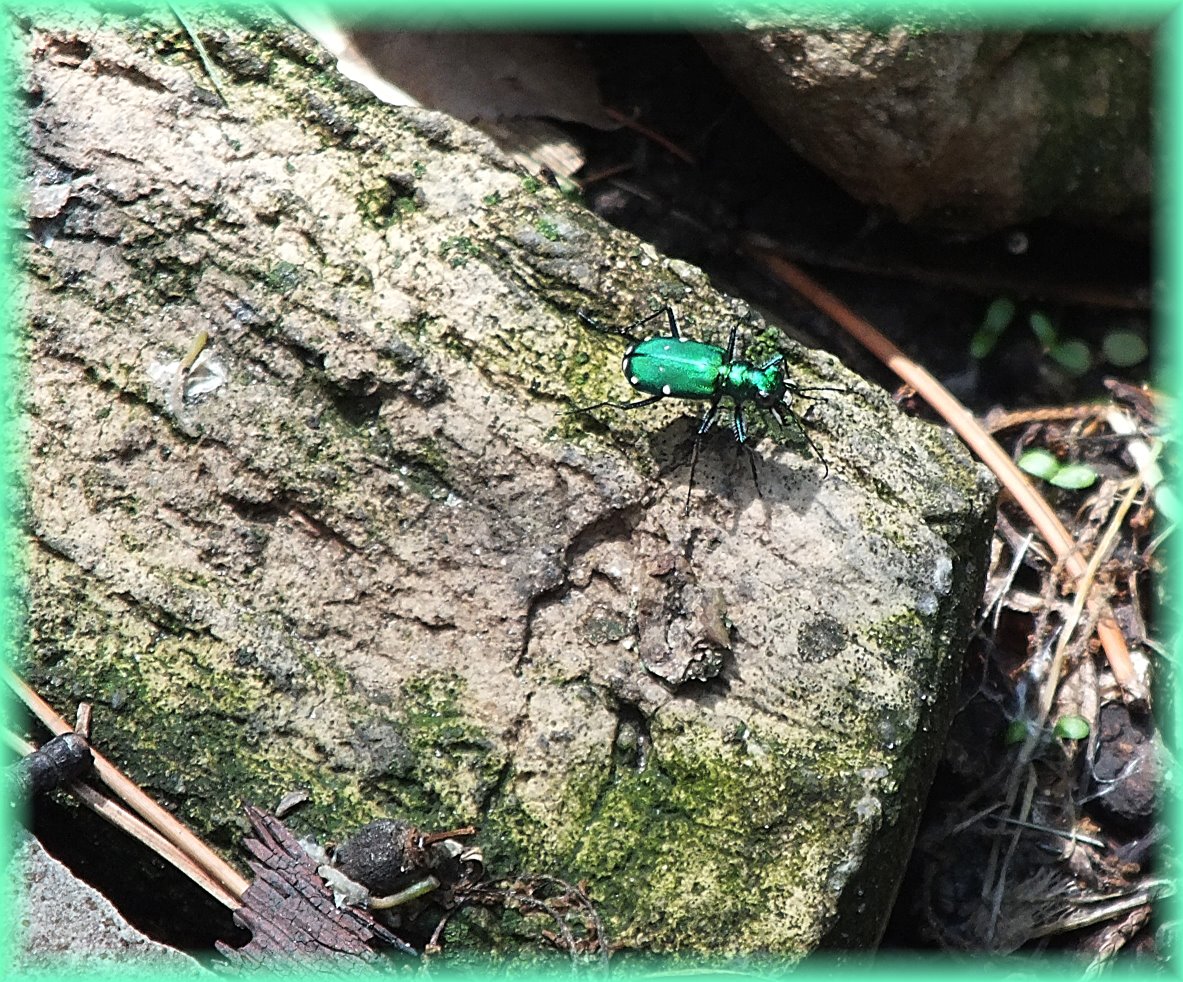
Ready for Another Meal … Photo by Thomas Peace c.2024
Understanding the whole cannot occur merely by the sequential movement of fragments. Parts can never perceive the whole or deeply be in communion with it. And, unfortunately, it is all too easy for the mind to play tricks on itself; for instance, it can stick to the notion of a controlling center (called “me” or “I”) that it thinks is the essence of itself. From this supposed “center,” it seems to operate. However, this so-called center is another fragment, a learned obtrusion of thought/thinking, and dependence upon it creates limitation and circumscription. However, almost all of us reinforce it… usually unaware that that is what we are actually doing. We feel safe and smart by doing so, but (in reality) it is neither safe nor intelligent. A false center creates separative distance and boundaries; a false center contributes to conflict (internally and externally), which creates havoc in the world.
Only a subtle, sensitive, keenly perceptive mind can go beyond the notion of a central ego, a central controller (that seems separate from the thoughts it supposedly thinks… that seems separate from others). Such a perceptive mind is then of compassion and wholeness. It no longer is wasting its energy on illusory separations, divisions, isolating beliefs, and absorbed false concepts. Freedom is not circumscribed… (and a psychological center has a limited radius). What is limited is not in true communion with eternity and boundlessness.
Thinking, being of abstraction, is sequential in nature; therefore, it is of time; it is time. It is psychological time that creates and manifests as fear. In time, one may be despised by others; in time (i.e., in the future), one may be laughed at; in time, one may become senile; in time, one may get psychologically hurt by another. So, often, thought and its shadow (i.e., concomitant fear) manifest in (and “as”) time. And remaining in (and “as”) conditioned, sequential abstraction… is a form of suffering. Such suffering is not blissful living.
Thought is often a very necessary tool. However, all too often, we go on thinking (when thought is not necessary). This remaining in (and “as”) thought/thinking, is remaining in what is merely conditioned, merely sequential, merely symbolic, and what is merely time-bound. To psychologically die, at times, to the repetition of abstract thinking, is to go beyond fear, secondhandedness, fragmentation, symbolism, and separation. It may be that the separation between the thinker and the thought is, in itself, another conditioned, sequential misstep… another learned fabrication that isn’t true. It may be that thought creates (and is) the thinker, not the other way around. And we are afraid to have thinking stop (because we are afraid of being nothing). But this “nothing,” that we are afraid of, is a projection of thought/thinking that is erroneous and illusory. To often go beyond the limitation of abstract, fragmentary, and sequential thinking — and all thought is fragmentary, sequential, and time-bound — may be (if it is actually done) rather blissful and beyond distortion, fear, and suffering.
Chameleonic Sweetie … Photo by Thomas Peace c.2023
In this very insane and violent world, in order to find out what is true, and what is beyond and deeper than what everyone else is thinking, believing, or hoping, one must have (and “be”) a tremendous and great passion (involving holistic discovery). This immense passion must be beyond motives involving hopes, desires, and secondhand patterns. One must — to truly explore — function with (and “as”) a mind that is untainted, unprogrammed, unafraid, unconditioned, and uninfluenced by others. Such a profound inquiry must not try to influence what may be discovered (via any internal, psychological influences such as hopes, beliefs, desires, and expectations). And, such a pristine, inquiring mind must be extremely healthy, via being part of a body that eats wholesome, very natural, nourishing foods, exercises often, and does not indulge in recreational mind-altering drugs, alcohol, and tobacco products (that can distort the observations).
Then, having laid the right foundation, one can inquire. This inquiry may best be done (psychologically) without methods, systems, and learned techniques… just by timelessly, effortlessly looking without conflict, and conditioning… beyond any previously learned psychological molding, casting, techniques, or shaping. Most thinking, per se, involves methodology, remembrance, and effort; being beyond thinking is neither of methodology nor time. Freedom, spirituality, and truth may not be what people think or what minds fabricate.
Shine On You Crazy Diamond … Photo by Thomas Peace c.2023
Conflict and friction are rooted in separation. We were miseducated to accept and embrace separation in (and “as”) consciousness. We were taught that we have a separate “ego” that controls things. We were not told about the possibility that this “ego” is merely a protrusion of thought/thinking. We were not told that, psychologically, the perceiver is not something separate from the perceived. So-called “normal” people look at internal anger, fear, and jealousy as if each is something separate from what they actually are. This inward separation also extends “outwardly.” Most look at life with separation and conflict and accept it as being normal.
Genuine, holistic love is not based on separation and conflict. Love is not what involves psychological distance and ironclad, circumscribed boundaries. The left hand that sees the right hand as something apart from itself is ignorant and is confined in (and “as”) blinding deception. Such ignorance and confinement manifest as sorrow. Wisdom transcends this.
Most people are magnetized to gravitate to (and to dwell in, and “as”) the known. They, unfortunately, cling to an existence exclusively in that superficial dimension. That dimension is a very limited dimension because one can only know (and accumulate) a very limited amount of things. To often exist as the unknown is foreign to them (and, for many, they never even considered it). The known is always of the past because it was accumulated in (and “as”) the past. Being of the past, the known always has a stale, secondhand element to it; it is never new, never totally fresh and living. Virtual, symbolic patterns, which constitute the known, are tokens and representations… not the actuality. It is good to use symbolic patterns often… but they are only temporary tools.
In so-called modern times, we were miseducated to dwell (and exist “as”) the known exclusively. Unfortunately, a mind that exclusively exists as the known is unbalanced and not whole. Society is a direct reflection of this unbalanced element, and insanity is rampant across the world. Interestingly, there is no procedure or method to step out of the known. All procedures and methods involve the known and are extensions of it. Procedures and methods involve time and the known is sequential (in its mechanical nature) and involves (and is) time. The unknown has the essence of nothingness to it (psychologically), and most people (unfortunately) are extremely afraid to be nothing psychologically. All want to be something, to attain something, to become something, to believe something, to get something, and to just continue to accumulate (sequentially). This exclusive sequential accumulation may be the very denial of true and timeless living.
Sorrow is a reaction. Sorrow is a mental response to something manifesting as a cause which results in an effect from what is accepted to be an observer. Conditioning concerning the manifestation of an “observer” results in a response allegedly from (and supposedly “by”) that observer. Intelligence, however, perceives that the observer is not separate from the observed. Such perception is not merely a standard reaction; it is, rather, holistic action beyond conditioned reaction (if it is indeed genuine, pristine perception, and not just an idea). This pristine perception negates the suffering of sorrow (in that it is clarity beyond robotic reaction). Does the clarity of wisdom habitually carry the burden of sorrow? Not likely. Wisdom is deeply living; sorrow and depression are not deeply living. Reactions are rooted in thought/thinking and can (and do) manifest as sorrow. Habitual thinking has the element of sorrow within it (intrinsically). Profound perception is living and is not exclusively rooted in thought/thinking. Such perception often exists beyond cadaverous, conditioned sorrow.
The ego of most people exists as a learned, limited set of reactions that involve separation, distance (from what are considered “others”), conflict, and a circumscribed (though false) center. Thought/thinking is the source of the ego, not the other way around. Egos, being restricted in nature, often cause havoc in the world; just check out the news. The ego, being limited, is often a cause of suffering (both with what are considered “inward” and “outside” events). The ego manifests suffering (because of its confinement and falsity). Deep, holistic compassion is dynamic and involves unadulterated perception. Such perception is direct and is not a mere reaction… it is action and is not robotic (like superficial reaction is). When the ego is transcended, a real, holistic compassion may occur that exists as immense and profound intelligence.
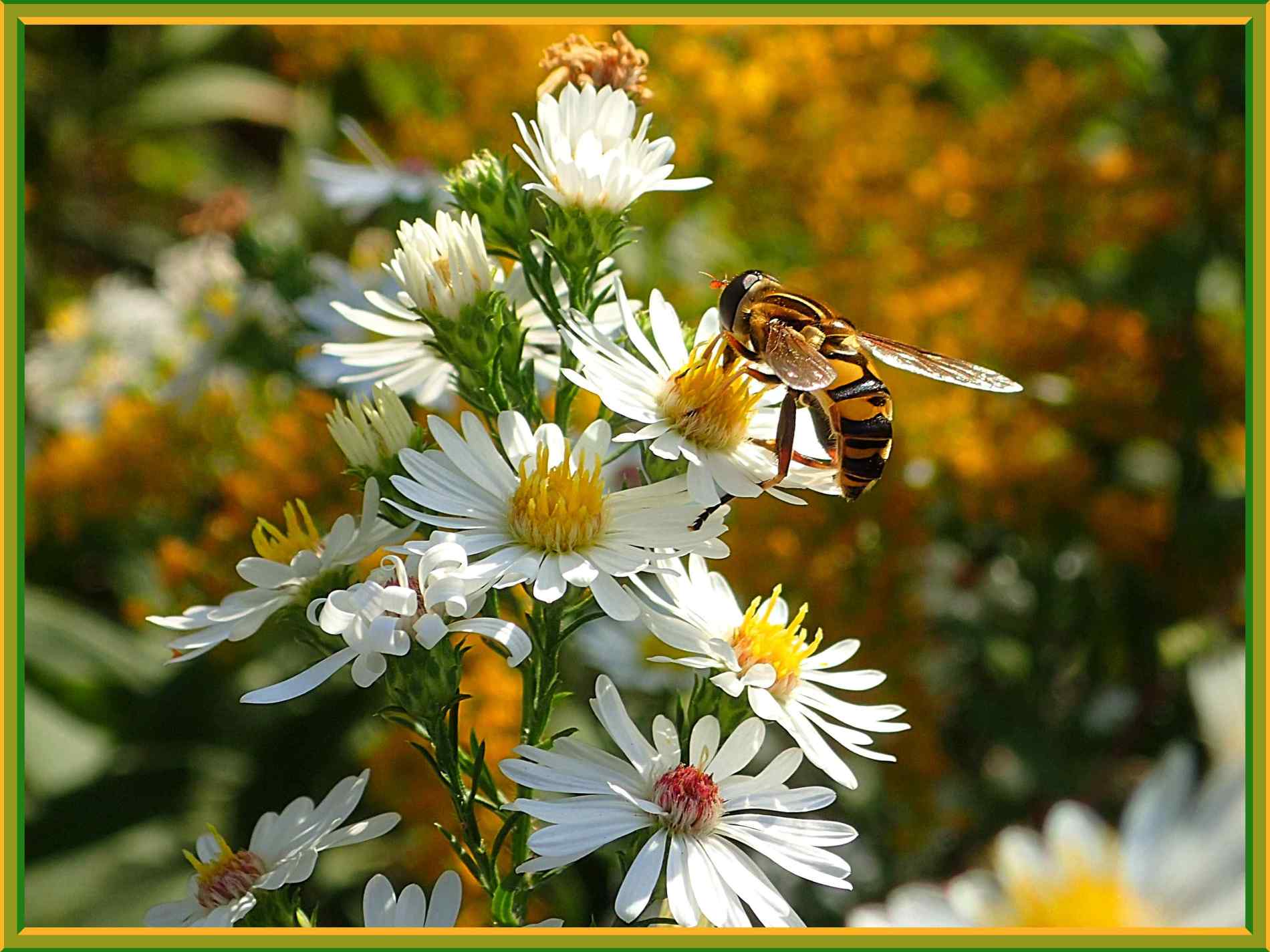
There can be a holistic awareness without significant thought/thinking taking place, (in which the intelligent mind often sees without thinking and cognition interfering). There can be, for example, simple awareness of creatures upon flowers and of leaves lightly dancing in the breeze. However, thought/thinking is then not merely labeling, analyzing, comparing, or projecting what science has taught concerning these things. Then the mind may be of a sweet emptiness that is beyond the second-hand constructs of man. That emptiness (of mind) may be a blissful, effortless negation of inherited mental fabrications. Such mental nullification may be the highest positive, for neither is it handed down, replayed as monotonous imitation, conjured up via effort, nor dully rehashed. And it can deeply exist (too) beyond the ordinary, habitual recognition of things. It is always refreshingly new and beyond dead blueprint-like (mental) structuring. (Too many of us take words to be the equivalent of reality; they are not.) And, coincidentally, real love is always explosive, pristine, and not copied or imitated. The ordinary “once-lers” of the world are, unfortunately, not of it.
The elderly, gray-haired Lo Zu was sitting — as he often tended to do — on a large boulder in nature… his wooden meandering cane leaning against him. Some youth saw him from a distance and they curiously journeyed over to where he was sitting. Then they asked him what he was doing. Lo Zu replied… “Doing nothing… being nowhere and existing as nothingness.” One of the youth queried, “What do you mean by ‘existing as nothingness?'”
After a long, meditative pause, Lo Zu replied, “When the ego is transcended, the mind is often mysteriously beyond its contents; then there is a beautiful nothingness that is blissfully beyond ordinary experience, sensation, space, and time; that emptiness is beyond the ‘known.’ But most people are afraid of being beyond the known. They are afraid of having their cup empty. Each one desperately wants their cup to be filled (with something). Their cups are full of stale theories, secondhand ideas, flat beliefs, antiquated traditions, divisive religions, corrosive fears, greedy desires, banal suppositions, learned superstitions, limited so-called organized systems, dead images, and shallow words from so-called leaders. But it may be that their fullness is the real poverty; it may be that real richness is in transcending the psychological self (that is an illusory troublemaker). Profound love is beyond the dilation of self.”
Experiencing things, for most people, involves recognition and thought/thinking. Experiencing things, for most people most of the time, deals with experiences that seem to be separate from the “experiencer.” But the “experiencer” is really not something apart from the experience (though he or she seems to be separate). Without the experience, there is no “experiencer.” Most tend to look with full-blown separation and distance.
When people look at the stars, they are observing something that happened millions of years ago (which, of course, is due to the fact that it took the stars’ light millions of years to get to the Earth). So, essentially, they are looking at the past. And even when one sees things that are physically very close, one is still observing the past. Experiencing is, for survival purposes, often very useful; it often is a necessity for survival. However, merely depending on experiencing — and existing as experiencing — may not be very prudent. Merely remaining in that limited realm may be remaining in (and “as”) the past. Many cling to the apron strings of experience… and they are afraid to venture beyond that limited and separative realm. It is wise to often be experiencing things and it is wise to be beyond experiencing things. Immense wholeness is beyond experiencing (and all of the traditional separation, discrimination, psychological distance, isolation, and circumscription that goes with it).
When you were a very young child, before society gave you all kinds of baggage to carry (mentally), you were euphorically joyful, deeply inquisitive, and full of bliss. Then you felt eternal, timeless, and profound, and you were not concerned about death, religion, politics, or how to climb a ladder of success. But they loaded you up with the baggage that they had accumulated (and concomitantly, a lot of the real beauty of life dissipated in consciousness over time). Perhaps you can do yourself a real favor and perceive again (without depending on any accumulated baggage). Perceive without all of their concepts weighing down upon you. Without all of the psychological baggage, perhaps you can be young and full of joy and living magic again.
Clinging to Easy Substance … Photo by Thomas Peace c.2023
Yes, one doesn’t normally post videos and one normally doesn’t like to watch them but the following short video — which was sent to me by friends in Canada that i used to live with and do volunteer work with, for six months, making non-competitive games — is an exception. The video is very sweet, in my honest opinion! Please watch it!
Pristine perception is not observing through a screen of conditioning. Very many of us look at things just as we were programmed to look… which really isn’t looking at all. To perceive without conditioning interfering requires a very dynamic mind that is not easily influenced by others. Such unconditioned observing is innocent, unsullied, profound, without a center, and has little to do with robotic reactions with their concomitant opinions and labels. Pristine perception does not involve the limited circumference that a psychological center brings about. Such perception is untethered, insightful, and — not being secondhand — is beyond methodology and imitation. Profound perception goes beyond mere recognition and remembrance. It is an effortless explosion of intelligent freedom.
Suffering is part of life. We all suffer. We suffer physically and we suffer psychologically. Physical suffering is unfortunate oftentimes, and often some of us get more than our fair share. When one suffers, one is not just suffering alone; the whole of humanity and life shares in that suffering; it is the suffering of life. Sometimes, we automatically run from suffering in a robotic, conditioned, thoughtless way. If one is intelligent, one can allow physical suffering to flower naturally somewhat (without just being totally negative about it). Physical suffering is often a signal… and we need not be too overwhelmed with some of these signals (as long as we are doing everything we can to live a healthy and responsible life).
Additionally, there is psychological suffering. The mind can suffer with grief, with fear, with sorrow, with depression, loneliness, and boredom. Habitually manifesting as grief and sorrow can, for instance, take its toll on the body; it can cause high blood pressure, strokes, and all kinds of things. One’s sorrow, one’s fears, one’s grief… are all not separate from what one actually is. One can, without effort, psychologically die to grief, fear, to sorrow (and such things). And merely dwelling in (and “as”) thoughts is a form of sorrow. Thoughts are merely virtual, symbolic images, and existing merely as virtual, symbolic images is intrinsically a form of suffering. And thoughts (and psychological images in time) are usually the sources of fear and anxiety. One can psychologically die to the endless chattering of thoughts; such a dying is inherently a blessing. Look at things directly and not just through a psychological screen of learned images and labels. It is the images and labels that take effort to manifest, which is not the case with direct perception and pure seeing. But we make effort into an endless habit and then claim that we can’t exist without it. Effort takes time; wise (pristine) perception is timeless. Compassion is instantaneous (and has an element of timelessness), by the way.
Coprolite — Fossilized Dinosaur Dung … Photo by Thomas Peace c.2023
I’ve included the following quote by Einstein in previous posts, and i’m including it here again.
“The true value of a human being can be found in the degree to which he has attained liberation from the self.” — Albert Einstein
The human brain goes through a huge amount of associative mental connections. Most people associate the “I,” the “me,” the “self” with power to control, with domination over “other” thoughts, and with freedom to act independently. However, the “I” — just like the other concepts of central authority — is just a protrusion of thought/thinking. In all actuality, there is no true central “controller” situated in the brain. Unfortunately, far too many people treat this thing as if it has a separate, substantive existence (apart from others). It may be that many millions deceive themselves each and every day. Transcending this limited, primitive, crude form of thinking opens the way toward deep compassion and holistic understanding. Our age-old associative ties to a central, independent “controller” (apart from the world) may be very erroneous.
being to timelessness as it’s to time… E.E.Cummings
Time is distance. We perceive with (and “as”) distance, and we remain stuck in time. Of course, you have to keep your doctor’s appointment, which involves a certain physical time and place. (A supposed isolated center looking out, perceives via distance.) Should time be the only domain we function in (and “as”)? This writer says, “No!”
Most of us are almost constantly churning — mentally — with various images, words, and patterns within our minds. (The words are often verbal in essence and usually occur as simulations of what one’s own physical voice sounds like.) Even when we listen to others, or observe others, what we perceive largely consists of patterns recognized (i.e., re-cognized) by mental patterns which already exist in (and “as”) the mind. We often take these patterns — these protrusions of thought/thinking — to be equivalent to pure reality. However, they are primarily just virtual representations that are fragmentary, symbolic, and of the past, since they are constituted of repetitive mental protrusions that reflect what was poured — piecemeal — into us by others. Even the “I” that each one seems to zealously harbor and worship consists of a protrusion of thought/thinking (that deceives the mind and often invites fragmentary, separative behavior).
A silent mind transcends this limitation by going beyond what is secondhand, virtual, and symbolic. Such a mind is not merely trapped in (and “as”) the representational. Such a mind is dynamic, alive, pristine, and beyond sequential, robotic imitation. Then, true care and compassion may manifest. Compassion does not emanate from what is fundamentally not alive.
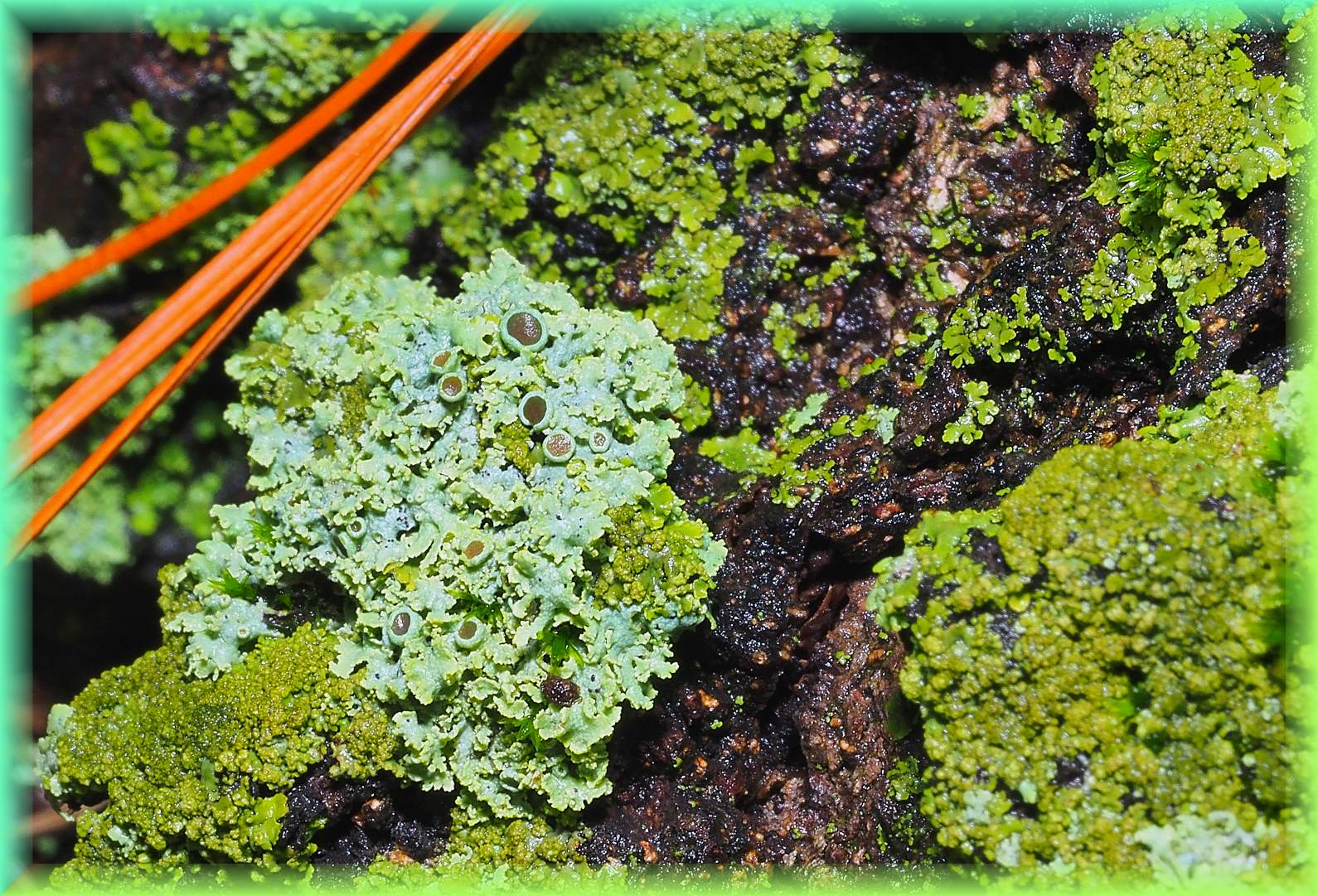
Lichen what you see … Photo by Thomas Peace c.2023
Time involves distance. Without distance, there is no time. Many people try to convince others — and themselves — that they have perceptions involving great depth and great wisdom. What does it mean to see deeply? Many people see deeply. They perceive with (and “as”) depth that involves distance… such as between a perceiver and that which is perceived. However, even animals perceive in such a way. Such depth involves (and is constituted of) conflict and separation. However, there is, in a few, a holistic depth of mind that does not involve conflict and separative distance. It is not of the mundane, so-called “normal” depth. A different holistic perception involves unity… and not mere separation between a perceiver and that which is perceived. In such perception, compassion exists, unity exists, and care and empathic action exist.
Getting to the timeless (i.e., the unlimited) through time — through effort and distance — is foolish.
A Little Innocence … Photo by Thomas Peace c. 2023
Time, evolution, light, sound, and thought/thinking all consist of a series of sequences. We live in a domain consisting of sequences. That is our life. I am suggesting here that great spirituality exists timelessly beyond what is merely sequential. Can you get to it by doing a series of things in time? No. However, is living a life that is orderly, perceptive, and caring (within time) essential? Yes. That sacredness may not be separate from an orderly, perceptive, caring life. However, if your mind exclusively consists of sequences and sequential patterns, you likely will never be visited by the timeless sacred. Sequences, per se, only consist of the partial (i.e., fragmentary patterns) and what is partial is not what partakes of the whole. This is why an orderly, meditative mind is crucial… but it is not something that one can practice or perform as a technique.
My previous blog posting included a photo of T-rex, my pet parrot; i used to breed parrots. Some readers expressed interest, so the following is an audio of T-rex. Needless to say, he is quite a character. (In the audio, at first, he rings a bell — which, often i think, is to summon me, as if i’m some kind of butler —and, when i don’t come running, at 4 seconds into the audio tape, he says “Oh, what the heck?!” Then he whistles a summoning whistle … and subsequently, he diverges, and his wolf whistles follow. He whistles better than i can. At 22 seconds he, quietly, says something — as if to himself — like “specific.” At second 25, he quietly says “stupid,” which is probably about me and not coming as he wants me to. At around second 34, he says “come on” a couple of times. At second 37, he says, “hello.” Then, among summoning whistles, he quietly — as if to himself — says “specific” again and says “come on” repeatedly. Personally, i think that he thinks that i’m his private butler whom he can summon whenever he wants; he rings that god-forsaken bell and expects me to come running. Sesame Street is what can be heard in the background. I put Sesame Street on tv for them daily, which they enjoy and learn things from.) Let’s face it, we are our pets’ menial servants. 😉
T-rex Talking and Whistling … Thomas Peace c.2023T-rex (back) … Photo by Thomas Peace c.2023
First of all, if you ever happen to be blessed with a true understanding of how eternity works, don’t go shouting about it from your rooftop. It is a thing for an individual to discover and is not something meant to be shared, one feels.
One will say this, however… Eternity does not depend upon the existence of a central “I.” Anyway, there never was a true central “I” in the first place. Each manifestation of an “I” (or “me”) is an obtrusion and product of thought/thinking and there is nothing truly central about it. This writer sometimes uses the term “I” when responding or writing in this blog because it is a common form of communication. However, in actuality, it is not truly necessary. Eternity exists quite nicely, thank you, without the need for the existence of an “I” or “me.” This seems counterintuitive. However, truly understanding how the cosmos functions (in its entirety) occurs best when the “I” and “me” (with all the falsities involved) are absent or psychologically negated.
One happens to have, and care for, a couple of wonderful pet parrots — I used to breed parrots — and they often speak with comprehension… and they sometimes correctly use the word “I.” For instance, recently my girlfriend bought colorful wooden toys for them and one of them, named “T-rex,” was tearing his huge wooden toy up so much, and making extensive messes, that i removed it (i.e., the toy) from his enclosure… intending to give him one section at a time. He said, “I want it back.” So even animals can use the word “I”; it’s no big deal.
One posits that, for us humans, it takes great intelligence to transcend the notion of a central “I” or “me.” Then, possibly, such a one may partake in great insights that transcend our rudimentary notions of time, space, control, death, life, and self. Many, however, would say, “Well, I’m not interested.”
T-rex (Catalina Macaw) … Photo by Thomas Peace c.2023
It’s not what we were taught to consider. The following contains a portion of what my response was to someone who gave comments in my previous blog posting.
Regarding what may happen when thought/thinking is not merely what occurs in (and “as”) consciousness… Well, what may remain is not a gut feeling or instinct. What we are talking about may occur when thought/thinking is in abeyance… and it is not what thought/thinking can easily grasp, label, pigeonhole, or categorize. But most people, in modern society, would be uncomfortable about often being where ordinary thinking is not… and they would likely say that what i am suggesting is malarkey. We are so indoctrinated with the process of thought/thinking, that anything else is unfathomable. Most of us were programmed to be what thought/thinking is… and anything else is unwelcome (and likely not what we are interested in).
Miseducation is often one-sided. Such so-called education is what can program us to wholeheartedly accept what is limited, confined, and false. The human world is a result of this miseducation… and currently, there is much conflict, violence, confusion, division, and separation. There may be an aspect of great compassion, bliss, and caring when transcending thought/thinking. Beyond the fragmentation that thought/thinking consists of, the burden of sorrow is not. Thought/thinking, by itself, on the other hand, often involves robotic, banal, sequential fragmentation; thought/thinking is primarily of a symbolic nature. Mere symbols are not true realities; they are mere tokens. It may be prudent to go beyond what your consciousness was educated to exist as.
There is, it seems to us, At best, only a limited value In the knowledge derived from experience. — T.S.Eliot
It is good to experience things in life often. For instance, one needs experience in order to function properly and in ways that do not end up being detrimental to one. Additionally, it is very wise to experience nature often. Nature contains a lot of profound beauty, order, and magical dynamics… consisting of occurrences that are real treasures to take in. However, it is also prudent to often go beyond experience… to dwell where experience has no place. Exclusively clinging to experience is what most people do (and such an existence may be very limited, very confined, and partial). Such a partial life is of sorrow. Most people exclusively crave more and more experiences, greater and greater experiences. Someone, to them, suggesting going beyond experience, must seem odd. Many would laugh at such a person.
When we experience, we usually do so in terms of what we have already mentally accumulated. We recognize things and classify things according to what we’ve already been taught (in and “as” the past) and according to what we already have stored in our brains. It can be a rather robotic (re-cognition), mundane process. And exclusively partaking in it may, in fact, be rather childish and mechanical. We recognize with (and “as”) the past and, in a sense, we keep living in the past.
A mind that sometimes perceives or exists without accumulating, labeling, or comparing patterns, however, may be atypical… and may be beyond normative experiencing. Such a mind may see (or be) holistically at times, in a way (or unway) that does not merely classify, label, recognize, pigeonhole, compare, or evaluate. Such a mind does not merely always cling to the apron strings of experience. (Do remember this… Going beyond limitation, the status quo, and confinement is not a terrible thing.)
The Experience of Nature … Photo by Thomas Peace c.2023
Human beings, for the most part, perceive things by looking through (and from) a screen that they’ve been taught to look through, that they’ve been instructed to exist as. This screen consists of accumulated knowledge, accumulated symbols, bundled memories, and learned images. We recognize what we were taught to recognize; most of us believe what we were taught to believe. It’s all rather regimented, robotic, structured, and prearranged. And we think that we are free, even as the way in which we perceive is very mechanized, predetermined, limited, and shaped by society.
We see what we were programmed to see, and this “seeing” is usually fragmentary, limited, symbolic, and secondhand. It may be, in a big way, like clinging to shadows. Stepping out of this quagmire may not be easy. It (i.e., this hand-me-down perception) often occurs unconsciously and it is deeply ingrained in (and “as”) us. Additionally, society does not want you to step out of this… for doing so might be a danger to all that is false.
Self-critical awareness may be necessary. And often looking without one’s accumulation may be prudent, whole, and what is beyond fear. Looking without accumulation may make one vulnerable (and we are so terribly afraid to be vulnerable); we cling to the known out of deep fear and cowardice. Too many of us became used to being told what to do, what to see, what to believe, and how to act. It’s so childish! But secondhand isn’t living. Merely looking at everything through learned, fragmentary symbols, and separative labels, may not be bona fide living.
Don’t just pigeonhole it … Photo by Thomas Peace c.2023
Many people, of course, think that their consciousness is their own individual consciousness. However, it may be truer that one’s consciousness is a branch of all of the consciousnesses of the entire cosmos. One’s consciousness is a branch of that multitude and it is not separate from it, though, to (far too) many, it appears to be entirely separate and individualistic.
Our human consciousness is often conditioned by what society has poured into us. Many of us are exactly what we have been shaped and molded to be. To step out of that mold requires a lot of questioning and creative, holistic insight. Internal quietness, beyond wanting a mechanistic result, may exist beyond all of the fallacious chatter, symbolic fragmentation, and delusory separation.
The Statue Inspector … Photo by Thomas Peace c. 2023
Many people believe that they have free will. Others do not think that that is the case. I say that free will is — for the most part — patently false. Reacting according to “thought/thinking,” as all of us do, depends upon the physiological processes of the brain. These physiological processes are complicated and are not what we can easily regulate. And the controller is not necessarily separate from the controlled. Of course, many things can be done to better help the organ of the brain function healthfully and properly… such as eating whole, healthy foods, exercising regularly, getting enough sleep, and avoiding recreational drugs, alcohol, and smoking. However, there exist genetic, environmental, and unseen forces that are beyond what we can easily regulate.
Then too, the majority of us are heavily conditioned by society. Such conditioning runs very deep within our psyches. Much of such conditioning is so ingrained in (and “as”) us that we are very unaware that it is taking place; we are unaware that it exists at all. Thought/thinking, by its very nature, is essentially very robotic, residual, mechanical, fragmentary, symbolic, second-hand, and sequential. (By the way, perceiving that we do not — for the most part — have free will does not mean that one can do whatever one likes, haphazardly; that would be ludicrous.)
Things like insight, true premonitions, deep compassion, and holistic perception can — and do — transcend conditioned, run-of-the-mill, second-hand thinking and conditioning. Still, most of us are primarily trapped in thought and (for the most part) function in (and “as”) thought. In rare moments — for humanity — during actual nirvana, for instance, a mind does go deeply beyond conditioning wherein (during such visitations/episodes) thought/thinking (temporarily) becomes very difficult… but that (so far) has been a rare occurrence and most of us primarily function in the very limited domain of thought/thinking. It may be prudent not to put all our eggs in one basket.
Excerpt from the poet E.E. Cummings:
A lot of people think or believe or know they feel — but that’s thinking or believing or knowing; not feeling. And poetry is feeling — not knowing or believing or thinking.
Almost anybody can learn to think or believe or know, but not a single human being can be taught to feel. Why? Because whenever you think or you believe or you know, you’re a lot of other people: but the moment you feel, you’re nobody-but-yourself.
To better understand the following poem, it may be helpful to read (or re-read) my blogs that immediately precede this one.
From the poet Wallace Stevens:
Theory
I am what is around me.
Women understand this. One is not duchess A hundred yards from a carriage. These, then are portraits: A black vestibule; A high bed sheltered by curtains.
These are merely instances.
Small organisms magnified… Photo by Thomas Peace c. 2023
In my previous two posts (prior to this one), if you understood that, psychologically, the perceiver actually is the perceived (and not merely something separate from the perceived)… then you may understand the following insightful poem by Stephen Crane. If you did not understand (even intellectually) what was previously written, then you will not understand Crane’s poem.
From the poetry of Stephen Crane:
The sage lectured brilliantly. Before him, two images: “Now this one is a devil, And this one is me.” He turned away. Then a cunning pupil Changed the positions.
Turned the sage again: “Now this one is a devil, And this one is me.” The pupils sat, all grinning, And rejoiced in the game. But the sage was a sage.
Image in Consciousness … Photo by Thomas Peace c. 2022
In my prior post, i delved into the likeliness that — psychologically — the perceiver is not truly separate from the perceived. Most people do not realize that their perceptions are not truly separate from what constitutes their consciousness and existence. Many people might argue and say, “Oh, no, I am so much more than my perceptions.” But take away your perceptions, your experiences, your observations, the robotic labeling of things, the conditioned judgments about the things seen… and then what are you? In actuality, you basically are these things and without them you are nothing. Most people are very afraid to be nothing; they “think” that their sense of self is necessary for security and for eternal prosperity. They do not realize that a mind of sweet, psychological nothingness is what security and eternity actually are. And people who are afraid to be nothing do not really understand meditation (though they may often talk about it and “think” that they practice it). (It might be prudent to read my post that is prior to this one.) In the following clever poem, Whitman insightfully talks about people as if they are the things in their lives that they deal with.
Excerpt from A Song for Occupations by Walt Whitman:
When the psalm sings instead of the singer,
When the script preaches instead of the preacher,
When the pulpit descends and goes instead of the carver that carved the supporting desk,
When I can touch the body of books by night or by day, and when they touch my body back again,
When a university course convinces like a slumbering woman and child convince,
When the minted gold in the vault smiles like the night-watchman’s daughter,
When warrantee deeds loafe in chairs opposite and are my friendly companions,
I intend to reach them my hand, and make as much of them as I do of men and women like you.
When one looks at a tree, one isn’t composed of chlorophyll and bark but the image of the tree is not separate from what one is. Of course, if one is compassionate, one may see the tree not merely as a thing but as a wonderful, precious living presence that one is not separate from. So, in sweet wisdom, the negation of separation goes even deeper.
Excerpt from a poem by Walt Whitman:
There was a child went forth every day. And the first object he look’d upon, that object he became, And that object became part of him for the day or a certain part of the day, Or for many years or stretching cycles of years. The early lilacs became part of this child, And grass and white and red morning-glories, and white and red clover, and the song of the phoebe-bird, And the Third-month lambs and the sow’s pink-faint litter, and the mare’s foal and the cow’s calf, And the noisy brood of the barnyard or by the mire of the pondside, And the fish suspending themselves so curiously below there, and the beautiful curious liquid, And the water-plants with their graceful flat heads, all became part of him. The field-sprouts of Fourth-month and Fifth-month became part of him, Winter-grain sprouts and those of the light-yellow, and the esculent roots of the garden, And the apple-trees cover’d with blossoms and the fruit afterward, and wood-berries, and the commonest weeds by the road, And the oldest drunkard staggering home from the out-house of the tavern whence he had lately risen, And the schoolmistress that pass’d on her way to the school, And the friendly boys that pass’d and the quarrelsome boys…
Too many people hate Dandelions. Photo by Thomas Peace c. 2022
To a great extent, the perceiver is not (psychologically) separate from the perceived. If we go through life merely as a sequence of patterns (i.e., from one set of fragmentary psychological patterns to another… which is time), then are we truly living as a bona fide whole?
It may be that to be timelessly alive, one often exists beyond the patterns and the mere robotic recognition of patterns.
A poem by Wallace Stevens:
The Indigo Glass in the Grass
Which is real… This bottle of indigo glass in the grass, Or this bench with the pot of geraniums, the stained mattress and the washed overalls drying in the sun? Which of these truly contains the world? Neither one, nor the two together.
We inevitably, when we want to change psychologically, tend to change according to the parameters and goals that constitute our brains’ contents. In other words, we change according to our brains’ attributes. So changes in our lives are based on what our old-style brains have been for millions of years. We change according to past accumulations, knowledge, experiences, and stored-up presuppositions and acceptances. Such change may be no real (fundamental) change at all. It may just likely be an altered version — an extension — of the same old thing. It may be clinging to the past, as we have done for centuries.
It may be highly prudent to be open to change that is not merely the product of past accumulations, past expectations, and past conditioning. Then the “old brain” is not merely calculating what should be (according to past patterns, and past conditioning). Then something completely new and genuinely revolutionary can perhaps take place. And it would not take place merely within the realm of the circumscribed accumulations that were poured into one in the past.
We cling to what others poured into us, via having beliefs and plans for change, etc. But that very “clinging” is preventing us from going profoundly deep (beyond ordinary, inherited, cause-and-effect formulations and acceptances). And that miraculous, timeless, ineffable immensity exists far from our sequential (old-style) concoctions and attachments.
[Note: In order to get the full effect of this Halloween Spider — and, for that matter, of any of my previous photos — it is advisable to go to the original post, and (there) look at the larger featured image photo.]
Halloween Surprise … Photo by Thomas Peace c. 2022
Belief primarily emanates from deeper psychological factors, such as fear, hope, and by what was poured into one in the past. Many people say, “I will not give up my beliefs.” And it may be an ego thing (i.e., these are “my” beliefs). The beliefs tend to actually reinforce the ego. (This, in itself, may negate the possibility of true nirvana, for nirvana may only occur in the egoless mind.) Many people think that if they believe something, they will get something out of it… spiritually, for example. It’s a quid pro quo, this for that, marketplace kind of thing. And, having different beliefs worldwide, we are at each others’ throats. Many — if not all — wars have resulted in the spilling of blood… over beliefs.
Being beyond “beliefs” demands a lot of acute awareness, deep examination, and tremendous inner discipline. It may be that a very intelligent mind largely exists beyond what “beliefs” entail. Such a mind is free to look without circumscribed conditioning. Such a mind does not look through (and “as”) preconceived, rigid, spoon-fed patterns. Only then can the real magic of free discovery happen. Then one does not belong to groups that cause friction, division, and conflict in the world. But most people don’t want to hear such things. They want to go on believing (because it’s the easy thing to do).
Most people are heavily conditioned, even though they insist or feel that they are not heavily conditioned. It is very easy (and comforting) to react and perceive through (and “as”) a tremendous array of conditioning. However, such reacting is not genuine living and such perceiving is not true perception. Such a pseudo-existence is not freedom whatsoever. It is based on fear, fitting in, conformity, misperception, belief, dependence, and superficiality. Such conditioning is not different from what sorrow is, (for a sorrowful mind is a reflection of inner disorder and inner disarray). Transcending the conditioning (that one is not separate from) is very arduous and is not the result of mere methodology but it is essential for true wisdom and true bliss to manifest.
Jack and the Bean Stalk … Photo by Thomas Peace c. 2022
Beyond the shadows of “thought/thinking” exists a sweet openness wherein what most people would call “the sacred” can come pouring through for a visit (if you are very lucky). Thought/thinking is incapable of describing or inviting that eternal sacredness. That immensity is too ineffable, too extraordinarily and profoundly beyond what limited, fragmentary words are capable of. Words — all words — are only about energy; they are never the actual eternal energy. Yet we human beings exist in (and “as”) transitory words… and what we see is dictated by a screen of potty-little words and learned mental accumulations. Words are intrinsically like empty shadows. Words are concocted, representative symbols that are essentially empty and void of real life. (Words are often necessary but many times words need not exist.) Merely existing in (and “as”) words is a kind of death… a mental death/decay situation that isn’t good. Most people, unfortunately, are stuck in that little, psychological hole (habitually) and are extremely uncomfortable about going beyond it.
Note: (Below is a short excerpt from one of my earlier blogs about Socrates’ Cave. It may shed some light on our current dark situation… if you are perceptive.)
In Socrates’ parable of the Cave — within Plato’s Republic — people were born in a cave, and they were fettered with chains… and forced to merely see and learn the details about shadows cast on the cave walls from puppets and a fire that they didn’t see behind them. One of them was taken — at one point, by force — first to see the fire… and then out of the cave into the true light of day… into a more genuine reality; then he came back down into the cave with the others. When he — the man who returned back — pleaded with them to look beyond the shadows, they called him a fool and continued giving prizes to those who could best guess which shadows came before or after.
Shadows and Sunlight … Photo by Thomas Peace c. 2022
Pretty much everybody is conditioned in myriads of different ways. It’s a big factor in why there is so much conflict in the world. Humans have different beliefs and ideas about how things should be done, and about what is best to do. All of our beliefs and ideas involve — and are the result of — time. These beliefs and ideas often result in conflict and friction. To go beyond this conflict without another method (in and “as” time) may involve negation and silence. Such silence is a wonderful negation (mentally) that does not involve time or methodology.
Most people, unfortunately, are conditioned to remain in time exclusively (in the mental sense). They habitually go from one set of symbolic sequences to another (unceasingly). It’s how they were educated (or miseducated) to be.
Great beauty and awareness exist beyond repetitive, sequential, mundane, symbolic mental patterns but most people are too afraid and conditioned to go beyond what they were programmed to be. And being afraid in such a way is just another extension of the stifling, dead conditioning.
Dwindling in Numbers … Photo by Thomas Peace c. 2022
🐜 While reading a certain poem, Suddenly an itchy feeling occurred there upon my head
(I could feel the irritating itchiness as i continued to read) (Or maybe it was that i read to continue) (There was intensified itchiness that persisted)
And Suddenly one realized the power of suggestion and(anyway it wasn’t “my head” like someone or something inside it owned it or anything)
A very intelligent mind often questions in dynamic ways that shatter old, traditional acceptances and assumptions. Albert Einstein, for example, often questioned standard assumptions, and his ground-breaking theories were proven correct by subsequent testing. Einstein once said, “It is a miracle that curiosity survives formal education.”
Organized religions and society (in general) do not want us to doubt much and question much. They want us to fall in line and follow unwaveringly. And most of us carry loads of deep-rooted conditioning, much of which we would never think of questioning. For instance, our very perception of the world around us (and of ourselves) is largely based on fragmentation, separation, delimitation, and learned distance and time. Most of this is fallacious and delusory, not holistic and of deep insight. When most of us cling to fallacious suppositions and presumptions then disorder is what ensues. And look at what is going on worldwide. (For one thing, if more people questioned wisely, the grocery stores wouldn’t be full of sugar-oriented products and adulterated foods that are shelf-stable but very unhealthy; and we wouldn’t dare dump sugar and crap into our automobile gas tanks.)
If one is fortunate enough to have a good, healthy brain, one can — perhaps — question wisely. Then going beyond crippling conditioning is a tremendous joy, adventure, and blessing beyond words, beyond limitation, beyond mediocrity, beyond time.
From E.E. Cummings: “Always the beautiful answer who asks a more beautiful question.”
People are told (for example, by gurus of the East) about how to meditate. Often they are given what is considered a “special” word or mantra to repeat and concentrate upon. However, doing that is merely a limited form of self-hypnosis. There is no “how” to meditate. Any “how” involves a method that takes time. One cannot reach the timeless via a time process.
Beauty exists when the intelligent mind does not merely operate from sequences (of thoughts) to further sequences (of thoughts) exclusively. Thoughts are (limited) symbolic, sequential patterns that depend upon time; indeed, they are time. Most people are habitually existing as them. It is often beneficial to exist as thoughts when necessary but it may also be prudent to psychologically die to them (when they are unnecessary). Such psychological dying does not take time. Psychological dying is fine; physical Death, on the other hand (as i’ve said before) is not my cup of tea. Additionally, one might mention that merely being a corrupt person on this sweet planet, while endlessly robotically moving from fragmentary thought to fragmentary thought (sequentially), may be a form of Death.
And here’s a little poem by E.E. Cummings:
dying is fine)but Death
?o baby i
wouldn’t like
Death if Death were good:for
when(instead of stopping to think)you
begin to feel of it,dying ‘s miraculous why?be
cause dying is
perfectly natural;perfectly putting it mildly lively(but
Death
is strictly scientific & artificial &
evil & legal)
we thank thee god almighty for dying (forgive us,o life!the sin of Death
Many of us pigeonhole things far too excessively. We see things as they are assigned in preconceived categories. So, really, we may not be “seeing” much at all but, rather, are identifying via remembered attributes. Most of us tend to perceive via fragmentary images that have been incorporated into (and “as”) our brains since early youth. With these rather superficial accumulations, we look… which really may not be deep “seeing” at all. Instead of perceiving freshly and holistically, we identify and categorize according to how we were molded (in a very secondhand way).
The robot-like mind may function like an automaton, assuming that it is living, but all the while it is robotically repeating what was poured into it (as it is bereft of deep insight, compassion, and holistic bliss). We need to go much deeper than what we were molded to exist as.
There is here We are them “I” is not When is where Past is future Future is past We are water Up is down Uncurled is curled Tears are joy Hate is mindless Poem is reading Awake not dreaming See not knowing Pour was spill Clean was dirty Little is big Born was dead Left to right Wings are resting Desert was thirsty Jungle was noise War is sorrow Flowers are calling She is he Silence is golden Once is always Time is ticking

























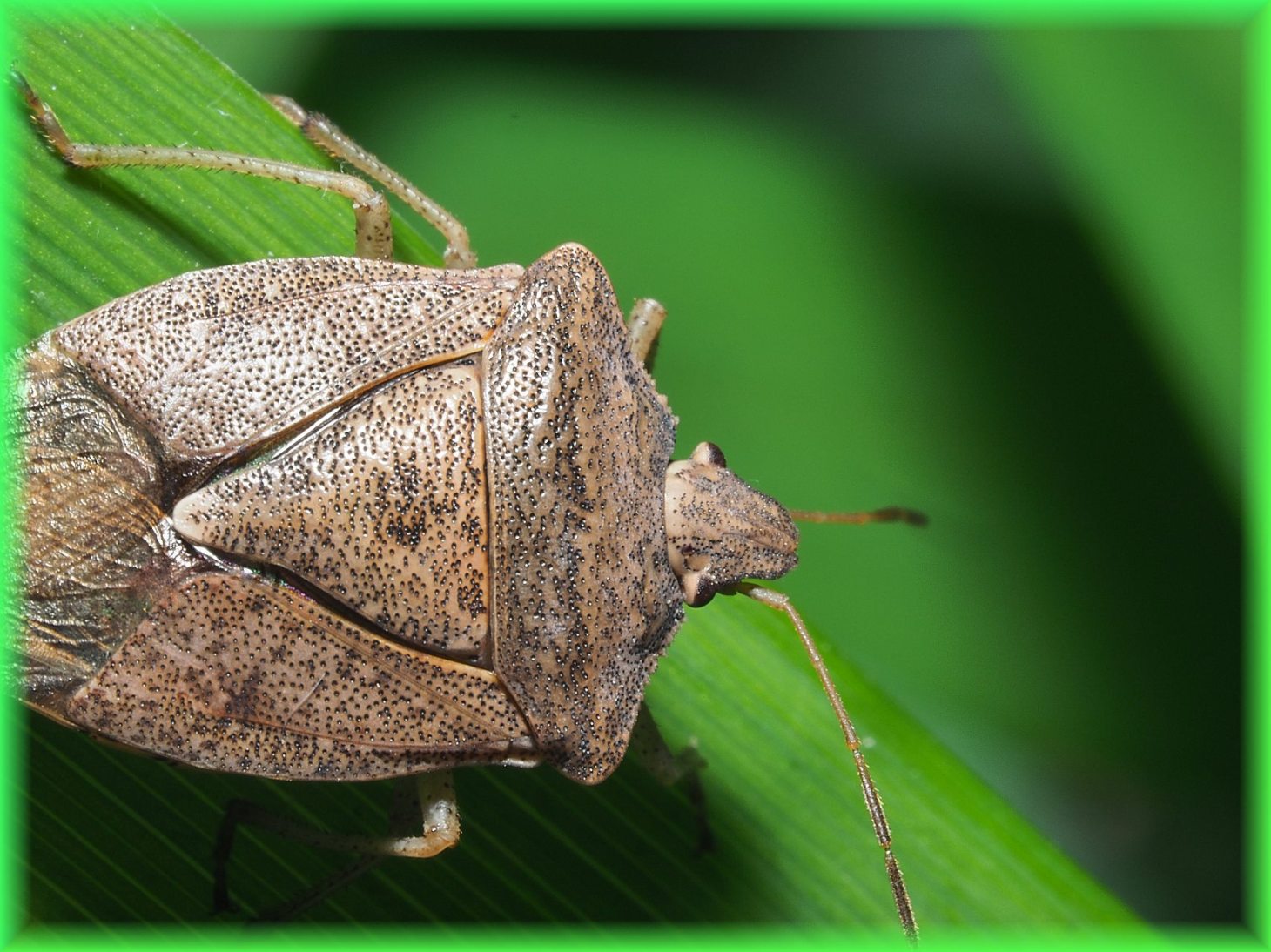


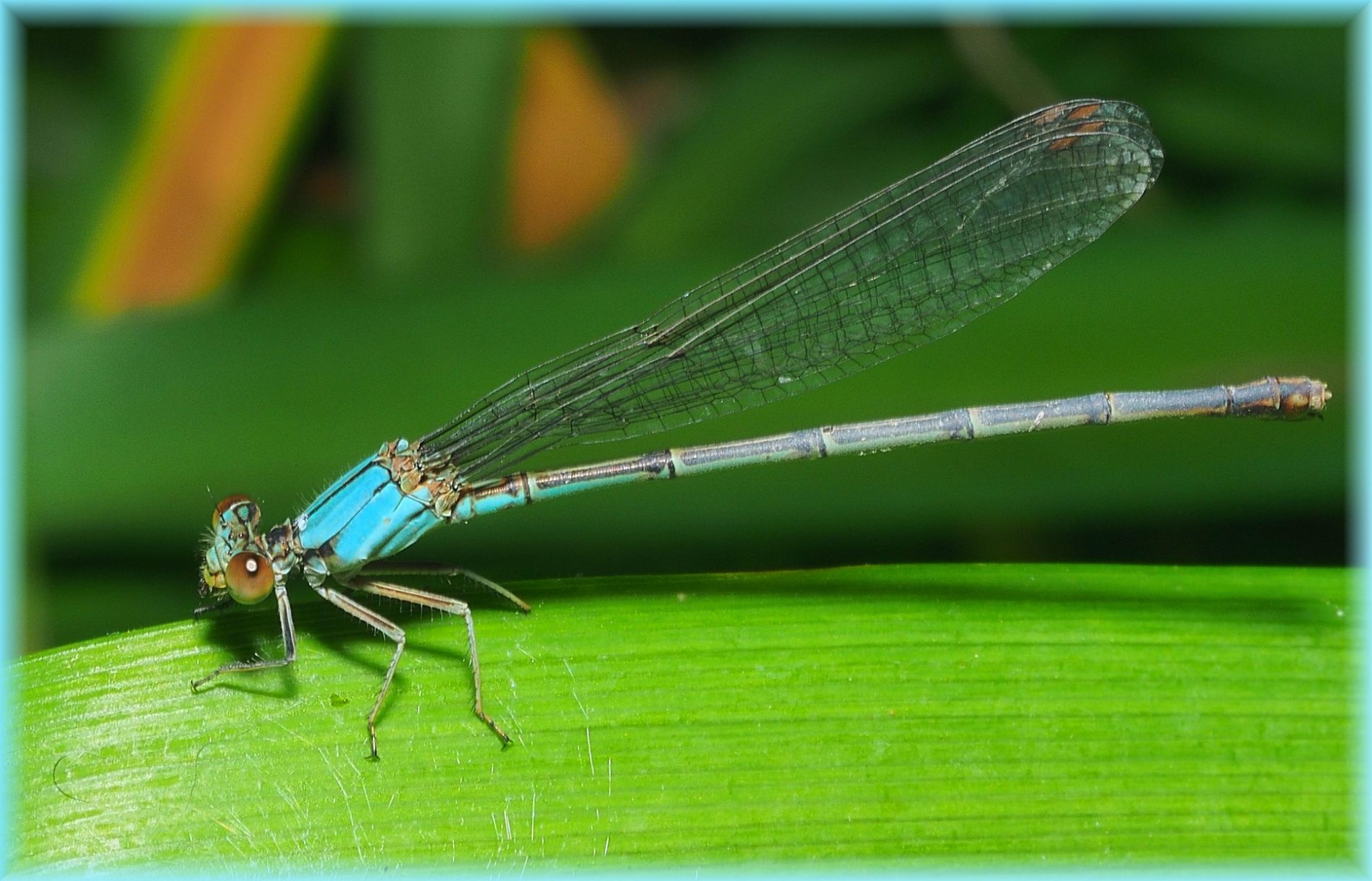











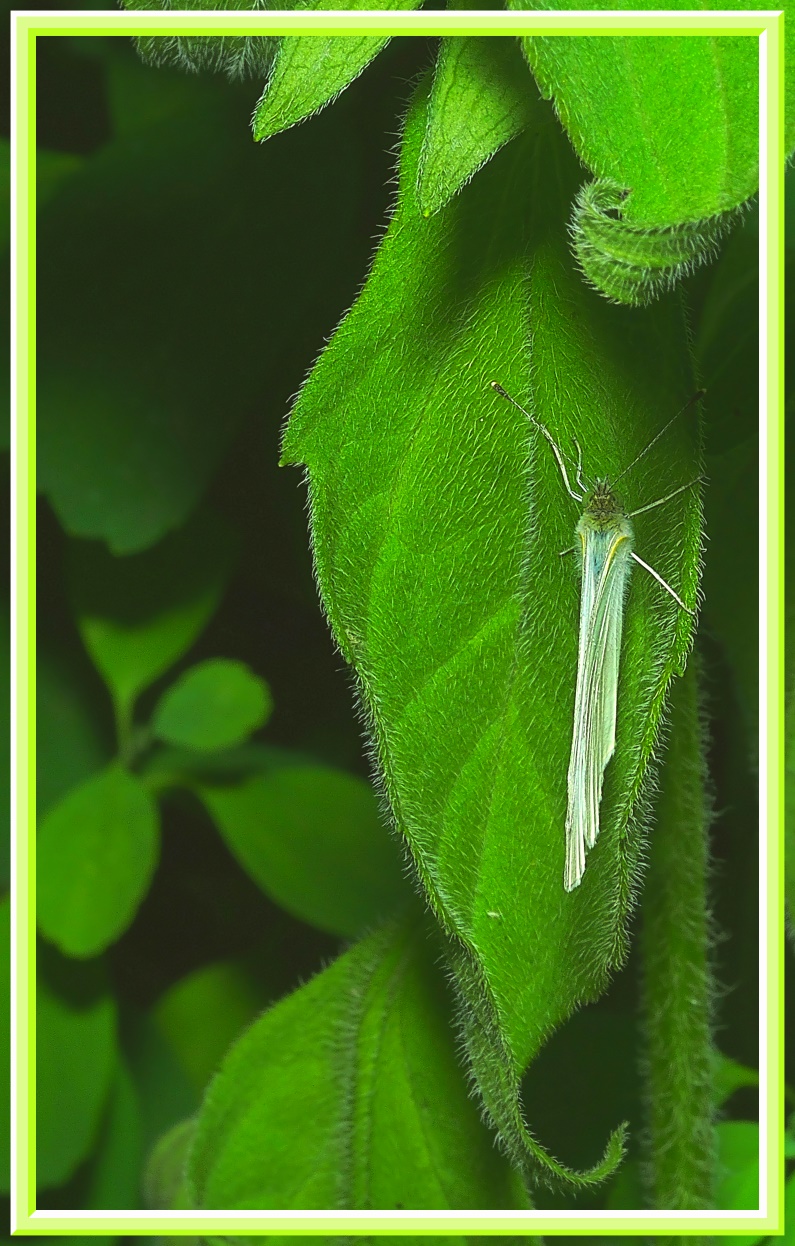
 Tom's Nature-up-close Photography and Mindfulness Blog