In every miraculous eternal blink
beyond the very primitive world of think
the joy of order
and the order of joy abides
In every cadaverous indifferent stare
leaden within pre-worn underwear
the anchor of self
outweighs the swimming of we
In every miraculous eternal blink
beyond the very primitive world of think
the joy of order
and the order of joy abides
In every cadaverous indifferent stare
leaden within pre-worn underwear
the anchor of self
outweighs the swimming of we
It is good to be perceptive, to be observant. Many of us, who take photographs and share them, reveal certain detailed (and often unique) perceptions that we have… (that we are appreciative of). To be perceptive is to be sensitive. Even our cameras have a certain innate, intrinsic sensitivity, wherein they pick up (and convey) many of the intricacies that a scene or area displays. To be a real human being, however, calls for much more sensitivity than what a mechanical camera is capable of. Interestingly, there are many people who go through existence being perceptive in more of a mechanical, mechanistic, camera-like way. They focus upon what others have directed them to focus upon; they capture (and hold) what they were developed to capture and hold. Like digital cameras, they store the data and their depth is artificial; they assimilate and grasp according to the way they were programmed. Their stored data depends exclusively upon imprinted patterns.
A truly insightful and reflective human being, on the other hand, may go far beyond a mere mechanical, superficial existence. The depth of a truly insightful, reflective human being would be amazingly real and beyond mere simulation. Real sensitivity has tremendous depth. That depth and real love/real living may not be different things. That depth shatters the separation between the viewer and the image. That sensitivity helps others in profound ways (that are not merely what can be photographed… although photographing may be part of how that sensitivity shares). That sensitivity penetrates far deeper than what any mechanical device can calculatingly and premeditatively (artificially) capture.
Last night, this movement was observing a science program on television concerning the universe. A lot of top scientists were talking about where the universe was going. They said that there is absolutely no evidence that there exists any eternity in the universe and that it is more than likely that everything will disappear entirely (and that is that). Unfortunately, they don’t understand what certain wise individuals understand; they (to a very large extent) don’t understand their own minds, and they don’t know what most of the cosmos (such as dark energy) consists of. If a mindlenscamera is constructed and programmed by the superficial, what it picks up and captures (to share) will often be rather superficial. Sometimes superficial and two-dimensional is very nice and excellent to visit… but one wouldn’t want to exclusively live there. Superficial snapshots from distortion impress most who are truly discerning and deep (only to a limited extent). As for those scientists, well, unfortunately, they are very good at capturing and conveying what they’ve discovered from limitation.
So, what transforms beyond the limited focus of the camera-i… is real integrity. Real, living integrity comes about only when the mind naturally becomes orderly beyond some dead blueprint or formulated mold. When real integrity comes about, the universe and its deepest magic comes to you; you don’t have to seek it. True integrity, which is wholeness, allows for (that deep order which is the entire universe) to flower within. That brings true bliss and enlightenment. The limited camera-i cannot do it, for what it perceives is little, separate snapshots here and there (according to some limited, manufactured programming). When real wisdom occurs, then the camera-i doesn’t merely try to capture things (with what it focuses on)… because then its instrument is not separate from all the mystery that takes place in the world (and all the mystery that is beyond place).
Beyond what is
possible
one irrefutable mystery
existing
Beyond what was
there
one not so distant
here
Beyond all that
fear
leaping beyond death
living
Beyond profound change
stagnating
one ordinary mind
imitating
[Note: The photo is of a piece of fossil Baltic Amber containing a Pseudoscorpion (with 2 mm body) and a Gnat; the Pseudoscorpion is posed as if attacking the Gnat as prey. This amber is around 50 million years old. Pseudoscorpions (and Gnats) continue to exist worldwide, even in cold climates, like in the United States and Canada. Are “mostpeople” — who tend to live ordinary (so-called) lives, who merely exist accepting (and copying) the commonplace values, routines, and perceptions — stagnating (almost as if they are imbedded in rock-like amber)? You decide.]
To be in rapport with truth, one must (obviously) be parallel to the nature and dimension of truth. Profound (not relative) truth may not at all be something that is merely acquired… like some kind of result (by way of a process), like some type of petty thing that comes about (by way of accumulation or calculated endeavor). The immensity of profound truth is not of the realm of standard and ordinary results. So, in a very real way, this negates a lot of what people do (in terms of ordinary meditation and orthodox religion… all of which provide you with concrete ways to come upon truth).
A very serious, truly intelligent person (unlike the indifferent masses who are caught and lost in rather superficial details) is extremely interested in the profound truth. If that interest is a deep passion to find out without merely depending on others, then that passion may be beyond mere accumulation and calculated endeavor. The others depend on people of “authority” to tell them what to do, how to behave, what and how to think, etc. However, an individual with that rare passion (that does not depend) is truly standing alone. (“Individual” means single and not dependent.) An individual who does not merely depend upon the symbols, images, and patterns that others provide regarding truth… may be truly standing alone.
You know, when I was a follower, going along with the crowd regarding orthodox traditions and all that popular stuff… nothing happened. Nothing truly miraculous occurred whatsoever. It was only after one had gone beyond all the bourgeois orthodoxy, beyond all the popular cults, beyond all the gurus, experts, and specialists, that something very special, immense, enlightening, and extraordinary happened. Of course, people can say, “Well this bloke is merely deluding himself, imagining something or fantasizing about something profound.” There exists palpable proof consisting of reflections (over the years) of the actuality of this; but people need to go in depth and discover it for themselves. People each need to take the initiative and examine deeply for themselves; if they don’t do it (with tremendous passion) there is plenty of the ordinary for them to mundanely continue to experience (and remain as).
Most of us do not realize the depth of the accumulations that we have psychologically absorbed from others (who, themselves, absorbed from previous others). With this stockpile from the antiquated past, we look; and what we perceive is circumscribed by the extreme limitations of symbols, patterns, images, and fragmentary, archaic concepts. (One has stated this time and time again.) To be truly independent calls for going far deeper than merely going beyond outside authority… because the processes and ways of outside authority are in (and constitute) what you actually are. (Our “inside authority” is an extension of — and it is — the outside authority.) Our very concepts of self and of time are composed of crass, primitive patterns stemming from the musty past. (When you look through the lens of the musty past, what you see will be very distorted.) Only in the unconditioned intelligence of standing alone does the deepest magic truly manifest. This standing alone does not merely seek a result; it does not merely attempt to catch truth in its web designed for contrived results to acquire; there may then be (within it) intrinsic beauty that is not merely acquired through calculation.
Existing in fallacy is to remain clinging to learned or absorbed false systems or mistaken beliefs. A truly dynamic, liberated mind is one that likely transcends beyond all (given) beliefs and manmade patterns… being a mind that perceives without contamination that has been absorbed from others. It is easy to exist in a slapdash way, merely allowing others (many of whom want power and control) to tell you how to do things. However, unless one looks with the purity of non-contamination, then what one perceives and believes in may merely be extensions of what others (with motivations involving power and suppression) have planted. When one supposedly has a belief, it is very likely that one is that belief… not merely something separate (from some kind of manufactured distance) “having” it.
The beauty of real innocence and pure perception (which is what is truly unsullied) is that they — together as one — are beyond secondhand values. Real innocence transcends self-importance, pompous display, and it goes beyond mere accumulation. In mere accumulation — including the gathering of images and beliefs — there is a “getting more and more,” which inflates the self (via increments of images, internal components, and others’ patterns). With uncontaminated, innocent perception, there is a seeing beyond the self and the accumulations that fill (and make) the self. It may be that profound relationship goes beyond any mental accumulations that constitute the self. Real relationship and true selflessness may not be two different things.
Though the body ages, creaks with pain, deteriorates,
slowly withers like a flower…
one can have a youthful, budding, blossoming smile
on one’s face
Energy, action, movement
which make up the body
is, as Einstein suggested, eternal;
but eternity runs deeper than that
It permeates much deeper than the superficial
will ever realize;
and as they (unfortunately) continue to deteriorate
both mentally and physically
something (warmly) eternally eludes dullness, indifference, and
deadcold callousness
It is great to go out and enjoy nature, being very appreciative of all that nature offers. There is tremendous beauty and order in nature. Even the more brutal, violent things that occur in (and “as”) nature are part of a larger, overall order that is truly immense. Those who are not at all interested in nature, who are not interested in the outdoors and in the many diverse plants and animals, are not to be envied; they are missing something in their lives; really, a life without “life” may not be much of a life at all.
When one experiences nature, how does one experience it? If one merely experiences it as an outside “observer,” then there is a very good chance that one is looking with distance and separation. However, if one looks passionately, deeply, without the contamination from the way that one was supposedly “educated,” then there may be real perception, real contact and relationship with (and “as”) what nature is. Then you and nature are not merely two separate things. Nature is alive; but if you look at it through a bunch of dead (learned and absorbed) images, are you really perceiving the immensity of nature? It is easy to look via distance and separation, and with learned, dead concepts and say, “Oh yes, indeed, I am one with nature, one with the whole!” However, that may be rather meaningless unless one profoundly goes beyond what was instilled in (and “as”) one throughout the past. With (and “as”) the past is how most of us view nature. We look with preconceived symbols, stiff images, learned distance and separation, labels, and lifeless concepts absorbed in the past… and so we are not really looking much at all; instead, our perceiving is contaminated. Our very concept of self — that thinks it is doing the looking — is (in itself) a learned, separate, rather defunct thought/set of thoughts.
Interestingly, through intense awareness and keen insight, if one gets to that point (which really isn’t a “point” at all, by the way), then one is beyond where boredom, depression, and indifference can take a hold. Without being dependent upon dead, internal images and symbols, one is where real life, fortunately enough, truly blossoms, just as it does in profound nature. Then one doesn’t need to take mind-altering drugs or cling to artificial, unnatural, man-made things, leaders, and systems. (Many, unfortunately, are like walking graveyards, and they don’t even realize it.) Then — unlike most, who were taught to cling to (and supposedly live as) dead symbols, musty conceptual images, and stagnant, repetitive patterns — one is where real living flowers. Then one doesn’t even need to constantly experience nature (or constantly experience anything, for that matter)… because there exists a flowing vitality, immensity, and intensity that is beyond (at times) the need for images, experiences, and “absorbing more and more, and still more.”
it was hiding in plain sight
the unconditionedwhole
but she never really saw it
like she did the littlegreen bowl
it was always to be seen
beyond cadaverous illusion or disjointed dream
but separative frag ments can not be it
like a drop ped b owl that was gre en
it’s popular to show off your wares
to all you know, to many friends of natty seg ments
but real joy is not to splinters shown
nor can be vis u ally ad mired by bro ken frag ments
So many of us live in — and “as” — fear without ever fully realizing it. Most of us remain in the structures and patterns of what we were taught… and comfortably remain there; we are either afraid or indifferent about going beyond. The older we get, the more set in our ways we get. So many of us — as we age — lose our mental pliability and flexibility; we become rigid, rather robotic followers of old, worn-out traditions that supposedly exist to save us and protect us. (Unfortunately, many of these traditions keep us in our place and fill certain individuals with power, money, and prestige.)
When fear exists, are you something separate from what that fear is? Most of us were taught that we are separate from our fears, desires, and systems of thinking. A truly wise human being can realize that fear (and what he or she is)… are not two separate things. (Of course, one is not merely just “fear.”) We run from our fears without truly facing them, without really being in an orderly relationship with them. A man might say, “I am dealing with my fears.” Therein, a learned image, involving self, is a separative part of a conditioned system that includes conditioned fear. However, one part of a conditioned system cannot “get rid of” (or “adequately resolve”) another part of a conditioned system. There might be alteration, subjugation, and the appearance that it did (get rid of something), but two wrongs don’t make a right, not in the long run. Ultimately, there is still disorder in (and “as”) what uses disorderly (i.e., false) means as a way to resolve psychological issues.
Real, pristine awareness, without needless friction, can shed a light on things and renew the mind (helping it to exist as order). However, if one is burdened with needless friction, conditioning, and false separation (and overburdened with symbols) — such as a concept of “me” or “myself” being something separate from the fear — then conditioned, learned images interfere with that spontaneous, pure awareness that is not merely a part of some (man-made) or primitive process of reaction. So, the enlightened being perceives without all that accumulated rigamarole that takes time. Transcending false values and conditioned reactions need not take time; but using erroneous, internal, false procedures depends upon time. For instance, with a wise being, there is often an intense awareness wherein conditioned, manmade (internal) symbols instantly (without taking time) dissipate (without some separate, internal entity trying to end them). (Any images “trying to end them” are merely part of the whole of the conditioned structure. One part of this conditioned structure thinking it is separate from another part — trying to control it — furthers erroneous division and extends conditioning.) So, with an entity who is truly wise, there exists a timeless “dying” or “ending” of the conditioned. No separate image of self or absorbed method is doing this; (otherwise it is merely just a part of the conditioning). Most people (in their acceptance of tradition and as part of their conditioning) put “dying” far away from daily life. However, a truly perspicacious individual is daily dying (with a huger than huge smile)… psychologically dying to (and “as”) false, dead symbols, methodologies, and rudimentary reactions. Such timeless dying (beyond any archaic, dead methodology of the stagnant past) is what is truly living (in the deepest, true sense). Observation without a pattern, without a method, without learned separation and symbols… is effortless and does not involve a technique to robotically practice over time. The masses, with their conditioned, fossilized methodologies and antiquated systems: that may be where the nasty (most real) kind of death is. That (unfortunately) is the fossilized matrix where most of them are buried, while thinking they are alive. Unfortunately, for the most part, pointing out about leaving it, to them, is like explaining the value of gold to frogs.
So, in this, living and dying are one. (The previous statement has a double meaning.) However, for the masses, they are something separate… as are so many things (for them), including their limited concepts of self.
There was this me
and every time this me looked
it saw what me was looking at
(This me was very orthodox…
being brought up by orthodoxy,
being cultivated by — and “as”– orthodoxy)
This me thought it was something separate
from the perceptions that it was taught it “had”
There was this movement without a center
and, when looking was taking place,
perceiving was what was…
without some separate center
doing the perceiving
(This nonme was not very orthodox…
having psychologically died t0 — and “as”– orthodoxy)
There was this primitive conditioning
and every time this cadaverous conditioning looked
it saw what it was programmed to primitively see
There was this freedom from the known
and often — beyond indoctrination —
it moved livingly/compassionately/sagaciously
without a static blueprint
without some canned and pickled doctrine
that — in rigidity — it would blindly cling to
(This posting is dedicated to the late Professor David Bohm, Theoretical Physicist, who specialized in Quantum Mechanics. I used to have some very good one-on-one conversations with David.)
In quantum mechanics, when a separate observer looks at (or tries to measure) subatomic phenomena, the (endless) waveform collapses and there is an object that, for instance, exists in a distinct place, duration, or time. (The waveform can exist at many places at once and has qualities of infinity.) We are perpetually measuring things, even when we are not fully conscious of doing so. Labeling things, identifying things, naming things, existing from one word-oriented symbol to the next… are all (in their own way) forms of measuring, categorizing, and assessing. We were taught that the observer is doing the measuring, doing the categorizing, and doing the assessing. However, is the observer truly separate from what the measuring, categorization, and assessment are constituted of? Without measurement and assessment, without the usage of symbolism, the (separate) observer does not exist. (Selfishness, by the way, requires the measurement that forges and invents a separate observer; therein, limitation is involved.)
Measuring (and all that type of process) is necessary at times. Measuring, calculating, labeling, assessment (and all that) was drilled into us throughout our education. However, they never taught us, or seriously suggested, that there are times when we can go beyond these things. They had us live in thought, exist in thought, and worship thought. They never suggested that we need not put all of our eggs in that one basket… the basket of thought (as measurement, categorizing, and assessing). They never suggested that thought and thinking is a tool… (and need not be the essence of the organism). You know, when you make tools all important, and forget about the living thing, you become rather robotic and mechanized… rather unalive. Our “self concepts,” too, are all (basically) learned symbols. Symbols are not the actuality; a description of an insect isn’t the insect. But so many of us exist from one symbol to another; even when we look at things, we tend to see through (and “as”) a screen of learned symbols.
We can exist beyond symbolism, measurement, and tool utilization… though symbolism, measurement, and tool utilization is often very necessary and prudent. This is not some fanciful living the the here and now. (Psychologically clinging to the here and now is rather like the collapse of the waveform; often involved in it are learned measurement, categorization, and assessment.) Most minds will not be appreciative of this. Most minds were indoctrinated by measurement (“with” and “as” measurement). This is unfortunate, because the measureless has a quality of true infinity to it. Limited — rather virtual — symbols (involving “self” or “not self”) can never capture or grasp that nonsymbolic, real, illimitable quality.
Deity did not create this universe
and is not responsible for
what takes place within
(and “as”) it.
Simple organisms
and rather more complex organisms
are in the same boat together.
Deity may not be of a prejudice
that favors one over the other.
One, not sophisticated enough
to pray, is not favored over
one with propensities to pray.
One that is beautiful
is not favored over one
that is ordinary or rather ugly.
But complex organisms
(themselves)
can
(with real action and affection)
directly help simple organisms
and complex organisms too…
and both the beautiful
and the not so beautiful.
It’s easy to “fit in”… to merely accept what the crowd (i.e., what the masses) say is the truth. It’s easy to comfortably “fit in” and lazily go along with what special groups say. That is where many find security and that is where they are all too willing to absorb what others maintain. Nazi Germany — and the way its people would blindly follow — was an example of this. But to intelligently question everything, to stand alone, to deviate (psychologically and profoundly) from the norm is not easy; it is very arduous and it is where one puts security aside. Many will not at all care for this; they will maintain that their special group has the answers; however, this (true independence and standing alone) may be the only way to come upon actual truth; otherwise one is stuck with old, secondhand, stagnant, and primitive values and traditions (which hamper real, legitimate discovery). Most are too conditioned, too rigidly formulated from the mold that society utilized to fabricate their structure; they will — one way or another — dismiss any real invitation to independently probe deeply.
Most will not ever realize that the very way we observe things is heavily conditioned. It is ironic that some, in the past — like the historic Christ (as can be seen in The Gospel of Thomas, Q, and the pre-narrative Mark) — transcended beyond normality and invited others to look within and find out for themselves… and that, after they died, others (over time) intentionally distorted and twisted their message in order to maintain power, authority, position, money, security, and control.
No one but you can discover the uncontaminated truth. However, if that “you” is a product of what was learned… then it will likely only find by way of limitation, contamination, and “secondhandedness.” (One’s very concept of self, for most, is a learned image/symbol, or a set of learned symbols.) When distortion looks… what it perceives is of distortion. The masses and the patterns of their world are full of distortion. Very few independently and sagaciously go beyond that, but (to be truly wise and not deceived) going beyond is absolutely necessary.
.
As she brushed
her long, flowing, blond hair,
she continued to admire her radiant beauty
in the large mirror.
However, she didn’t
reflect enough
around that superficial mirror.
She never realized that
the beauty that she was
a part of extended as
the trees, the butterflies,
the bees, the rocks,
and the fish.
Her mind was apart from the whole
which, when it’s all said and (never) done,
may be apart from
the real beauty.
.
.
Being truly mindful or of a deeply meditative mind, is not something that one can know that one is experiencing or part of. The beauty of the unknown is that it cannot merely be held or captured by the known. It is a state of true humility where the one who may be involved with it is not certain that it is being done. There’s no certitude in full mindfulness and profound meditation, because the unknown cannot be captivated (and owned) by the known. So many of us are indoctrinated by mere symbolic knowledge… by the known; it is what was poured into us — formulating us — throughout our youth. Even our individual concepts of self are essentially learned symbols and images. Concentration is all well and good, at times, but it has little to do with this; this goes far beyond mere concentration. Concentration involves focusing on various images and mental patterns (symbolic patterns). Concentration is often necessary, but a mind that merely concentrates is stuck in a very limited segment of what the mind is capable of. We’ve been concentrating for eons, and look where it has gotten us. We may have better machines and more comfortable lives, but we are lost in symbols, competition, separative ideologies, with power-hungry leaders and mechanical systems manipulating our lives.
It takes great courage and intelligence to step out of that field (that so many of us are immersed in). To leave the field of the known (i.e., the field of absorbed symbols and learned mental formulations) is, indeed, a kind of psychological dying. However, it is where the true innocence and true beauty of a different kind of intelligence exists. Not doing it is truly a morbid kind of decay. Most of us want to be certain. We remain (perpetually) in the field of learned images and symbols; we are frightened to go beyond that. Interestingly, remaining (perpetually) in that field continues with what remains secondhand, stale, and unoriginal.
.
.
Things in the universe, though they may seem to be separate and very different, may all be reflections of a larger whole. However, most of us were educated to perceive via fragmentation. Even most of the top scientists of the world currently tend to dissect things and look more at the parts… not so much at the whole. The mind can intelligently perceive without merely seeing via standard patterns and images (that were instilled within it, formulating its constitution). For many of us, even self-images consist of fragmentary concepts and images that were accumulated from learned paradigms. Even when we look inwardly, we see fragmentarily… we see learned symbols/images. Undoubtedly, there would be less wars and less indifference towards nature if more of us would go beyond the norm and perceive more holistically. The right arm will not robotically wage war against (and try to vanquish) the left arm if it clearly sees the reality of the whole.
True independence is going beyond conditioning; it is going beyond the dependence upon old patterns and systems that were implanted by others (who absorbed and became them themselves). If one remains in circumscribed patterns, one can’t go far; and, interestingly, such a “farness” is beyond distance and separation.
.
.
When I was very young, (before I became a vegetarian) I was an avid fisherman. I loved fishing tremendously; being out there, with nature, was a large part of it (and was very special). There was a manmade lake that I would often fish at that was fairly new; adjacent to it, and connected to it by a narrow channel, was a huge, shallow swamp area (that was nearly as big as the lake itself). Most people who fished at the lake didn’t know about the swamp area; it was a superb area that contained many fish, many of which would go there to spawn and lay eggs. All kinds of other wildlife were there. There was a large factory not far from the swamp, however, and each year the swamp would get more and more slime and oily residue floating at the surface, much of which was undoubtedly due to pollution from the factory and from the industrial environment. Each year would be exponentially worse than the next. There would be less and less fish each year and more and more noxious algae and scummy debris. Back then, as a kid, I felt that what was going on in the swamp was a precursor to what would be going on for our entire planet; I deeply felt that often.
Now scientists are saying that we don’t have much time left (before it’s too late) to “get it right” with changing things for the better with regard to the environment. The permafrost of the globe is melting rapidly, and they say it will get exponentially worse each year, which will affect our environment in drastic ways. Our weather is getting more and more erratic and violent and the coral reefs are rapidly dwindling. Please try to do something more green; please try to use fossil fuel planes and automobiles less frequently and please recycle and look into using alternative energy forms that don’t leave as big of a carbon footprint. Our human population, additionally, needs to be regulated more and intelligently diminished; an aquarium with too many fish within it cannot adequately recycle the waste and remain balanced. Each one of us is highly responsible and must do our part.
(This won’t fit under a rug; it’s our planet.)
.
.
Most of us, in existence — because of the way we were educated (or miseducated) — are immersed almost exclusively in the conceptual, rather than in what is of real energy and substance. Our concepts (and our perceptions that are based on concepts) are almost always about virtual patterns and images; they are seldom (or never) of the essence of actual energy. Our modes of consciousness are almost always based around “patterns” within energy; we are seldom (or never) pure and unadulterated energy. Certain people and groups maintain that you should strive to exist in the “here and now” to better come into contact with that pristine energy (or the essence or source behind all things). (They’ll give you all kinds of techniques or methods for getting to the “here and now,” which is so ludicrous, as if a technique from the past can fabricate the present.) Really, for many, the “here and now” is often the result of more concepts, more propositions and proposals put forward by others to absorb and react to. Then such a “here” or such a “now” becomes a learned frame of mind or mindset (that seems to be divorced from the past), but that really is an extension from (and of) the past. Perhaps the conditioned recognition of the “now” (as being separate from the past and the future) requires reactions (from the past) that negate the actuality of really being in (a now that is not merely part of the past). So there is a strong possibility that the moment you recognize that you are in “the here and now”… you really aren’t in (or of) it.
Most of us are endlessly talkative (to ourselves), endlessly chattering (or visualizing mental images) throughout the day (and night, as we sleep). We thrive on these endlessly chattering patterns… we are these endlessly chattering patterns. We are used to being the past, endlessly restructuring itself from (and “as”) patterns that were learned and absorbed. If the mind (naturally, without method or effort) is quiet (at times) throughout the day, (extremely aware and alert, but without endlessly chattering to itself internally), then at night it can really rest and sleep (without any continuing and habitual, conditioned chattering). Then, when it sleeps, dreams (and the many absurd patterns that they entail) need not take place; then the mind can really rest and gather energy, without friction, without fears, inner struggles, needless conflict, and all that clutter. Then, when such a mind wakes, it is naturally (without any effort whatsoever) quiet. In that quietness, there is no conflict, struggle, friction, control, or domination. Then there’s no recognition of a “now” separate from the past or the future; but there is an intensity (an intelligent awareness) without dependence upon anything — not even dependence upon recognition and knowledge (which so many are frightened to leave) — (and this includes being beyond the patterns that were poured into it when it was younger). Then, when it looks, it doesn’t merely robotically perceive what was taught. Such a mind is truly alive and doesn’t exclusively perceive through (and “as”) the screen of the learned/programmed past.
.
.
If one cares to understand the entirety (i.e., the completeness) of the universe as a whole, then one must essentially be complete in oneself. One can’t be complete in oneself if one merely perceives fragmentarily, with conflict, separation, and with mere conceptual images that were learned. So many try to spread their conceptual images of what they themselves absorbed (in terms of what they believe wisdom and truth to be). However, truth is never secondhand, and it is never what one merely rearranged or calculated from what one absorbed from others. Too many (online and in books) try to point the way to truth, when — throughout their entire life — enlightenment never occurred. Many merely share what they were brainwashed with (or “as”), which isn’t (usually) real substantial sharing at all. When the blind lead the blind, both eventually end up in the ditch. Writing about facts and about certain basic things like “love for others” or about “love of life and all of life’s creatures” is good (from others) and admirable; however, when they go beyond that and spill into delicate philosophical areas, without having gone beyond secondhand concepts or realizations, that is something else.
Profound truth is never secondhand, nor a free ride; you have to do the work. Don’t adhere to what anyone says about what the truth is; discard all leaders, gurus, sages, religious cults, and all those popular lemming groups. Find out for yourself. If you don’t find out for yourself, then what is discovered will (more than likely) largely be conceptual or rehashed… which is no substantial discovery whatsoever.
.
.
It’s taking off time
4 the bee.
4 U 2 soar, beyond being and unbeing,
there must be taking off time
4 U.
U can’t be there
if U are not taking off time.
A mere sequence of accumulating
patterns and experiences in time
isn’t soaring;
it’s unsoaring-merelybeing.
Every now and then
(beyond the mere groping after sequential patterns or the mere running away from patterns)
take off some time
(beyond conflict) and soar.
.
.
Many minds depend upon experiences in order to exist… without fully realizing that they are those experiences. Reacting to (and “as”) experiences involves conditioned responses following each other, in sequence. Without such experiences most minds would be lost, for their very composition desperately depends upon such experiences. Even ancient organisms, such as the mighty Tyrannosaurus rex, had brains that exclusively depended upon experiences. However, a few very intelligent minds — very few — though being highly appreciative of many experiences, have realized that they need not just exclusively depend upon experience. Such minds, though they often use and appreciate experience, go beyond it at times. Such minds are a light to themselves, and they do not exclusively depend upon things… not even upon experience. To be beyond dependence is to be truly free; the other way is primitive, limited, partial, and without majestic vastness.
.
.
Experience is good oftentimes, especially when it is occurs with sensitivity and learning. However, too many fall into experiences, exclusively, just like moths into the flame. A mind that does not habitually, robotically blast into experience… goes beyond it at times. It might seem odd or strange that one suggests that going beyond the realm of experience is beneficial and healthy… (but it is). Many of us seek new and “more exciting” experiences. In doing this, one thinks that one will achieve happiness. However, once something is experienced, its supposed “newness” tends to quickly evaporate and when we experience similar things, they tend to lose their quality of being beyond the same old patterns; so we seek new and different patterns, different experiences. However, different patterns are still mere patterns. A mind that clings to various series and strings of patterns (to be stimulated) becomes dependent upon such patterns. A brain dependent upon mere patterns, for its happiness, is a mind that is not at all independent and free; it is enslaved with dependency upon the patterns (as so many people, unfortunately, are). Then boredom, frustration, and depression often easily slip in; for a mind that is based merely upon patterns (an their recognition) easily gets fixated in robotic cause and effect reactions (based largely on what the patterns may or may not provide). Inevitably, they never provide enough. The experience and the experiencer are not two separate things.
A mind beyond mere experience — and there are few such minds — is really independent and free. It goes beyond mere patterns and the recognizing of patterns. It doesn’t do so out of volition and will; it just happens; intelligence is a factor. When it happens, the mind is still (though highly active and aware); however, it is not merely absorbing or rearranging patterns. Being beyond sequential reactions and patterns of recognition, it is an explosion of the new and immeasurable. Joy and insight, beyond dependency upon experiences, exists then.
.
.
If you duck the issues and don’t pay full attention in life… then when thoughts and feelings occur in (and “as”) you, you will not attend to them completely and fully. To attend to thoughts and feelings completely (as they occur) there is intense observation without separation, without the indifference of distance. In looking fully and attentively, which is deep learning, there need not be mere judgment, condemnation, or control according a learned authority at some (supposed) distance (be it external or internal).
.
[Note: Paleontologists have been saying that birds are a branch of dinosaurs that survived the great extinction event. A close-up of this duck shows what eerily looks like dinosaur raptor teeth. The tooth-like structures are really lamellae… sieve-like projections that help to extract edible items, such as seeds or insects, away from mud or sand. They also may be beneficial for defense. Duckasaurus rex!]
.
In an oscillating universe, if an entity does not get it together and transcend mediocrity psychologically, then the consequences remain infinitesimally dull, like a seed that never germinates. If one flowers and grows, the winds of enlightenment may be truly endless.
.
.
Interesting, isn’t it, about how perfectly the universe works with orderly sequences creating the higher elements via nuclear fusion, with supernovas (creating rare elements) and the like, all with immense order and precision? Yet isn’t it curious how we humans — many of us — live in tremendous disorder, with wars, violence, deceit, damage to the environment, manipulation via power, and all kinds of disorder that is willing to let others be harmed? So amongst all of the order, there is the continuing disorder of man; and that needs to change.
.
.
One of the fundamental problems — which was observed even when one was rather young (in college days) — was that people who were trying to transcend beyond the self (in order to meditate or merge with the whole) were still clinging (in various ways) to the notion of a central “I” or central “ego.” Innumerable people would each say things like: “This is my form of meditation which I practice daily.” Or: “I am observing my behavior throughout the entire day.” Or: “I watch thoughts as they take place and vanish from consciousness.”
Separating the “I”, psychologically, from the rest of thought/thinking and maintaining that it has control is a waste of time and energy, and it contributes to friction and separation within (and “as”) the mind. A dog perpetually trying to catch its own tail wastes energy (though in such a case it may at least be getting some needed exercise). As was stated before (in previous posts)… one can function quite easily without the ego (which is, in itself, inherently false anyway). Thoughts are tools used by organisms in order to achieve certain ends. Maintaining that there is a central agency that is “separate from and controls these thoughts” may not be at all accurate. (See my previous posts about the corpus callosum.) Thoughts are conditioned responses; the manifestation of the “I” or “me” is another conditioned response, another thought or projected symbol. Ego projections overly utilizing the “I” or the “me” are manifestations of brains that have some transformation or evolving to do. The ego, being a falsity, tends to create an erroneous psychological radius and circumference around itself… (which tends to involve separation, learned space, and indifference). Nullification of the “I” or the ego does not destroy boundless intelligence nor the eternity and timelessness of dynamic wisdom.
Though one can still use the term “I” in conversations with people, one may not — if one is fully aware — use it as a reference to a central point. When not talking or communicating with others, this movement — while thinking internally — often uses “we” instead of “I.” Or one can use the term: “this movement” (instead of “I”). Of course, the “I” can represent all of one’s thoughts; but one is actually far more than conditioned mental reactions… and far more than some temporary, biological mass. This isn’t some kind of mental game. If we were educated wrongly and cling to primitive falsities, we will remain in what is a circumscribed circumference that perpetuates limitation and disorder.
.
.
Top scientists have stated that it is likely that our universe functions in ways that are totally different than what we expect or think. One couldn’t agree more. So, one has to discard what one has been taught, and look and perceive freshly, without all that was poured into one to mold and shape the way that one perceives. If one merely sees with the patterns that were implanted into one, then there is likely mostly jaded perception (that is looking through a fabricated psychological screen). Only a dynamic mind can go beyond what was rigidly poured into it. If we don’t see beyond the limitation that has been provided, then we will remain circumscribed by those who were also defined and shaped by others who, in the old past, delineated and fabricated them. If we remain in the limited, we will never discover the new, the timeless, and the truth.
.
.
One must purge what all the pundits, leaders, and experts have taught. Most of them are full of themselves. We (despite thinking otherwise) live in very primitive times psychologically… and if one doesn’t figure things out for oneself, one will remain within (and “as”) the quagmire of the false and crass. If one’s very mode and manner of thinking (and, hence, perceiving) was constructed by them, then there must be a fundamental transformation of the mind if one is to see without past corruption and without merely looking with old patterns and standard modes. To observe without distortion, one must look without a blueprint, methodology, system, or absorbed structure; that can only take place via pristine observation that is unsullied by past dictates or precepts. Most are unwilling or unable to do this. They are too mesmerized by what was poured into them, unfortunately. When they try to guide others, psychologically and spiritually, they are often (even unknowingly) merely projecting what they were taught, (which is essentially second-hand). Direct observation, without all the garbage and distortion, is possible; deep insight and profound understanding depend upon it.
.
[Note: If you are using the “Reader”/ “Blogs I Follow” method, note that they have recently revised it. Personally, I am not too fond of the revision (photograph-wise). If you wish to see my photos much better than what happens after “one” or “no” clicks… please click on the “three dots” at the upper righthand corner of the initial presentation, then click on “Visit Site.” Then you will see the photos the way that they were meant to be seen. (WordPress needs to explain the revision better to everyone.) Of course, my site is primarily about philosophy, mindfulness, and true self-awareness… not merely about pictures/images. The photos are an accompanying addition (about splendid nature), but are not the primary thing that I really want to share.]
.
Effortlessness is essential in regard to being a mind that is open to real wisdom and harmony in (and “as”) the universe. Effortlessness occurs when the mind is not merely regulating and performing things from what seems to be a center (i.e., central point) and as mere fragmentary reactions. Effortlessness exists beyond measuring and copying (i.e., imitating what was learned). The moment one knows or thinks that one is in a state of effortlessness, effortlessness is likely negated. In effortlessness there is no imagery of an observer separate from the observed; and in deep effortlessness, the observed undergoes a transformation into what exists beyond mere categorization and rote recognition. A wise individual in effortlessness is not merely lazy; on the contrary, true effortlessness is tremendous, majestic/intelligent action; one can do many things while effortlessness is taking place, wherein the acting and the actor are not two separate things. One can be diligently watering and caring for some garden plants, for example, and be in a state of effortlessness. There can also be effortlessness while sitting or sleeping.
Involved in all this is an effortless psychological dying from moment to moment. Deep psychological creativity manifests as a measureless, unbridled dying from moment to moment. Only a mind engaging in such psychological dying can be renewed from moment to moment, without merely carrying the burden of the past. A mind that is not of such dying is likely stuck in the past, (which is stale, rehashed, and what is truly fundamentally dead). A mind that clings to being a separate observer, that clings to merely being “known and accumulated patterns that react” (and project themselves from a supposed center that was learned), is not likely to be the joy of the measureless and the freedom of profound depth. A mind of effortlessness, unlike innumerable other minds, does not often waste energy (with internal friction involving conflict, fields of separation, and mere fragmentary struggles).
Only a mind of effortlessness is what is immersed in profound grace. Minds not of such grace are involved with friction, conflict, rigid images, separation, and psychological energy wastage. A mind full of feelings of domination from a (supposed) central point is composed of patterns of subjugation and tyrannizing influences that eclipse pristine perception and waste time and energy.
.
.
We are the mountains
We are the golden sun
We are the butterflies
We are the stirring spoon
We are the bird’s song
We are the turning key
We are the churning thoughts
We are the thunderstorms
We are the wars of lies
We are the poetry lines
We are the rocking chairs
We are the light through the forest down the lane
.
.
Protecting mysocalledself
from all that’s ever bad
perhaps with wisdom’s razor-sharp points
that innumerable many never had
In a world full of violence, destruction,
dull ignorance and some joy
a coating of fine needles
is unblunted intelligence to employ
.
.
Two_________female
antswish
____ing
to
share________________ the same
flower for
ever
Whoever says that they should not
is out of the blossoming
.
[Added note: My sister-in-law is married to another woman; both she and her spouse are very sweet, caring, and kind; they are far better parents than mine ever were.]
.
My heart goes out to those in Charleston, South Carolina who lost their lives or loved ones. The Confederate flag needs to go. To many, it (justifiably) represents repression and hatred. Personally, one doesn’t care to wave flags of any type. If you are a global citizen (i.e., a true citizen of the world), then separative flags have very little meaning. Flags tend to reinforce the feeling of separation and indifference regarding “those at a distance.” Many think that their country or area is superior to “that” country or “other” place… or is superior to “those other people.” During war, so many feel that “God” is on their side… as if God takes sides in violent, separative confrontations! A truly perceptive mind realizes a profound truth that places it in a common bond (united) with all living creatures. Separative flags (of any kind), which promote boundaries and divisiveness (and they pretty much all do), have little significance to a mind that is truly in such a bond beyond demarcations.
https://secure.avaaz.org/en/the_confederate_flag_needs_to_go_loc/?bqntMib&v=60732
.
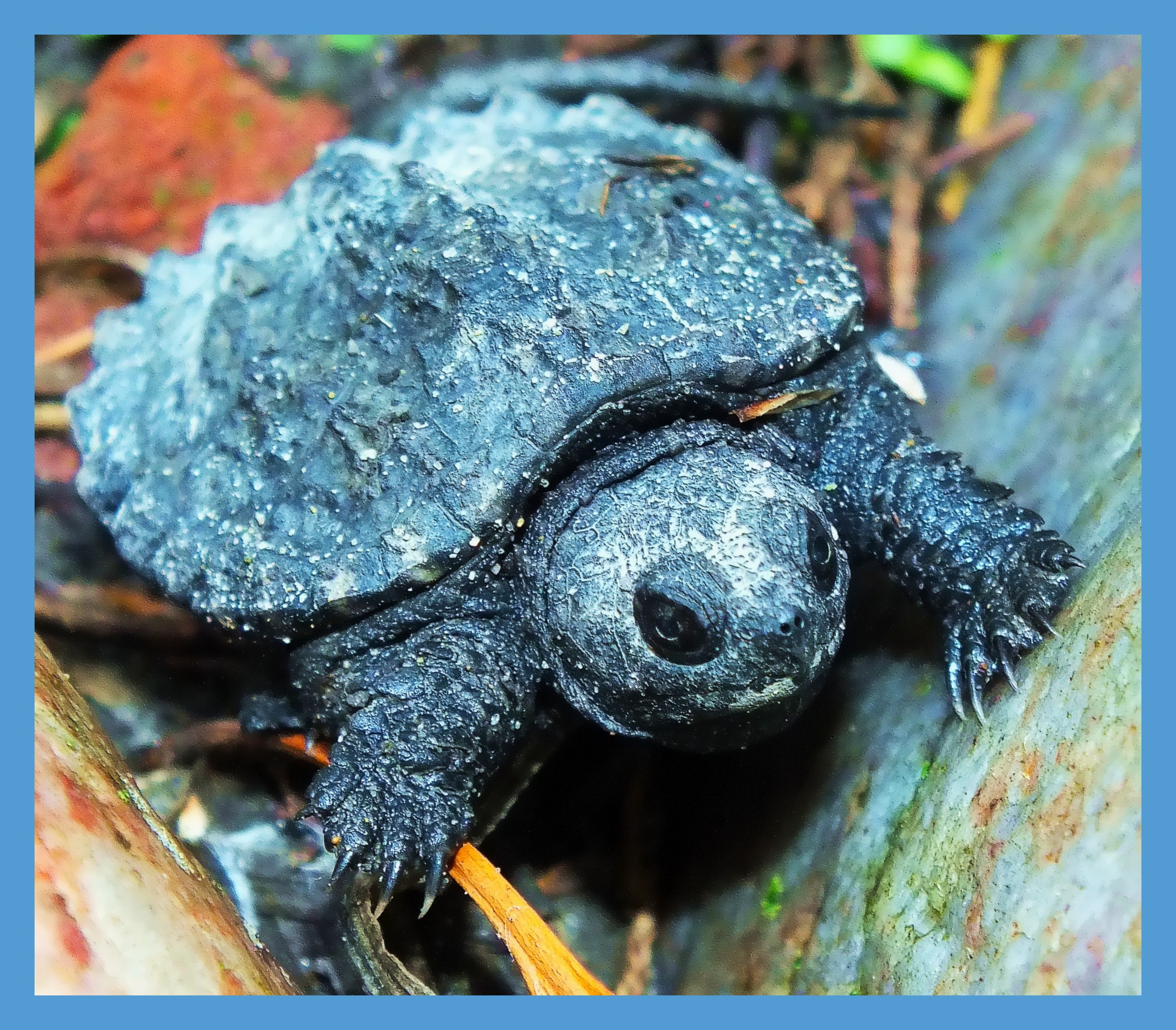
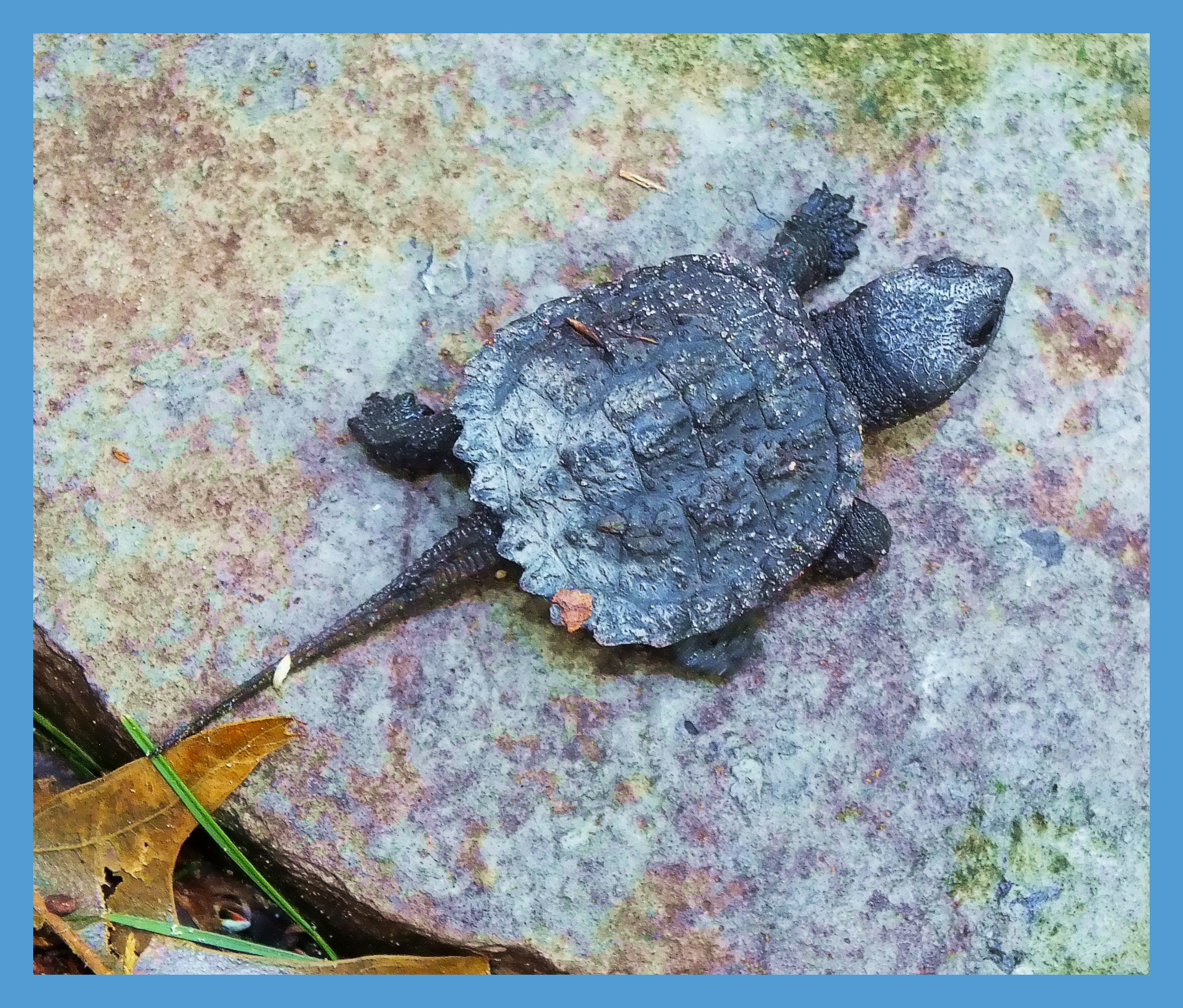
[This baby snapping turtle was in the backyard, running about. The adults lay their eggs in the ground; when the babies finally hatch, they need to quickly get to water (or else they get eaten by raccoons, coyotes, foxes, or crows and such). After taking a few photos, I carefully tossed this little guy into the river that we live on.]
.
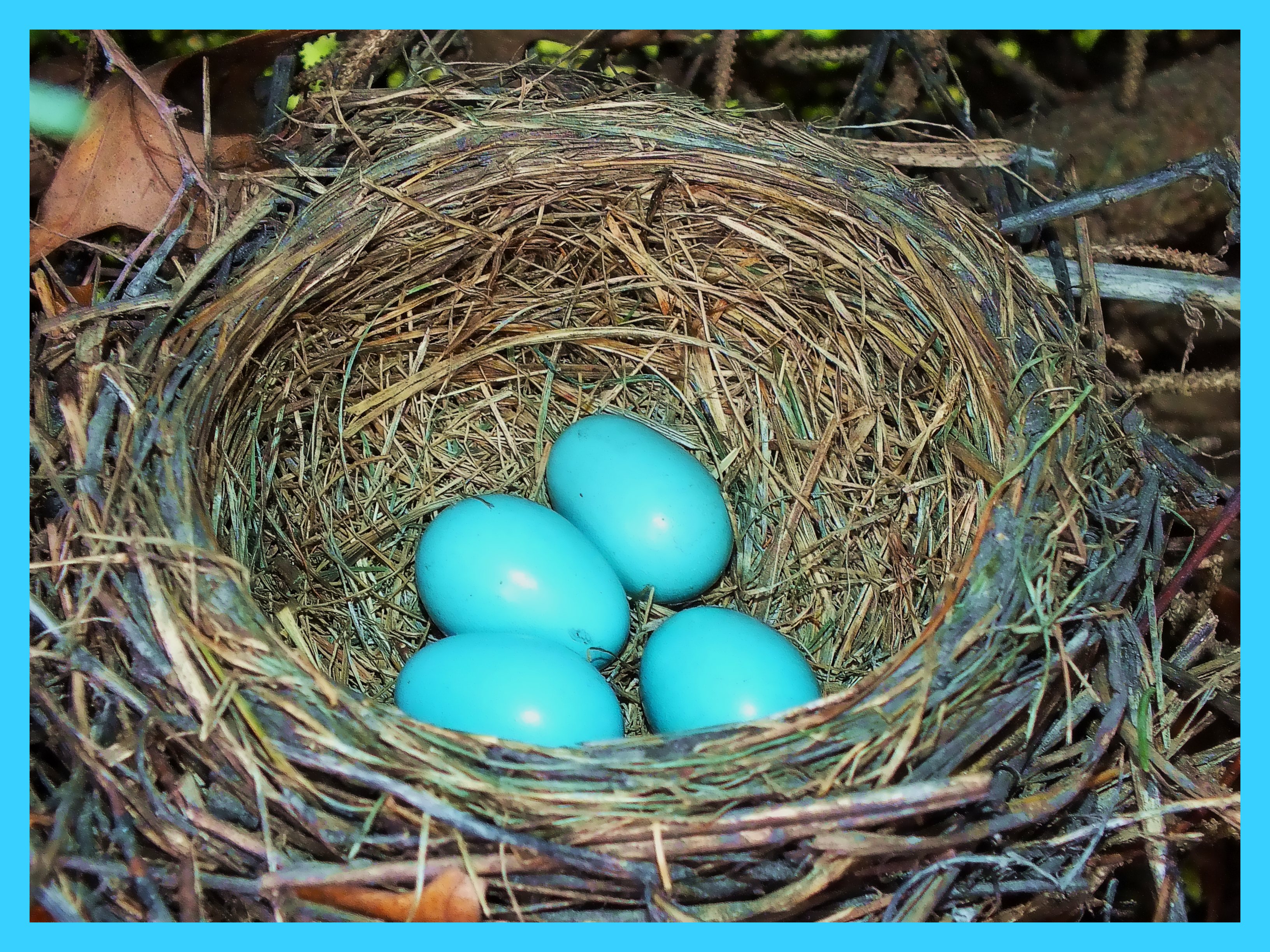
When we are young, we are like fledglings, depending on the those who are more mature to help us to do well and survive. However, at some point, we (if we are to really soar in life) have to leave the nest. As human beings, many of us never actually leave the nest; we continue to depend. We cling to the ideologies, patterns, religions, politics, traditions, and habits imprinted upon us by others; and so we never really independently soar. Most of us “feel safe,” nested in their ways and traditions. For human beings, however, true enlightenment is never merely within the circumscribed confines of a limited, little nest (or prepared space). Most of us are afraid to take the plunge, to let go of all the habits and traditions that we have been nesting in. Most merely cling to symbols, words, representations, ideologies, and learned concepts of (and including) a central “I”… and never ascend from being supposedly “safely nested” in those limited conceptions. That is why most never soar, and it is as simple as that.
.
.
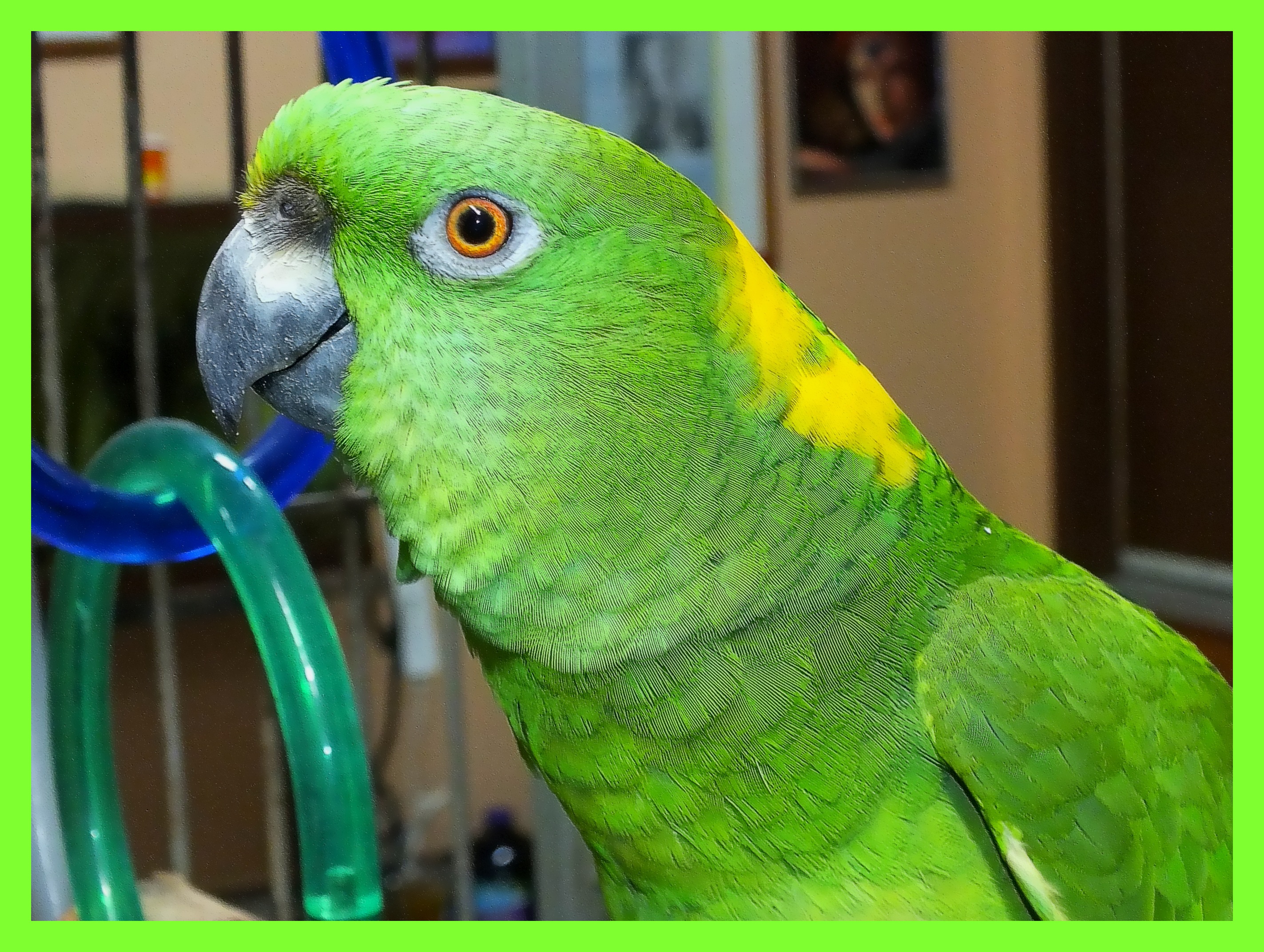
Before I retired, I used to (as a hobby) keep and breed macaws. Now that I’m older and retired, I have 3 pet parrots… two that are macaws, and one that’s a Yellow Naped Amazon.
Parrots make great pets but, because of their intelligence, you have to give them a lot of time and stimulation. In many ways, they are a lot like dogs… except they can talk. I exercise all of my birds daily… taking them out of their large cages and moving up and down with them many times (as I simultaneously exercise). They have their own high definition TV in their room, where they like to watch things like The Muppets, Sesame Street, and Rock’n Learn (learning/phonics) videos.
Their intelligence is phenomenal! Makes me glad I’m a vegetarian… though I realize that certain birds, like chickens, don’t even come close to the intelligence of parrots. There are many other intelligent animals, including pigs and dogs. Tweety Pie, the bird pictured here, talks in complete sentences. She creates and makes up her own sentences and has great comprehension. Some birds just mimic; others have comprehension. For example, when we put on our coats or jackets to go outside, Tweety would ask: “Are you going to go bye-bye now?” … or “Can I go too?” We never taught her those questions; she came up with them herself; she says them with the right intonation for a question. She sings complete songs, like the “Oh what a beautiful morning” song and other songs including one by the Backstreet Boys. (I don’t even know the lyrics to that Backstreet Boys song, thank goodness.) Once, when I was in the living room and couldn’t get the Playstation to work, she said, “What seems to be the problem?” I said, “I can’t seem to get the TV to work right.” She then said, “Can I help?” Something else! Last night I kept the birds up a bit late because I was cleaning aquariums in their room. On two separate occasions I told the birds that they could “sleep in late”… (by me not turning on lights or opening window shades until later in the morning); after each of the two times that I told them that they could “sleep in late in the morning,” Tweety Pie” said “Thank You”! The night before, I asked the birds about which video they’d like to watch; I said, “What do you want to watch… Children Singing, Sesame Street, or The Muppets?” Tweety said, “Muppets.” So The Muppets were put on.
I tried to do videos of Tweety, but she won’t talk in front of a camera (at all). Once, when I worked (before retiring), I recorded her conversations on an audio recorder, took it to work for people to listen to, and people were totally amazed. (I included a couple of YouTube videos here — of other people’s parrot friends — for people to see, so that they can observe just how intelligent these birds can be; the ones in the videos are not against being video recorded.) Many of these birds don’t just mimic. Some, especially, have great comprehension. One of our macaws, Scarlet, talks and has great comprehension. When I was younger, I took her to work with me (to my classroom for the multiply handicapped); she would sit on my lap in the car, as I was driving, and was perfect in behavior in the car and in the classroom. Sometimes Scarlet calls for me by name, saying “Tom, come here,” and Marla, my wife, says that it sounds like I have another wife! Just last night, I had been playing a learning-video for them about colors, shapes, and counting, and as they (on the video) demonstrated counting to ten; Scarlet then, after they got up to ten, said “eleven.”
(See the videos below. The one of the African Grey Parrot, named Einstein, is one of many; to see other of her – she’s a female – videos, do a YouTube search on “Einstein Texan Talking Parrot”; there are other videos of another bird, that’s a show bird, named Einstein… but I like Einstein from Texas best.)
.
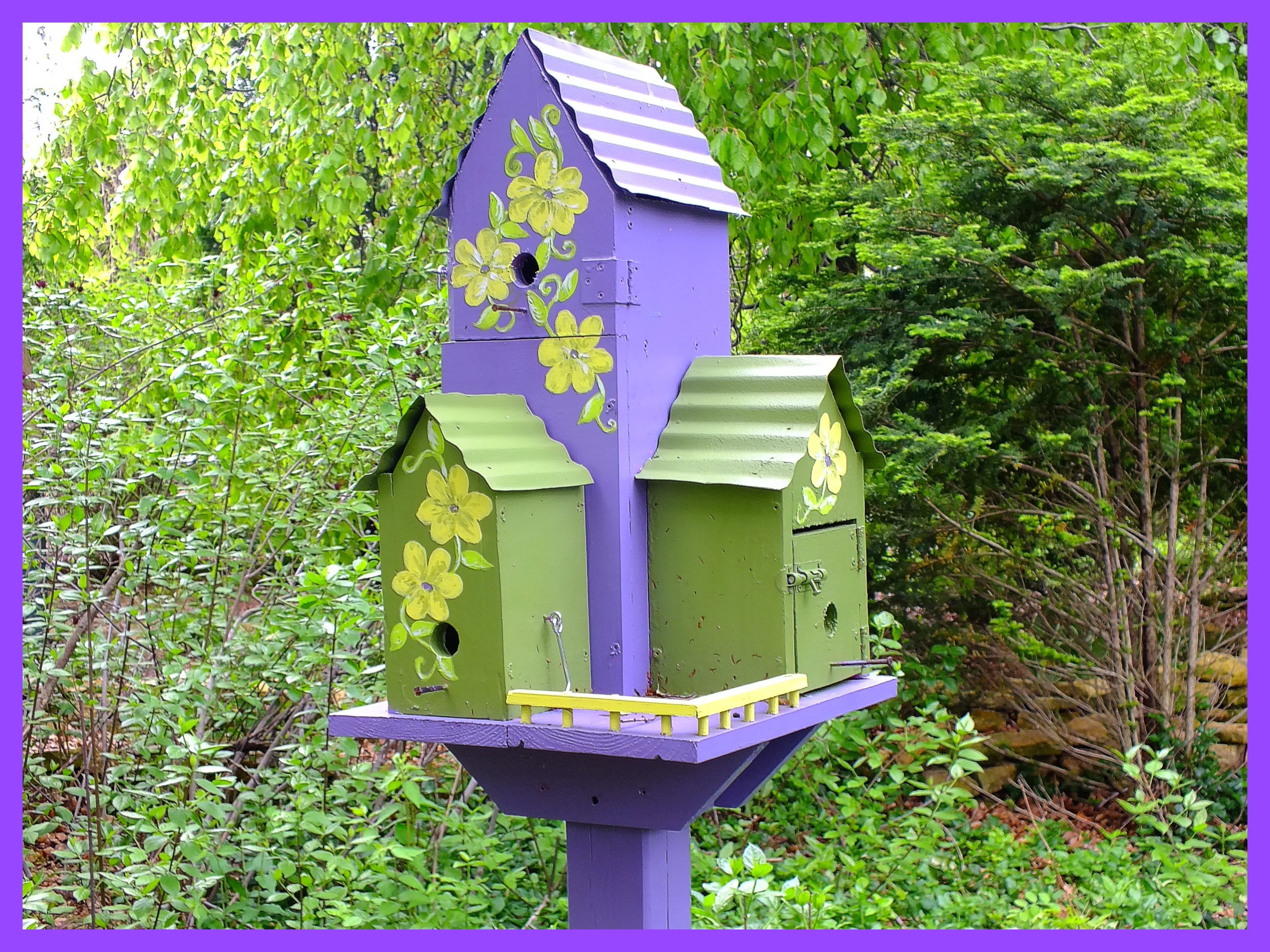
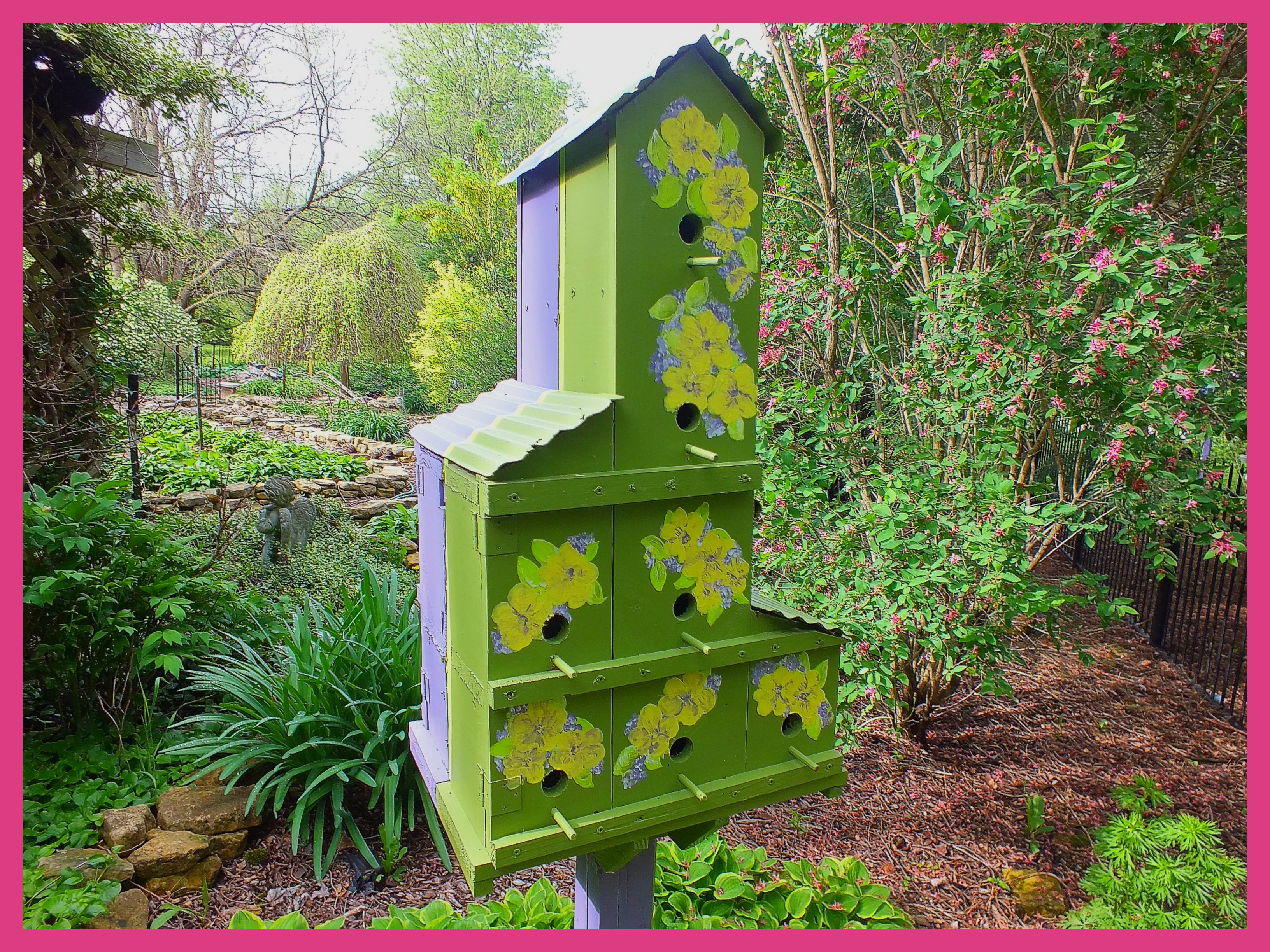
In my birdhouse
we take shelter from the rain
In my birdhouse
we sleep well,without pain
In my birdhouse
we are safe from violent wind
In my birdhouse
we are born,we come in
.
[Note: Birdhouses at my sister-in-law’s (Mary’s) and brother-in-law’s (Gary’s) place. They were constructed, homemade, by Gary…. painted by Mary.]
BURNT NORTON (by T.S. Eliot)
(No. 1 of ‘Four Quartets’)
I
Time present and time past
Are both perhaps present in time future,
And time future contained in time past.
If all time is eternally present
All time is unredeemable.
What might have been is an abstraction
Remaining a perpetual possibility
Only in a world of speculation.
What might have been and what has been
Point to one end, which is always present.
Footfalls echo in the memory
Down the passage which we did not take
Towards the door we never opened
Into the rose-garden. My words echo
Thus, in your mind.
But to what purpose
Disturbing the dust on a bowl of rose-leaves
I do not know.
Other echoes
Inhabit the garden. Shall we follow?
Quick, said the bird, find them, find them,
Round the corner. Through the first gate,
Into our first world, shall we follow
The deception of the thrush? Into our first world.
There they were, dignified, invisible,
Moving without pressure, over the dead leaves,
In the autumn heat, through the vibrant air,
And the bird called, in response to
The unheard music hidden in the shrubbery,
And the unseen eyebeam crossed, for the roses
Had the look of flowers that are looked at.
There they were as our guests, accepted and accepting.
So we moved, and they, in a formal pattern,
Along the empty alley, into the box circle,
To look down into the drained pool.
Dry the pool, dry concrete, brown edged,
And the pool was filled with water out of sunlight,
And the lotos rose, quietly, quietly,
The surface glittered out of heart of light,
And they were behind us, reflected in the pool.
Then a cloud passed, and the pool was empty.
Go, said the bird, for the leaves were full of children,
Hidden excitedly, containing laughter.
Go, go, go, said the bird: human kind
Cannot bear very much reality.
Time past and time future
What might have been and what has been
Point to one end, which is always present.
II
Garlic and sapphires in the mud
Clot the bedded axle-tree.
The trilling wire in the blood
Sings below inveterate scars
Appeasing long forgotten wars.
The dance along the artery
The circulation of the lymph
Are figured in the drift of stars
Ascend to summer in the tree
We move above the moving tree
In light upon the figured leaf
And hear upon the sodden floor
Below, the boarhound and the boar
Pursue their pattern as before
But reconciled among the stars.
At the still point of the turning world. Neither flesh nor fleshless;
Neither from nor towards; at the still point, there the dance is,
But neither arrest nor movement. And do not call it fixity,
Where past and future are gathered. Neither movement from nor towards,
Neither ascent nor decline. Except for the point, the still point,
There would be no dance, and there is only the dance.
I can only say, there we have been: but I cannot say where.
And I cannot say, how long, for that is to place it in time.
The inner freedom from the practical desire,
The release from action and suffering, release from the inner
And the outer compulsion, yet surrounded
By a grace of sense, a white light still and moving,
Erhebung without motion, concentration
Without elimination, both a new world
And the old made explicit, understood
In the completion of its partial ecstasy,
The resolution of its partial horror.
Yet the enchainment of past and future
Woven in the weakness of the changing body,
Protects mankind from heaven and damnation
Which flesh cannot endure.
Time past and time future
Allow but a little consciousness.
To be conscious is not to be in time
But only in time can the moment in the rose-garden,
The moment in the arbour where the rain beat,
The moment in the draughty church at smokefall
Be remembered; involved with past and future.
Only through time time is conquered.
III
Here is a place of disaffection
Time before and time after
In a dim light: neither daylight
Investing form with lucid stillness
Turning shadow into transient beauty
With slow rotation suggesting permanence
Nor darkness to purify the soul
Emptying the sensual with deprivation
Cleansing affection from the temporal.
Neither plenitude nor vacancy. Only a flicker
Over the strained time-ridden faces
Distracted from distraction by distraction
Filled with fancies and empty of meaning
Tumid apathy with no concentration
Men and bits of paper, whirled by the cold wind
That blows before and after time,
Wind in and out of unwholesome lungs
Time before and time after.
Eructation of unhealthy souls
Into the faded air, the torpid
Driven on the wind that sweeps the gloomy hills of London,
Hampstead and Clerkenwell, Campden and Putney,
Highgate, Primrose and Ludgate. Not here
Not here the darkness, in this twittering world.
Descend lower, descend only
Into the world of perpetual solitude,
World not world, but that which is not world,
Internal darkness, deprivation
And destitution of all property,
Desiccation of the world of sense,
Evacuation of the world of fancy,
Inoperancy of the world of spirit;
This is the one way, and the other
Is the same, not in movement
But abstention from movement; while the world moves
In appetency, on its metalled ways
Of time past and time future.
IV
Time and the bell have buried the day,
The black cloud carries the sun away.
Will the sunflower turn to us, will the clematis
Stray down, bend to us; tendril and spray
Clutch and cling?
Chill
Fingers of yew be curled
Down on us? After the kingfisher’s wing
Has answered light to light, and is silent, the light is still
At the still point of the turning world.
V
Words move, music moves
Only in time; but that which is only living
Can only die. Words, after speech, reach
Into the silence. Only by the form, the pattern,
Can words or music reach
The stillness, as a Chinese jar still
Moves perpetually in its stillness.
Not the stillness of the violin, while the note lasts,
Not that only, but the co-existence,
Or say that the end precedes the beginning,
And the end and the beginning were always there
Before the beginning and after the end.
And all is always now. Words strain,
Crack and sometimes break, under the burden,
Under the tension, slip, slide, perish,
Decay with imprecision, will not stay in place,
Will not stay still. Shrieking voices
Scolding, mocking, or merely chattering,
Always assail them. The Word in the desert
Is most attacked by voices of temptation,
The crying shadow in the funeral dance,
The loud lament of the disconsolate chimera.
The detail of the pattern is movement,
As in the figure of the ten stairs.
Desire itself is movement
Not in itself desirable;
Love is itself unmoving,
Only the cause and end of movement,
Timeless, and undesiring
Except in the aspect of time
Caught in the form of limitation
Between un-being and being.
Sudden in a shaft of sunlight
Even while the dust moves
There rises the hidden laughter
Of children in the foliage
Quick now, here, now, always—
Ridiculous the waste sad time
Stretching before and after.