
For many years, i collected and made 3D glass holograms. They are, i feel, superior to regular 2D photographs… since they also convey depth (without the need for wearing special glasses), not just the implication of depth. Holograms, though most people (when they see them) really love them, never became very popular. Depth in photography, like real depth in philosophy (i.e., the real “love of truth” pure philosophy), is rarely deeply appreciated by people. (By the way, the 2D surface of a properly made holographic film, when illuminated by a decent light source, projects images that appear as 3 dimensions.) As time went by, i personally made true (full) color holograms; true color holograms are very difficult to make. I would get my blank plates, to make images on, from Yves Gentet, whom Discover Magazine proclaimed to be the best photographer in the world. When making full-color holograms, i had to use multiple lasers and special dichroic glass filters… and everything had to be extremely precise, without any distortion whatsoever. It’s the same thing with true philosophy and the concomitant real understanding of one’s mind (i.e., real self-realization)… there must not be any distortion whatsoever.
When i was quite young, years before ever getting interested in holograms, i partook in one-on-one conversations concerning philosophy with Professor David Bohm, a world-renowned quantum physicist whom Albert Einstein wanted as an assistant. We had many very deep discussions (but never once were holograms mentioned). Then, years later, i was walking through a large mall with my wife, Marla, and saw some holograms displayed. I was hooked! I often visited the Museum of Holography in Chicago and was well known by Loren Billings who ran the museum. Loren and i had many great discussions about the holographic nature of the universe (including space and time). My book on philosophy deals a lot with time; it mentions holography in terms of its significance with regard to time and our human position. Now, remarkably enough, scientists — most all of the very best, top scientists (worldwide) — are saying that our manifested universe is quite “holographic” in its very essence. They are saying that the periphery of (not only black holes) but also of the entire universe behaves much like a holographic film… and that we are projections of what is contained on the surface of that film. They are saying that there is an exact copy of what we are, were, and will be, at that peripheral region. So, is that “surface” film more real than we are, or are we what is more real? They say: take your pick; both are legitimate. It may be that the past, present, and future are intrinsically enfolded into one another and are not at all separate. Years after collecting and making holograms, i found out who the scientist was who was instrumental in the initial development of this holographic universe discovery; it was (coincidentally) Professor David Bohm.
Interestingly enough, when one breaks a hologram (of a rose, for example) in half and illuminates it with another laser, each half will have an image (though not quite as clear) of the entire rose. Subsequently, break each of those halves in half… and each will have an image of the entire rose. The wise man, who transcends the fragmentary, superficial, illusory symbols of man, may deeply connect with (and perceive) much of the whole, whereas those who exist superficially see little of reality; they are looking at the broken borders and boundaries; the wise mind is perceiving the whole (beyond the breakage). (It’s a shame that so many write and blog about truth while, all along, they have not really seen much of anything… though they “think” they have.) Regarding holograms, the parallax nature that they inherently have is very incredible; in other words, for example, you can look at a hologram of an open umbrella being held, and if you bend your head down you can actually see the inside of the umbrella’s top (that you couldn’t see until you bent down as if it were an actual umbrella being held)! When you again stand erect, you see the very top of the outside section of the umbrella as you normally would. With a hologram of a box, for example, you can stand in front and see the side that is facing you; if you move to the left, you can see another side of the box; if you move to the right, you can see yet another side of the box. Of course, the universe is not some kind of giant hologram; it is living, dynamic, and much more than that. However, the holographic model can be useful to explain certain dimensions of it to others. Professor Leonard Susskind and other top scientists helped Stephen Hawking and others see that the holographic model had amazing potential, reality, and legitimacy. The implications of all this are profound, and they affect what man can penetrate into spiritually, philosophically, and actually; but not many people are perceiving this significantly. A few of us were seeing this long before the top physicists came up with their calculations; we were seeing much more than what the calculations could reveal.
[Note:
The following is a short 2D animation of one of my 3D holograms; it is of a floating “pear” with parallel lines behind it. Of course, the crude 2D animation does not come close to doing justice to the actual beauty and quality of the hologram. This particular hologram is a monotone green on black… but it (the “pear” image part) projects out into the viewing room at a very great and very impressive distance; you can move your hand through and around the pear… and it has very phantom-like attributes. (The pear seems to float out in the space of the viewing room, and the parallel lines go very deep into the wall.) Other holograms are of flowers, animals, and people… and they are very beautiful, some in full, natural color. (Additionally, please watch the YouTube video below.)]
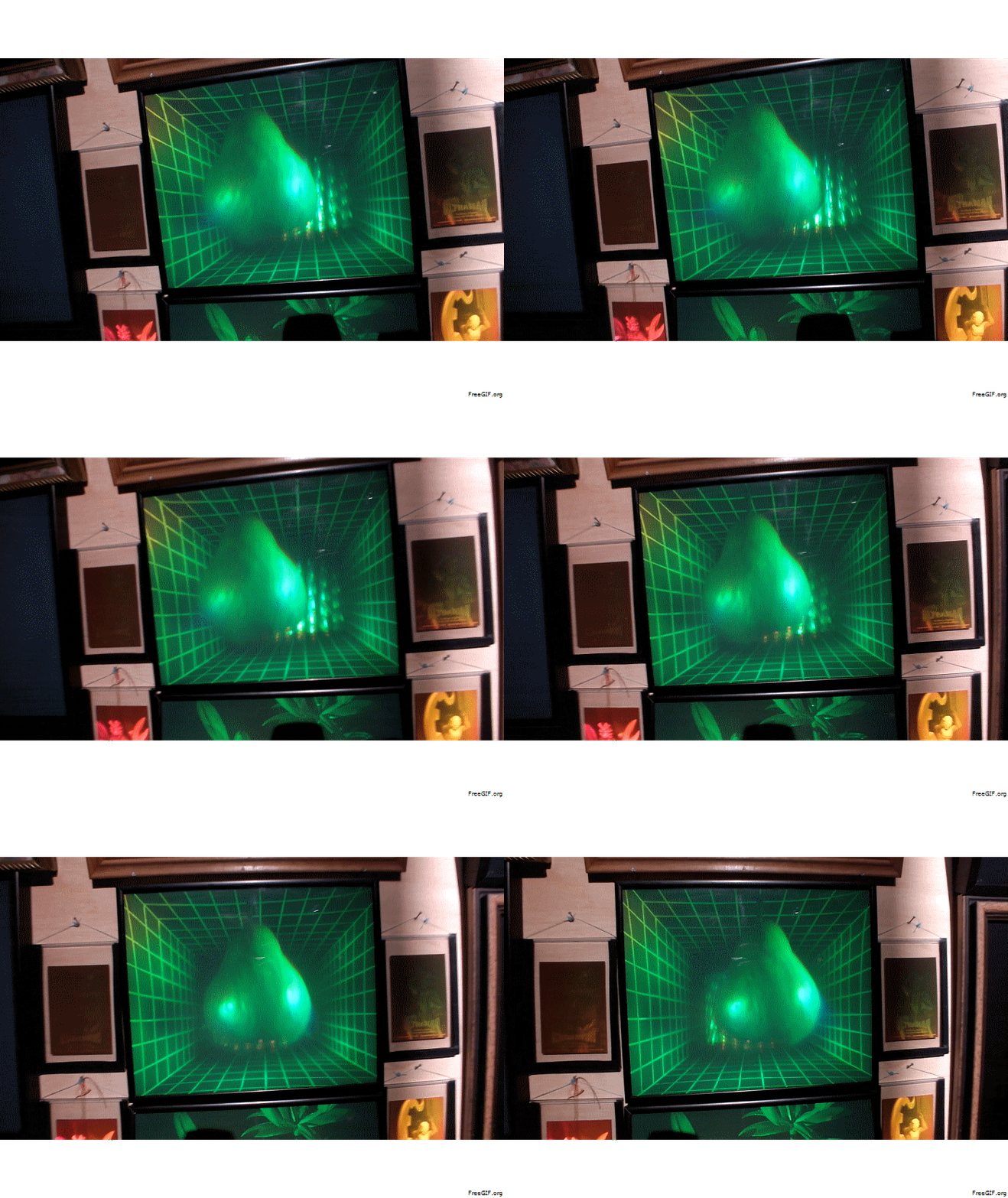
Pearallel-lines Glass Hologram. Video by Thomas Peace c. 2016 See the YouTube video:
 Tom's Nature-up-close Photography and Mindfulness Blog