The name Allosaurus was derived from the Greek, and it means “different lizard.” It was considered “different,” by paleontologists, because its bones were a lot lighter than in dinosaurs previous to its existence. Its bones were much lighter because they were riddled with many more air channels and blood vessel channels that previous species of dinosaur did not have as much of. This allowed it to be faster and more nimble for its size, which are great benefits to a big, meat-eating animal.
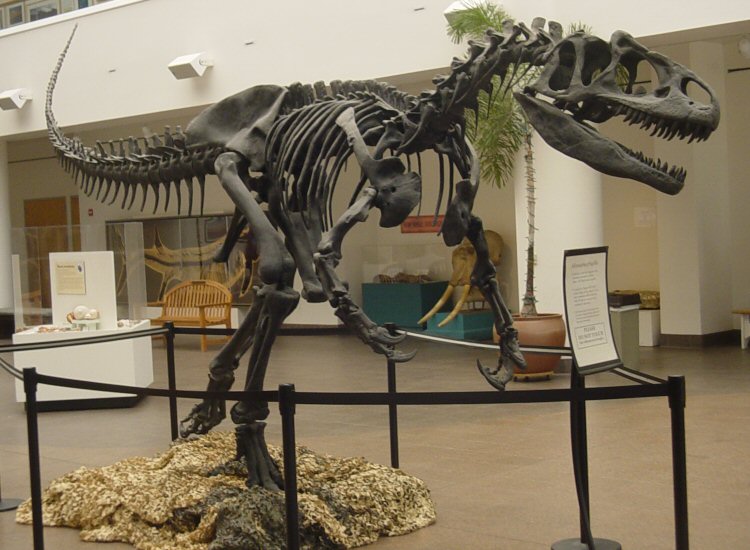
As most of you probably know… Allosaurus was a huge, carnivorous dinosaur. It occurred in the Jurassic Period, around 150 to 155 million years ago. The following is a photo (not taken by me) of an Allosaurus skeleton on exhibit (at the San Diego Natural History Museum).

- Allosaurus (San Diego Natural History Museum)
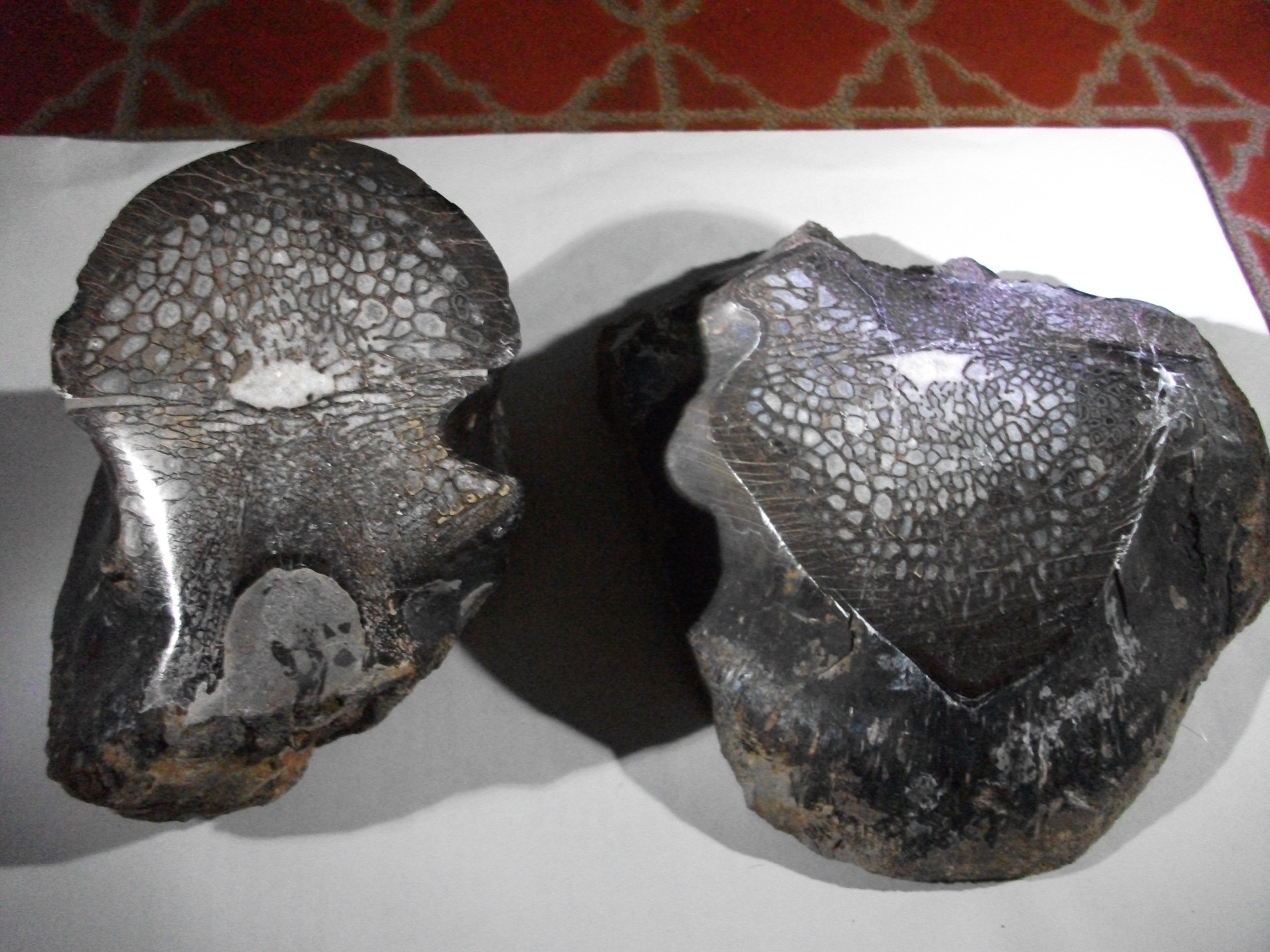
The following are photographs of an Allosaurus vertebra (backbone) that I purchased at one time. The vertebra comes from southern Utah. The vertebra was split in half; then each half was polished (on the side where the split occurred) to show the beautiful cells and spaces within the bone. Certain dinosaur bones (in certain isolated localities) become (over millions of years) permineralized by various minerals that permeate into the bone cells over time. Depending what the minerals are… the colors (within the bone spaces) can be of many different types… some very beautiful. This particular Allosaurus specimen has white crystallizations within… which look quite nice.
After I had the bone in my possession for a while, I noticed that one of the halves had a couple of places (on it) that were entry ways for pneumatic diverticulae. Pneumatic diverticulae, in the more evolved of the dinosaurs, were branches and channels — that would come from the air sacs and lungs — that would bore into and through the bones, enabling air (from the lungs) to be stored and transported. (So, unlike mammals, they could transport and store air within their bones!) Some of these channels would (later) progress to the outside of the body (and allow gases to be emitted out of the organism). Younger dinosaurs do not have these, at first; they grow and increase (and branch out more and more) as the animal ages. Many birds have this. A turkey wing — that someone is preparing for consumption — may have a little hole in the skin here or there. These are the exit chambers of the pneumatic channels! (A young turkey may not have these holes; most turkeys sold — to consume — are young turkeys). Birds are actually evolved from (and they are) dinosaurs. Many mammals, including humans, have cranial pneumaticity (exclusively in their heads)… but only dinosaur/birds have the very advanced postcranial pneumaticity (as well as an advanced form of the cranial kind).
Mammals (such as we humanoids) do not have this advanced kind of respiratory system. Ours is much more primitive. You won’t hear this taught in public schools; they, of course, continue to put on airs of superiority for our species! (I tell things straight, though, just as I do in my book.) One of the reasons why dinosaurs had such a monopoly over mammals for millions and millions of years has to do with their superior respiratory systems. In dinosaurs (and birds), special air sacs and pipework keep (new) fresh air coming into their lungs consistently. Air flows into a bird’s lungs only in one direction. Air from the (pre-lung) air-sac that puts air into a bird’s (or dinosaur’s) lungs is always being replenished with fresh air. Air from another (post-lung) air-sac that comes “from” their lungs… always is pushing out “old-used” air. The lungs never get the bad (used) air coming in with the fresh. Air only travels in one direction through their (i.e., dinosaurs’) lungs; their lungs are not the inefficient “in and out” kind (like blowing in and out of a paper sack) like ours (i.e., the mammals’) are. In fact, the lungs of dinosaurs (and birds, which are a small type of dinosaur) do not ever move; only the air-sacs around them move! Our lungs (of mammals) that move with the ribs, muscles, and diaphragm around them, breathe in the same bad air that we were trying to exhale (and through the same pipework too); that is very inefficient. That is one of the reasons why dinosaurs reigned supreme for so many millions of years… until that 6-mile-across asteroid wiped most of them out (except for the birds); the impact of that asteroid also wiped out 70% of all species on earth. Mammals, during the time of the dinosaurs, were always small, mostly nocturnal, and would hide under rocks (which is one of the reasons why we survived that impact); there were no large mammals during the time of the dinosaurs… because the dinosaurs were too dominant over the mammals. Most dinosaurs were a lot more hot blooded — the average body temperature of birds is 105 degrees Fahrenheit — a lot better at breathing… and (hence) a lot more sprightly and agile than the mammals. (The dinosaurs were not “sluggish,” as we were once — not long ago — taught.) If that asteroid would have missed the earth… they would still be the dominant ones… and who knows what they would have evolved into…
The following is a photo of the two halves of an Allosaurus vertebra with crystal cells (after polishing). Weight: 5 lb 10 oz
The cells, which once were air channels and passageways for blood vessels, are now filled with crystallized minerals (various silica, calcite, dolomite and other minerals).
.

Allosaurus Dinosaur Split Vertebra by Thomas Peace c.2013
Note (in the photo below) the larger oval crystal section around the center; look to the right and (especially) to the left of it to see where the pneumatic diverticulae have entry-ways (fossae pleurocels, or pneumatic pores) that enter the vertebra bone from the air sacs/lungs! If you look at such a dinosaur vertebra, you will see little spots here and there on its sides; these are the entry-ways (fossae pleurocels/pneumatic pores) that go into the bone. This vert was cut just at the “right spot” (i.e., right where the pneumatic diverticulae enter the bone… as pneumatic pores); the guy who used to polish these didn’t have the faintest idea about what these entry-ways were! I’ve sent pictures of this to, and have corresponded with, a noted paleontologist. (The action of the pneumatic diverticulae functions almost like an organism within an organism; it is a very advanced stage in regard to breathing physiology.)
(Left click on the photos to enlarge; hit left return arrows to return back.)

Allosaurus Vertebra (1) by Thomas Peace c. 2013
Some close-ups…(please note, in the first of the following photos, the entry-way — the pneumatic fossa, or pneumatic pore — going into the vertabra )… It’s the “spear-shaped” chamber on the left. (It would form a convoluted passageway throughout the vert in ways we can’t simply see via a slice-view.)
-
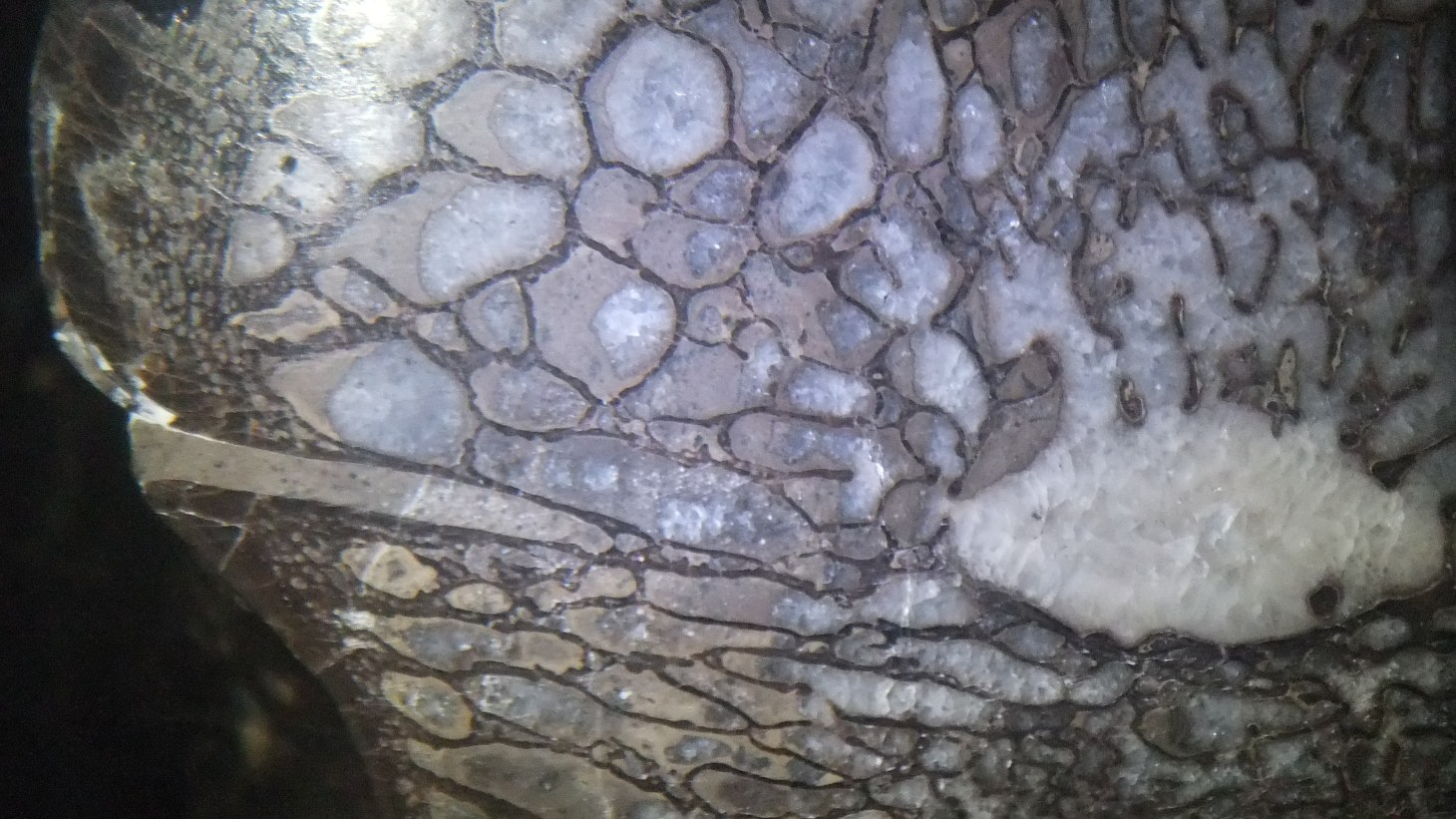
Allosaurus Vertebra (2) by Thomas Peace c.2013
-

Allosaurus Vertebra (3) by Thomas Peace c.2013
-
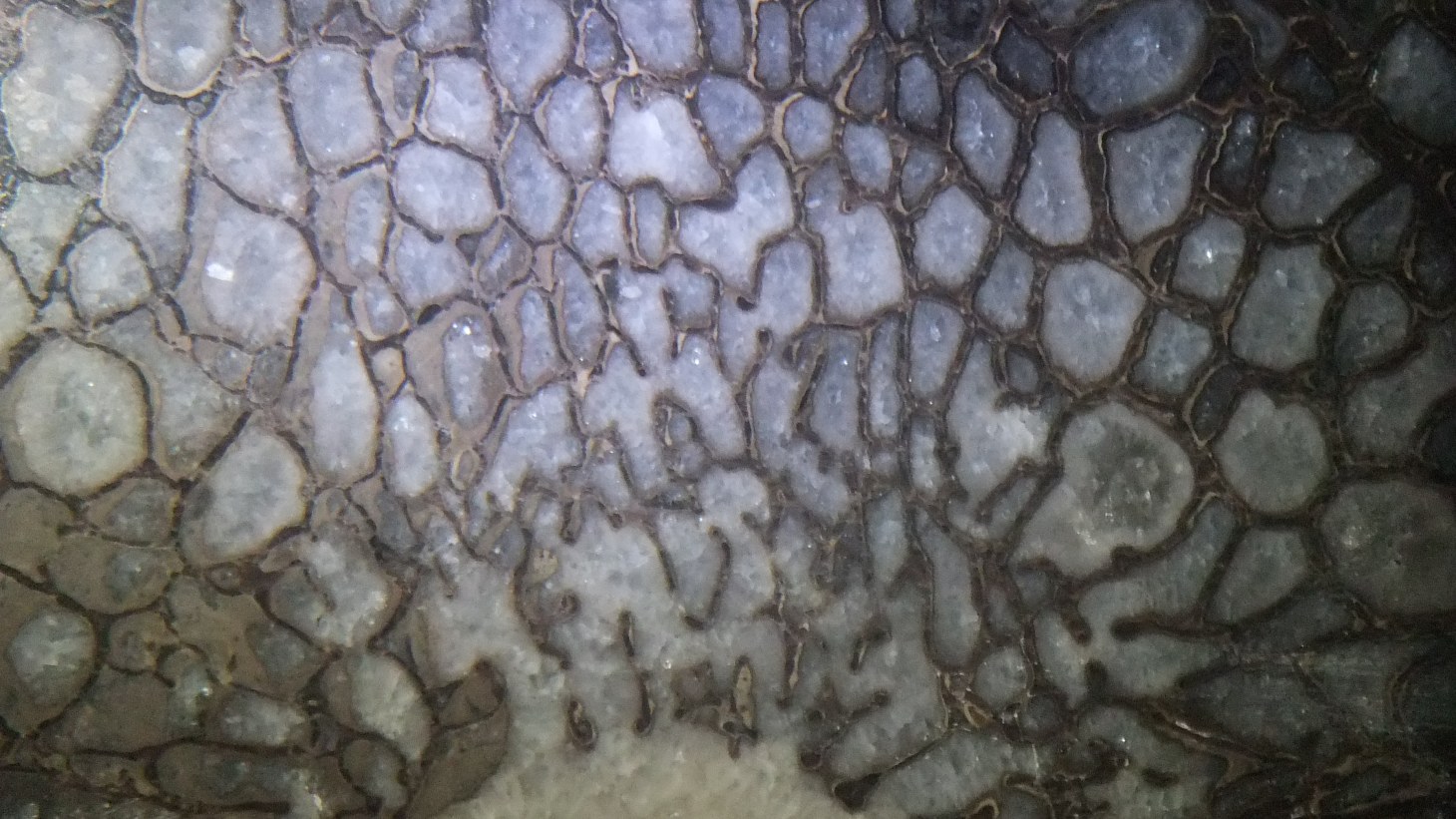
Allosaurus Vertebra (4) by Thomas Peace c.2013
-
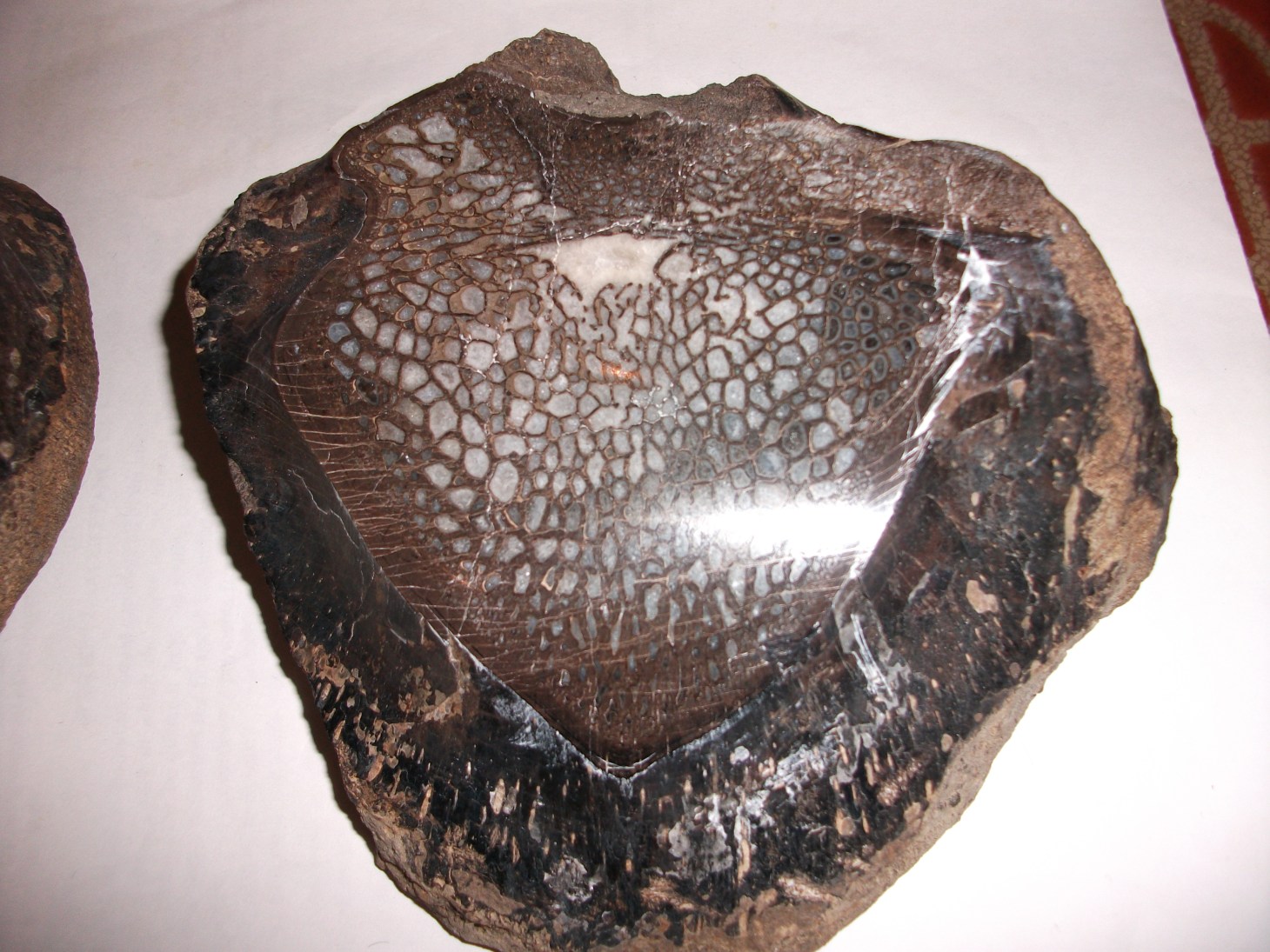
Allosaurus Vertebra (5) by Thomas Peace c.2013
…………………………………………………………………………………………………………………………………………………
[A subsequent post,we’ll have, is: Photos of fossil Troodon Dinosaur (the “intelligent” dinosaur)]
………………………………………………………………………………………………………………………………………………….
Highly Recommended:
Cool DVDs of Allosaurus:
You can get these at amazon.com or at ebay:
Allosaurus: A Walking with Dinosaurs Special
Jurassic Fight Club: Season One
************************************************************************************************










 Tom's Nature-up-close Photography and Mindfulness Blog