
All of us function, in life, with regard to various motives. We react in (and “as”) conditioned responses involving these motives. Each motive gives us a certain direction to move in; we follow these specific directions, based on motives, throughout life (just as we were taught to). Very few of us have considered directionless. Very few have inquired into the possibility of perceiving without being constantly influenced by motives or directions. Each of us has motives and directions that each one clings to and functions from, (even the so-called great scientists). Often, these motives conflict — with the motives or directions of other people — and friction ensues. Desire and greed are often involved with the motives that people have (and desire and greed tend to function from — and “as” — the reactions that they are psychologically). One’s mind, too, can harbor conflicting motives… conflicting directions to pursue or go in.
A very wise mind, however, is involved with a measureless directionlessness. To observe purely, without tainted motives or covert conditioning influencing what is seen, requires a highly unprejudiced mind that does not merely perceive via fragmentation and limitation. Looking in a certain direction — which most all of us tend to do — by its very action (or, rather, reaction) precludes other directions and is always limiting and partial. Even precise scientists are limited — in their own fields and by their own (learned) processes, habits, prejudices, and procedures — and most would likely laugh if one suggested that they consider directionlessness. However, a truly sagacious mind would perceive the limitation and fragmentation that motives and directions inevitably bring with them; such a wise mind may then go beyond mere motive (and beyond mere direction).
A mind that perceives beyond merely having a “motive” or “psychological direction” must be a very dynamic mind. To look (at times) beyond mere motive or beyond specific desire takes tremendous intelligence and great purity. Directionless is not a stagnant state that one mesmerizes oneself in; rather, it is a causeless explosion of awareness without mere motive and without the influence of psychological conditioning. It truly is an explosion without any cause. It is a movement without any direction. Greed and desire have nothing to do with it; greed and desire are of motive; greed and desire always involve a specific direction.
There is a vast difference between a mind that often is of directionlessness and a (common) mind that always functions by way of motive and direction. Of the two mentioned in the aforementioned sentence, one of the two always (without exception) reacts (via motives and directions set up by limited influences); the other, of the two — though it also often reacts and is choicelessly aware of the reactions — may often go beyond that… such that it exists with (and “as”) motiveless perception (beyond borders). Only one of the two can ever perceive and understand the whole (instantly, without mere sequential process); the other must be caught in time-bound, sequential parameters that manifest as fragmentation and limitation.
The beauty of real ecstasy occurs only when harmful (i.e., fallacious) ways are finished while true joy blossoms without motive.

Jagged Ambush Bug in Cone Flower (1) Photo by Thomas Peace c. 2018
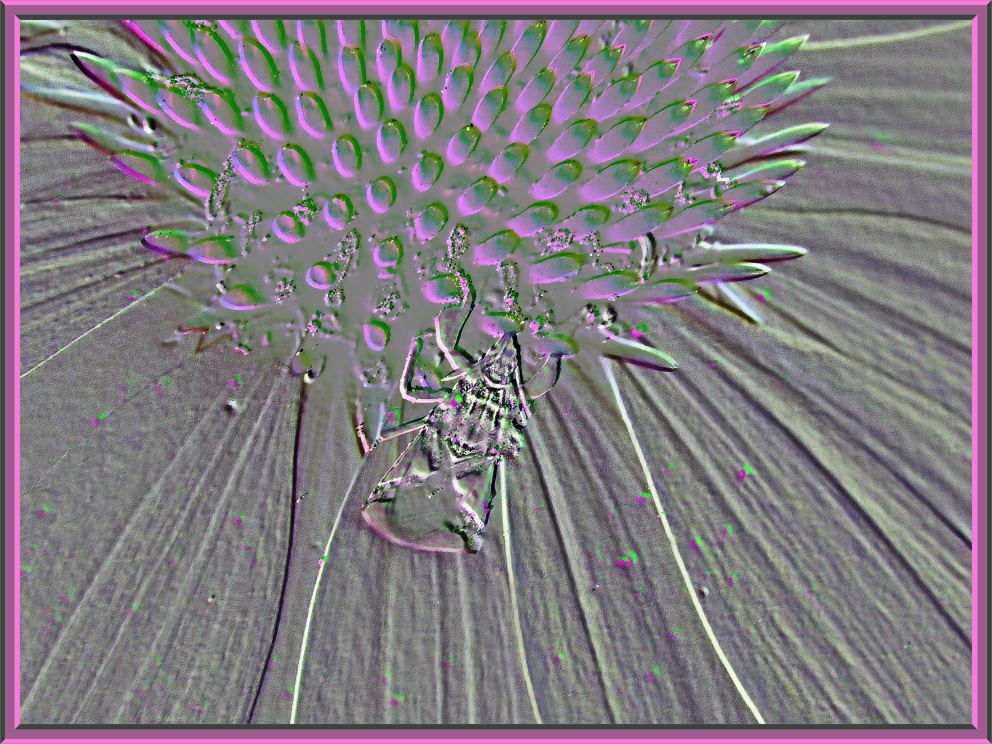
Jagged Ambush Bug in Cone Flower (2) Photo by Thomas Peace c. 2018

 Tom's Nature-up-close Photography and Mindfulness Blog